With your permission, Google Analytics measures visits and Microsoft Clarity records clicks, scrolling and page interactions, with form inputs and page text masked. We use no advertising cookies.
7 days free. A card is needed to start, and nothing is charged if you cancel before the trial ends.
For grown-ups: how phonics works in Litsee, the other games and questions
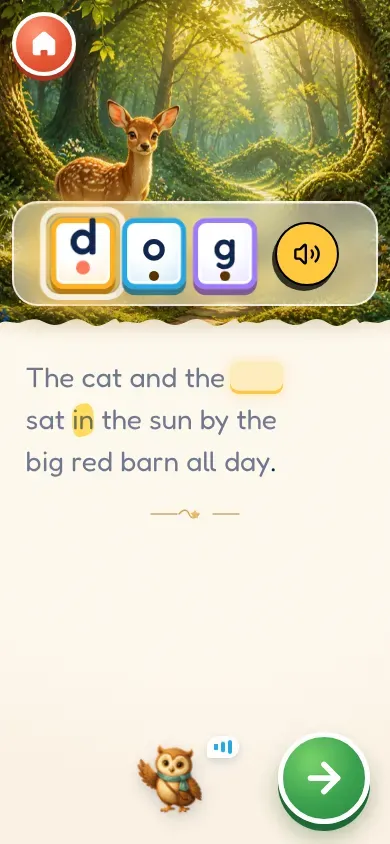
What your child practises: hearing a word's sounds and blending them together, and building a word from its sounds in order. National Curriculum, Year 1 word reading: “apply phonic knowledge and skills as the route to decode words”.
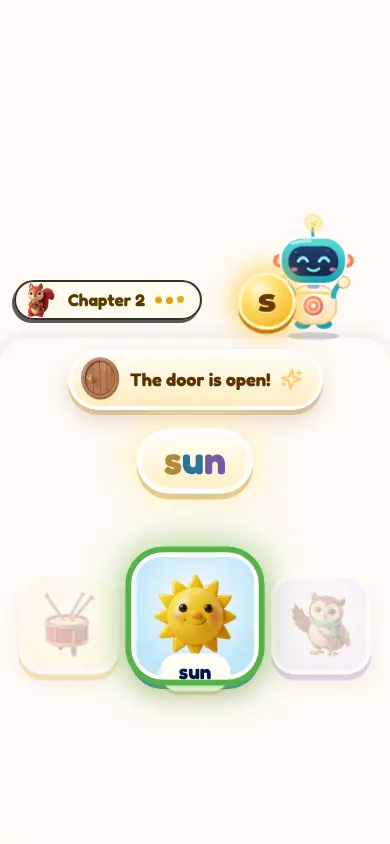
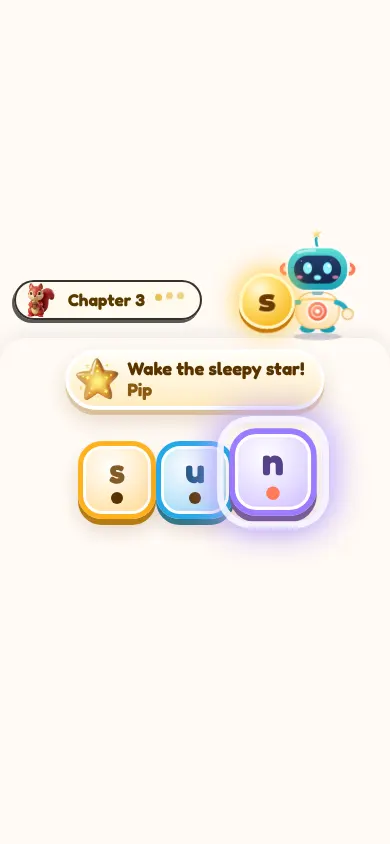
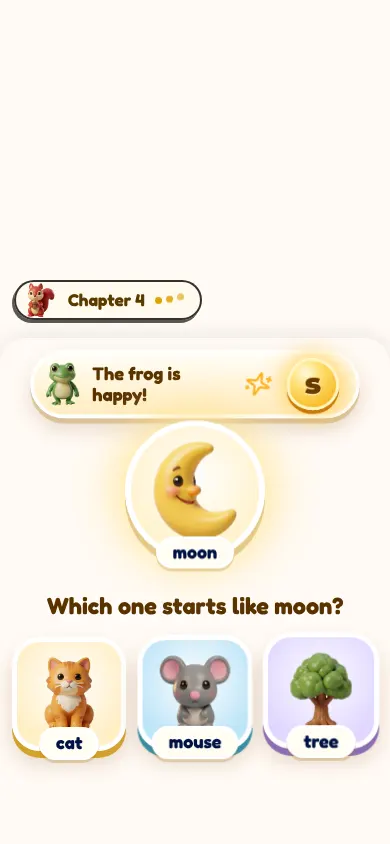
In Litsee, sounds and rhymes are part of the adventure. A sound robot needs the password to a locked door, a sleepy star wakes when your child builds its word, and every chapter ends with a line for them to read themselves. The game above is made from the app's own sounds, pictures and puzzles; the ones below are small working copies of the rest.
7 days free. A card is needed to start, and nothing is charged if you cancel before the trial ends.
sun
LITTLE EXPLORERS
Phonics in every chapter, never a worksheet
Little Explorers is Litsee for children just starting to read: every story is read aloud, choices are big pictures, and a friendly owl says what to do. While the next chapter is being written, the sound robot turns up as the hero's friend with one puzzle, made from a word in the chapter they have just heard.
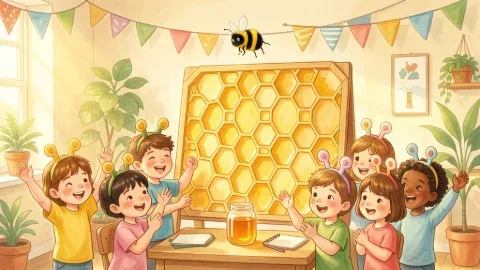
Gentle sound words glow on the page so your child can shout them with the owl. Once a chapter, the story stops just before a rhyme: tap the word that finishes it. Wait four seconds and the story says it anyway.
What they practise
Rhythm, rhyme and joining in: the early listening skills phonics builds on.
How it fits the story
It is the story's own sentence, read in the story's own voice.
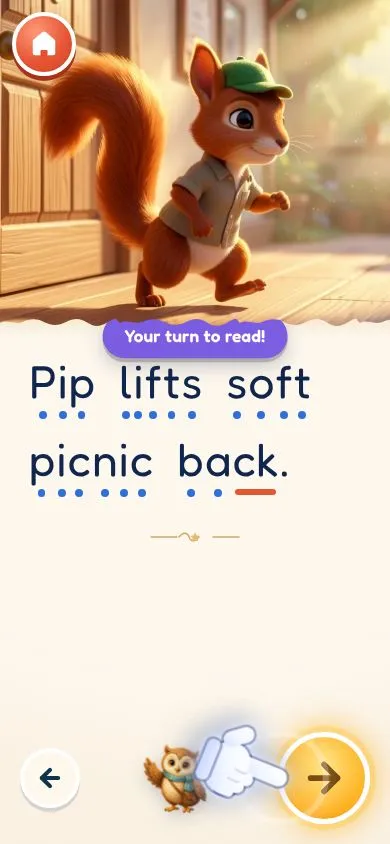
Each chapter ends with one short line from the story, written with sounds your child knows, for them to read themselves. Tap any word and it lifts off the page, splits into its sounds and says each one.
What they practise
Decoding: reading real words from the story using the sounds they know, with tricky words marked with a star.
Help is one tap away
A word says its sounds one by one; “Read it to me” reads the whole line.
Always praised
“I read it!” earns a cheer every time. Nothing is marked.
Your turn to read, in the app.
Tap a word: “dog” split into its sounds.
THE STAR JAR AND DRESS UP
Every story fills the jar
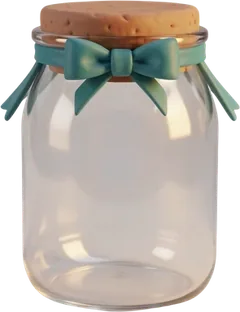
Each story a Little Explorer finishes drops a star into the glass jar on their Home screen. There are no numbers to read: tap the jar and the owl says how many. Stars unlock outfits for their hero, and they are never spent. On this page, every game you solve adds a star to the jar in the corner. Try it, then dress the hero.
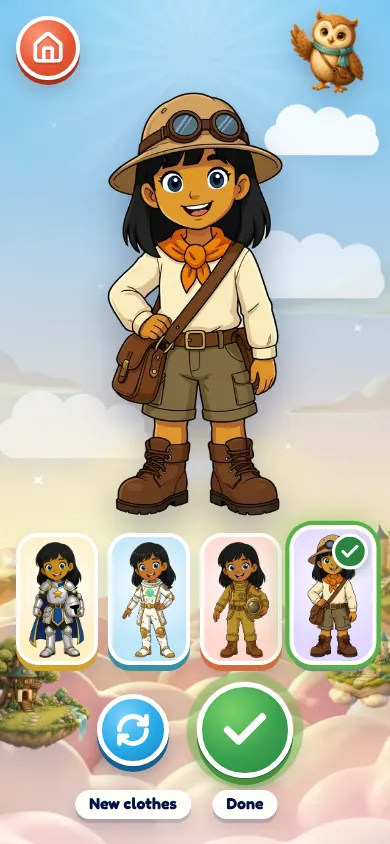
Your child's own hero stands in the middle with four big outfits to tap. One tap puts it on with sparkles; New clothes deals four more. The outfit appears in the pictures of their next stories.
Star outfits
15 outfits unlock as stars build up, each needing one to five more stars than the one before. The first ones here unlock at their real targets: 1, 2, 4, 6 and 8 stars.
No shop, no prices
Stars are earned by reading and kept for good. Nothing is taken from the jar.
Dress up, in the app. Real app, no sound.The star jar's outfits, in the app. Real app, no sound.
THE SOUNDS THEY LEARN AT SCHOOL
Practising the sounds they learn at school, inside their own story
Schools in England teach reading through systematic synthetic phonics: letter sounds in a set order, blended into words. Litsee's sound games follow the same approach, so practice at home points the same way as the classroom.
How it works
Follows a systematic synthetic phonics order: 83 letter-sound pairs in 19 sets, from phase 2 to phase 5, based on Letters and Sounds and the Department for Education's Reading framework.
Plays pure sounds (“sss”, not “suh”) from sound files. A computer voice never says a letter sound.
Uses the sound buttons children meet at school: a dot for one letter, a dash for two or three, a star on a tricky word.
Practises one sound at a time in each chapter's puzzle, in teaching order, and brings back sounds already met.
satpset 1
inmdset 2
gockset 3
Why children love it
It never feels like homework. The sounds they practise at school turn up inside the story they are making: a password for a locked door, a magic word that wakes a star, a riddle from the frog on the log.
Every word comes from the chapter they have just heard, so the practice is part of the adventure, and a line to read at the end of each chapter lets them show off what they know. Wrong taps just get a gentle wobble and another go.
Teachers using Litsee's Teacher Studio can play eight spelling games on the board, live on pupils' devices, as homework or as solo practice, with the class's own spelling words.
These eight are in Teacher Studio, so they can't be played on this page, except one: play Unscramble Dash below.
Everything below sits in Grown-ups, behind your PIN, for each child separately.
Listen & PlayThe simpler, guided way in: stories read aloud and picked with a tap.
Sound gamesRhymes, sound words, the chapter puzzles and tap a word. On unless you turn them off.
Your turn to readOne short line at the end of each chapter for your child to read.
Narration speed and story soundsHow fast the stories and the owl read aloud, and the soft sounds of the story's world.
Sounds practisedOne plain line, such as “Mia has met 14 sounds. Practise next: sh, ch, ee.” A picture of practice, not a test. The record holds only sounds, counts and dates, never audio.
A break, and a way to tell usAfter about 20 minutes a gentle break screen appears. If anything in a story worries you, report it from Grown-ups.
Questions parents ask about phonics in Litsee
How does Litsee help with phonics?
Early readers practise the sounds they learn at school inside the story they are making. Litsee's sound games follow the same systematic synthetic phonics approach schools use, starting with s, a, t and p, with pure sounds and the sound buttons children see in class. Between chapters they blend, build words and solve rhymes, and each chapter ends with a line for them to read.
Which age are the phonics games for?
They are part of Little Explorers, the simpler, guided way into Litsee for early readers, usually about 5 to 7. Readers aged 5 to 7 on the full story can also tap a word to hear its sounds. You choose which way in suits each child, and can change it at any time.
Do the games interrupt the story?
No. The puzzles fill the short wait while the next chapter is being written, and they use a word from the chapter your child just heard. After two tries the robot helps, and your child can carry on as soon as the next chapter is ready.
What do the sounds sound like?
Each letter sound is a pure sound played from a sound file, like “mmm” rather than “muh”. A computer voice never says a letter sound, because it gets them wrong (it says “buh” for b). If a sound isn't available, the screen asks you and your child to say it together.
Is anything marked or timed?
No. There are no scores, timers or wrong answers to worry about. A wrong tap gets a gentle wobble and another go, and “I read it!” is always praised. Stars come from finishing stories, not from getting things right.
Can I turn the sound games off?
Yes. In Grown-ups, behind your PIN, each child has a Sound games switch and a Your turn to read switch, along with the narration speed. Sound games are on unless you turn them off.
What do I see about my child's sounds?
One plain line in Grown-ups, such as “Mia has met 14 sounds. Practise next: sh, ch, ee.” A sound counts as met after a few goes on different days. It is a picture of practice, not a test. The record holds only sounds, counts and dates, never audio.
What are the star jar and Dress up?
Each finished story drops a star into your child's star jar. Stars are never spent: they unlock outfits for your child's hero, who can also try on outfits in Dress up. The outfit they choose appears in the pictures of their next stories.
Are there games for schools?
Yes. Teacher Studio has eight spelling games, from Picture Spell to Syllable Snap, that teachers play on the board, live on pupils' devices, as homework or as solo practice, with the class's own words.
7 days free. A card is needed to start, and nothing is charged if you cancel before the trial ends.
Try it in LitseeYour child creates the hero, picks the world and chooses what happens next, in an illustrated story that is read aloud.Start your free trialUse it in classRead an illustrated, narrated story together on the whiteboard, and let the class choose what happens next.Start a free classroom trialSee Litsee for schools