
The Missing Christmas Star: an interactive Christmas Eve story for kids
Ages 5–7 · Reading age 6 · About 7 minutes · Questions to print
- Read
- Choose
- Keep
Chapter 1The tree with no star
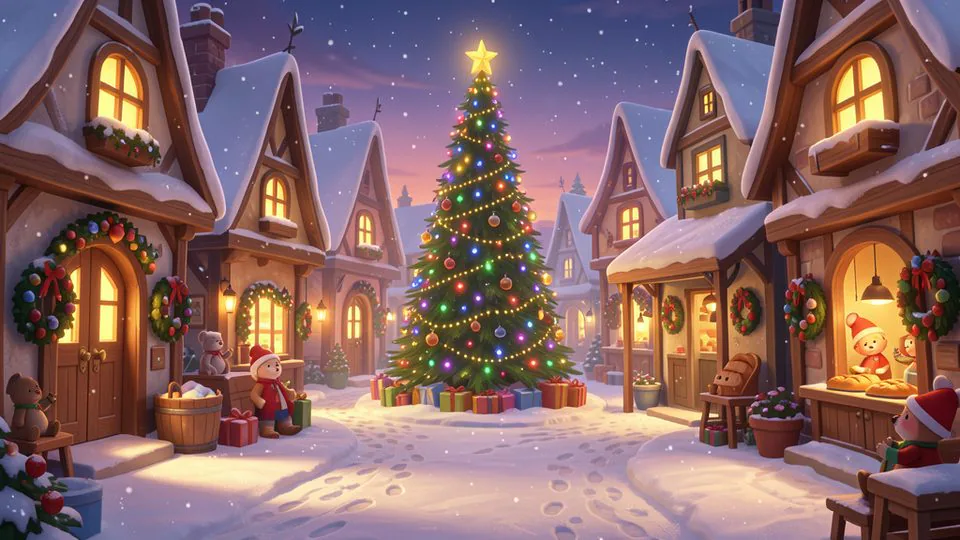
It was Christmas Eve in the village of Holly Hill. Snow fell softly on the rooftops. In the square stood a tall tree, twinkling with lights.
“Time for the star!” called Mr Ade from the bakery. Everyone looked in the big box. It was empty! The golden star had gone.
Everyone said the star helped Father Christmas find Holly Hill. Nia had to find it. She looked all around the square.
On the fence sat a little robin. In its beak was a gold ribbon, just like the star’s. The robin looked at Nia. Then it flew off towards the woods.
You choose what happens next
What should Nia do?
For grown-ups: comprehension questions to print, new words and how to read it together
On Christmas Eve, the golden star for Holly Hill’s tree is missing. Read along as Nia follows a robin into the snowy woods. Your child makes three choices, and the last one picks one of three endings.
Free interactive story · ages 5–7
- Reading age 6
- 3 short chapters, 3 choices and 3 endings
- About 7 minutes
- Christmas
Questions for grown-ups to ask
Did you spot it?
- EasyWhat was missing from the village tree?Answer: The golden star.
- MediumWhy didn’t Nia walk across the frozen pond?Answer: The sign said the ice was thin, and Nia knew that ice can crack.
- HarderWhy do you think the robin flew to Nia?Answer: It had found the star and the cold fox, and it wanted someone to help.
Talk about it
- Which ending did you choose? Go back and read another one. Which do you like best, and why?
- Nia wants to help the village and the fox. How does each ending try to be kind to both?
- Is there someone you could help to have a happy day this winter?
Christmas comprehension questions for KS1
Ten read-and-answer questions about The Missing Christmas Star, for Year 1 and Year 2. Read the story together first, just for fun. Then talk through a few of the questions, or print the sheet for your child to write on.
Questions 1 to 5 are about chapter 1, which every reader shares. Questions 6 to 9 are about chapters 2 and 3, which are the same whichever way your child goes. Question 10 asks about the ending your child chose. Each question shows the reading skill it practises.
Chapter 1 · 1b finding information
1. What is the name of Nia’s village?
Chapter 1 · 1a vocabulary
2. “In the square stood a tall tree, twinkling with lights.” What does “twinkling” mean?
Chapter 1 · 1c sequencing
3. Number these 1, 2 and 3, in the order they happen.
- Everyone looked in the big box.
- The robin flew off towards the woods.
- Mr Ade called, “Time for the star!”
Chapter 1 · 1d inference
4. Why was the ribbon in the robin’s beak a good clue?
Chapter 1 · 1e prediction
5. The robin flew off towards the woods. What do you think Nia will find there? Why?
Chapter 2 · 1b finding information
6. How did Nia know that the gold thing across the pond was the star?
Chapters 2 and 3 · 1c sequencing
7. Number these 1, 2 and 3, in the order they happen.
- Nia found the fox asleep next to the star.
- Nia saw a sign: “Thin ice. Keep off!”
- Something glowed on the other side of the pond.
Chapter 3 · 1a vocabulary
8. “It had come to fetch help!” What does “fetch” mean?
Chapter 3 · 1d inference
9. Why couldn’t Nia just pick up the star and run home?
The ending you chose · 1b finding information
10. Which ending did you read? How did Nia help the fox in that ending?
With lines to write on, and no answers.
Show the answers
For inference and prediction questions (1d and 1e), any answer the story backs up is a good one. Ask “How do you know?” and look back at the page together.
- Holly Hill.
- Shining with little lights that sparkle on and off. Any answer about shining or sparkling is right.
- 1: Mr Ade called, “Time for the star!” 2: Everyone looked in the big box. 3: The robin flew off towards the woods.
- It was a gold ribbon, just like the star’s, so the robin might know where the star was.
- Any idea that fits the clues, with a reason. In the story, Nia sees the golden star glowing on the other side of a frozen pond.
- It glowed, it was gold and it had five shiny points.
- 1: Something glowed on the other side of the pond. 2: Nia saw a sign: “Thin ice. Keep off!” 3: Nia found the fox asleep next to the star.
- To go and get something or someone and bring them back. The robin had come to get help for the cold fox.
- The little fox was asleep next to it, and the star was keeping him warm. Holly Hill needed its star that night, but the fox needed to be warm too.
- Home to Holly Hill: the fox followed Nia home and curled up by the warm bakery door, and Mr Ade gave him a soft blanket. The red scarf: Nia tucked her red scarf round the sleeping fox. Christmas in the woods: Nia brought the whole village to the woods. They put the star on a little fir tree next to the snowman, and the fox woke up to singing and a party.
The reading skills
Each code is a content domain from the Standards and Testing Agency’s key stage 1 English reading test framework, in its own words:
- 1a (vocabulary)
- “draw on knowledge of vocabulary to understand texts”
- 1b (finding information)
- “identify / explain key aspects of fiction and non-fiction texts, such as characters, events, titles and information”
- 1c (sequencing)
- “identify and explain the sequence of events in texts”
- 1d (inference)
- “make inferences from the text”
- 1e (prediction)
- “predict what might happen on the basis of what has been read so far”
More practice: Reading comprehension practice for Year 1 to Year 6.
Words to talk about
- glowed
- Gave out a soft, warm light.
- frozen
- So cold that water has turned into hard ice.
- trotted
- Walked along with quick, short steps.
- curled up
- Lying in a round shape, like a ball.
- square
- An open space in the middle of a village or town, where people meet.
Reading it together
This is a short story for Christmas Eve, a December evening or a snowy afternoon. Each page is only a few short sentences, written for children aged 5 to 7, so many Year 1 and Year 2 readers can read it themselves, with a grown-up close by for words like “understood”.
There are three choices, one at the end of each chapter. Read the options aloud and let your child decide. The first two change what happens on the way; the last one decides the ending, and there are three. Reading all three endings is half the fun, so go back and try again.
The story is about kindness rather than presents, so it works for families who mark Christmas in different ways. Father Christmas is mentioned once, as part of the village’s story, and the magic is kept. It also carries a safety message worth repeating every winter: never walk on a frozen pond, however solid it looks.
In class, put it on the whiteboard and let the class vote at each choice. Afterwards, children can write a fourth ending, or plan their own winter story with our Christmas story starters.
About this story
- Reading age
- 6 (ages 5–7). Written for Litsee’s reading level for age 6, where sentences are mostly 5–9 words long.
- Length
- 3 short chapters, 3 choices and 3 endings. Each way through is 373–396 words.
- Reading time
- About 7 minutes for a 6-year-old reading on their own, at Litsee’s pacing of 60 words a minute for that age. Reading aloud to your child is usually quicker.
- Book band
- Roughly Turquoise to Purple, if your child’s school uses book bands (schemes differ; see our book bands guide).
- Characters
- Nia, a robin, Mr Ade the baker, a little fox
- Theme
- Christmas
About this story
The Missing Christmas Star is a Litsee original, written for this page by the Litsee team and checked against Litsee’s reading level for age 6. Everyone who reads it here sees the same words, with three endings to discover; in the app, every story is made fresh for your child.
The pictures are painted winter worlds from the Litsee app, created with AI image tools and hand-picked by the Litsee team. They show the places in the story, not the characters. Nia is one of the 15 heroes children can choose in Litsee. “Read to me” plays an AI voice recorded in advance.
Last updated: .
Questions parents and teachers ask
What age is The Missing Christmas Star for?
Ages 5 to 7, from Reception to Year 2. It is written at Litsee’s reading level for age 6: short sentences, everyday words and one clear problem to solve.
Is it suitable for children who don’t celebrate Christmas?
We hope so. It is a winter story about helping others, with no religious content. Father Christmas is mentioned once, in what the villagers say.
Can I use this story in class?
Yes. It is free to read on a whiteboard with no account. Let the class vote at each choice. For a full lesson, see our Christmas story unit for KS1 and KS2.
Is there a printable Christmas comprehension for KS1?
Yes: the ten Christmas comprehension questions for KS1 on this page print on one A4 sheet, with lines to write on and no answers. The answers are on the page, under “Show the answers”.
More to read and try
- The Big Footprints: a free story for ages 5–7
- Picnic on the Moon: a free story for ages 5–7
- The Treehouse Steps: a free story for ages 5–6
- The Whispering Woods
- Christmas story starters
- Christmas story unit for KS1 and KS2
- Christmas reading challenge for the holidays
- Letter to Santa template for KS1 and KS2
- A reading Christmas Eve box: a book, this story and a bedtime routine
- How the Litsee storybook app works
- All free stories
Now let your child make a story of their own.
In Litsee, your child creates the hero, picks the world and chooses what happens next in an illustrated story that is read aloud.
Start your free trial7 days free. A card is needed to start, and nothing is charged if you cancel before the trial ends.