
Christmas story starters and writing prompts for KS1 and KS2
- 1 Choose
- 2 Read
- 3 Make
- 4 Keep
Choose your story starter
About Christmas
For grown-ups: every starter, the full generator, the curriculum and questions
What your child practises: carrying a story on from its first line: choosing what happens next, what the character does and how it ends, then writing the next page. National Curriculum, Year 2, Writing – composition: “writing narratives about personal experiences and those of others (real and fictional)”.
Here are 24 Christmas story starters and writing prompts for children aged 5 to 11, one for every day from 1 to 24 December, sorted by key stage, with a generator, a festive story plan, a word bank and Christmas writing ideas for KS1 and KS2.
Reviewed by Joshua Younger, Education Lead, on .
Every starter: the full generator
Story starter generator
Only starters that come with three choices for what happens next.
Pick a world
 Toy Factory
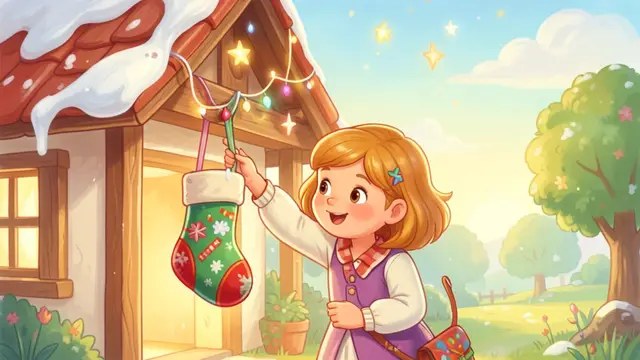
Example starter · Christmas · Years 1–2
Mia hung up her stocking. Then she heard a jingle on the roof.
Stuck? Say it out loud first. Who is in your story, and what do they want? What goes wrong? How does it end? It doesn’t have to be true.
“Print my story page” puts this starter on an illustrated A4 page, with its words, a checklist for the key stage and lines to carry on writing.
Prints every starter for the year group and theme chosen above, with the Christmas word bank.
Make this into a Litsee story
In Litsee your child turns a first line like this into an illustrated story read aloud: they create the hero and choose what happens next. 7-day free trial; a card is needed to start.
The generator picks from a fixed list in your browser. It doesn’t use AI, and nothing you choose is saved or sent anywhere.
All 24 Christmas story starters
KS1 (Years 1–2) · ages 5–7
- 1.Mia hung up her stocking. Then she heard a jingle on the roof.
- 2.A little robin landed on top of the Christmas tree and began to sing.
- 3.Father Christmas had dropped a mitten in Ben’s garden.Has three “What happens next?” choices
- 4.The gingerbread house was finished. Then a light came on inside it.
- 5.Grandma’s Christmas jumper had a pocket, and something in the pocket was wriggling.
- 6.It was the school Christmas play, and Leo could not remember his line.
- 7.The snowman had a carrot nose and a red scarf. In the morning, the scarf was on the cat.
- 8.Ella made a paper star for the window. At bedtime, it began to twinkle.
Years 3–4 · ages 7–9
- 9.Every light on Holly Street had gone out, and the big Christmas switch-on was at six o’clock tonight.
- 10.Every year, Grandpa wrapped one present that nobody was allowed to open until the very end of Christmas Day.
- 11.All through December, someone had been leaving tiny parcels on the school steps, each labelled with a different child’s name.Has three “What happens next?” choices
- 12.The Christmas cracker snapped, and instead of a paper hat, out fell a tiny brass key.
- 13.When the snow came, it fell on only one house in the street: Mr Okoro’s, and he had never seen snow before.
- 14.Martha’s job was to deliver the village Christmas cards on her bike. One card had no address, just a drawing of a lighthouse.
- 15.The workshop elves had one rule: no toy leaves unfinished. So why was there a teddy bear with one ear sitting in the sleigh?
- 16.Josh had saved up all year to buy his little sister the perfect present, but on Christmas Eve the shop had a sign on the door: Closed.
Years 5–6 · ages 9–11
- 17.Every Christmas Eve, the clock in the town square struck thirteen, and only children could hear the extra chime.
- 18.The calendar on the fridge had twenty-four little doors. Behind the twenty-fifth, which had not been there yesterday, was a staircase.
- 19.Christmas dinner was nearly ready, the table was laid for eleven, and the oven had just switched itself off for good.Has three “What happens next?” choices
- 20.The letter was written in careful, curly handwriting: “Dear Finder, this decoration has been in my family for two hundred years. Please return it to where it belongs.”
- 21.Nobody in the Harper family could agree on anything at Christmas, until the snow trapped all eleven of them in Great-Aunt Bea’s tiny cottage.
- 22.Kit was the only one awake on Christmas morning, which is why she was the only one who saw the hoofprints across the lawn, leading to the garden shed.
- 23.The sign in the charity shop window said: “Wanted: one Christmas helper. Must be kind, must be good at wrapping, must not ask questions.”
- 24.Every December, a different house on Wren Lane decorated the street. This year it was the turn of the one house that had never joined in.
What happens next? Three choose-your-path starters
Read the starter, read the three choices aloud and let your child pick one, then write that part of the story.
Years 1–2
Father Christmas had dropped a mitten in Ben’s garden.
- Ben leaves it on the doorstep with a note and a mince pie.
- The mitten is warm and magic, and it makes the snowflakes dance.
- A reindeer lands on the lawn to look for it.
Years 3–4
All through December, someone had been leaving tiny parcels on the school steps, each labelled with a different child’s name.
- Priya stays behind after school to find out who is leaving them.
- One parcel is labelled with a name that nobody in the school has.
- The parcels are clues that lead to a surprise for the dinner staff.
Years 5–6
Christmas dinner was nearly ready, the table was laid for eleven, and the oven had just switched itself off for good.
- The family carries every dish next door and cooks with the neighbours.
- Gran declares a winter picnic, and everyone eats in coats around a fire pit in the garden.
- Amir finds an old camping stove in the shed and makes a plan, one dish at a time.
A Christmas story recipe
Christmas stories are about getting ready, something going wrong and putting it right just in time. Five steps make the plan.
- 1
Getting ready
Show the build-up: lights going up, a kitchen full of baking, cold air outside and a countdown to the big day.
- 2
Something goes wrong
A present goes missing, the lights go out, the snow blocks the road or someone is about to be left out.
- 3
Against the clock
Christmas has a deadline. Remind the reader how much time is left: three days, one night, ten minutes.
- 4
Kindness fixes it
Solve the problem by helping, sharing or working together, not by buying something new.
- 5
Together at last
End with everyone together, and one small detail the hero will remember next year.
Want to plan it on paper? Use the free story mountain template, fill in the five boxes online and print it.
Christmas words
Twelve words to use in a Christmas story, with meanings a child can understand.
- festive
- full of the happy, busy feeling of a celebration
- tradition
- something a family or a town does in the same way every year
- decorations
- lights, paper chains and other things put up to make a place look special
- tinsel
- long, sparkly strings used to decorate a tree or a room
- wreath
- a ring of leaves, often hung on a front door
- sleigh
- a sledge pulled by animals across the snow
- gingerbread
- a sweet, spicy biscuit or cake, often made into shapes
- cosy
- warm, comfortable and safe
- twinkle
- to shine with small flashes of light, like a star
- glisten
- to shine because something is wet or icy
- generous
- happy to give and share with others
- anticipation
- the excited feeling of waiting for something to happen
Curriculum links
Where a Christmas story fits the National Curriculum in England:
“writing narratives about personal experiences and those of others (real and fictional)”
Year 2, Writing – composition (statutory)
“writing for different purposes”
Year 2, Writing – composition (statutory)
“in narratives, creating settings, characters and plot”
Years 3 and 4, Writing – composition (statutory)
“in narratives, describing settings, characters and atmosphere and integrating dialogue to convey character and advance the action”
Years 5 and 6, Writing – composition (statutory)
How to use these with your child or class
Christmas gives children a setting they already know in detail and a plot with a built-in deadline. Something has to be ready by the big day, and something gets in the way. Before writing, ask two questions: “What has to be ready?” and “What goes wrong?” A missing present, a power cut or a blocked road is enough for a whole story.
Not every child celebrates Christmas, and most classes have a mix of families. These starters treat Christmas as a festive winter setting: lights, snow, baking, parties, presents and neighbours. None of them tells a child what to believe. A child who does not celebrate can write as a visitor, a neighbour or a helper, or choose the winter story starters instead, which have snow and long nights and no Christmas at all.
Some starters include Father Christmas, elves and reindeer. They are written to keep the magic for younger children, so you can read any of them aloud to a whole family or a mixed-age class without spoiling anything. If an older child writes a magical Christmas story, encourage them to add some magic of their own: a new job for the elves, a sleigh with a secret, a workshop nobody has seen.
Christmas is a setting for the senses: the smell of oranges and baking, the crunch of snow, the rustle of wrapping paper, lights reflected in a dark window. In Years 3 and 4, that makes it an ideal theme for describing a setting. In Years 5 and 6, children can build atmosphere through contrast: a warm, noisy kitchen against a silent, snowy street, or one dark house in a road full of lights.
The season also suits writing for different purposes, which is part of the Year 2 curriculum. A Christmas story can grow into a thank-you letter from one character to another, a list of what the elves still need to finish, instructions for building a gingerbread house or a diary entry written on Christmas Eve.
There are 24 starters on this page, so you can use one a day from 1 to 24 December. At home, read the day’s starter at breakfast and finish the story aloud at bedtime. In the last busy week of term, give each table a different starter from the same band and make a class book of Christmas stories, one chapter per table.
Worked example (KS1)
- Starter: “Father Christmas had dropped a mitten in Ben’s garden.”
- Talk first: Where did Ben find it? How does it feel? What will Ben do?
- Sentence 1: The mitten was red and fluffy and very, very big.
- Sentence 2: Ben put it on the doorstep with a mince pie and a note that said “Is this yours?”
- Sentence 3: In the morning, the pie was gone and the note said “Thank you, Ben!”
About this page
Reviewed by Joshua Younger · How it works · Sources
Sources
The curriculum links on this page are copied word for word from these documents, with the year and section each applies to.
How it works
Reviewed by Joshua Younger, Education Lead, on .
Every starter is written for a year group and shown on these pages, so you always know what your child will see. The generator runs in your browser, and nothing your child chooses is sent anywhere. A finished story is kept on this device only if they press “Keep it on my shelf”.
Questions parents and teachers ask
Are these Christmas story starters suitable for children who don’t celebrate Christmas?
They treat Christmas as a festive winter setting, with lights, snow, baking and neighbours, and make no religious claims. Children who don’t celebrate can write as a visitor or helper, or use the winter story starters, which have no Christmas in them.
Do any of the starters spoil the magic of Father Christmas?
No. The starters with Father Christmas, elves or reindeer are written to keep the magic, so they are safe to read aloud to younger children and mixed-age groups.
Which Christmas story starters suit KS2?
Choose the Years 3–4 and Years 5–6 starters on this page, or set the generator to KS2 and the Christmas theme. The Years 5–6 starters, such as the clock that strikes thirteen, suit longer stories with atmosphere and a twist.
When should I use Christmas story starters, in class or as Christmas homework?
Any time in December. With 24 starters you can use one a day from 1 to 24 December, or save them for the last week of the autumn term, when a short, festive writing task fits a busy timetable. For Christmas homework in KS1 or KS2, send home one starter with the five-step festive story plan, and keep it optional over the holidays.
What Christmas writing activities work for KS1 and KS2?
Start with a story starter and the five-step festive story plan. Then turn the story into another kind of writing: a thank-you letter from one character to another, the elves’ list of jobs still to finish, instructions for building a gingerbread house or a diary entry written on Christmas Eve. In the last week of term, give each table a different starter and make a class book of Christmas stories.
Turn a starter into an interactive story your child can steer.
In Litsee, your child creates the hero, picks the world and chooses what happens next in an illustrated story that is read aloud.
Start your free trial7 days free. A card is needed to start, and nothing is charged if you cancel before the trial ends.