
Space story starters for kids
- 1 Choose
- 2 Read
- 3 Make
- 4 Keep
Choose your story starter
About Space
For grown-ups: every starter, the full generator, the curriculum and questions
What your child practises: carrying a story on from its first line: choosing what happens next, what the character does and how it ends, then writing the next page. National Curriculum, Year 2, Writing – composition: “writing narratives about personal experiences and those of others (real and fictional)”.
Here are 24 space story starters for children aged 5 to 11, sorted by key stage, with a generator that gives you a new one each time and a plan for turning it into a story.
Reviewed by Joshua Younger, Education Lead, on .
Every starter: the full generator
Story starter generator
Only starters that come with three choices for what happens next.
Pick a world
 Moon Base
Example starter · Space · Years 1–2
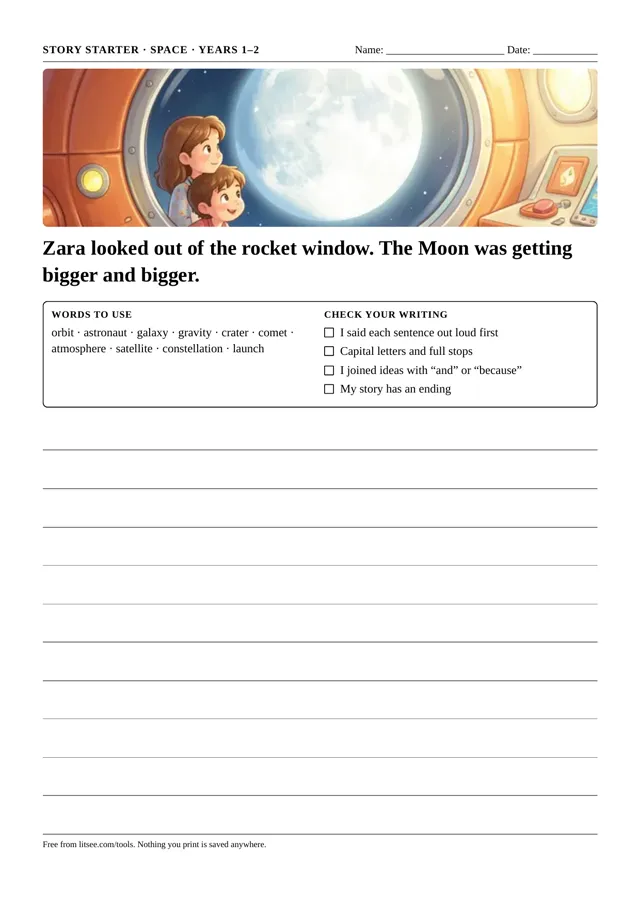
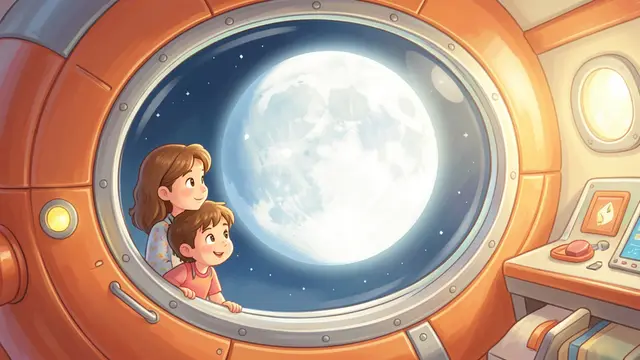
Zara looked out of the rocket window. The Moon was getting bigger and bigger.
Stuck? Say it out loud first. Who is in your story, and what do they want? What goes wrong? How does it end? It doesn’t have to be true.
“Print my story page” puts this starter on an illustrated A4 page, with its words, a checklist for the key stage and lines to carry on writing.
Prints every starter for the year group and theme chosen above, with the space word bank.
Make this into a Litsee story
In Litsee your child turns a first line like this into an illustrated story read aloud: they create the hero and choose what happens next. 7-day free trial; a card is needed to start.
The generator picks from a fixed list in your browser. It doesn’t use AI, and nothing you choose is saved or sent anywhere.
All 24 space story starters
KS1 (Years 1–2) · ages 5–7
- 1.Zara looked out of the rocket window. The Moon was getting bigger and bigger.
- 2.The little robot beeped three times. That meant “Something is outside!”
- 3.Tom’s rocket landed on a planet made of soft, purple sand.Has three “What happens next?” choices
- 4.On Mars, Ava found a red rock that hummed when she held it.
- 5.The stars were not twinkling tonight. They were spelling out a word.
- 6.Leo packed his space bag: a torch, a sandwich and a map of the Moon.
- 7.An alien tapped on the window of the space station. It was holding a cake.
- 8.Grandad’s old telescope showed something new: a tiny planet with a front door.
Years 3–4 · ages 7–9
- 9.The message arrived at seven minutes past three in the morning: four beeps, a pause, then four more. Captain Priya knew exactly what it meant.
- 10.Nobody had ever landed on the far side of Planet Quill, so Kofi was surprised to find footprints.
- 11.When the ship’s computer started telling jokes, Mei knew something had gone very wrong.Has three “What happens next?” choices
- 12.The space station’s greenhouse was meant to grow tomatoes. This morning it had grown a door.
- 13.Sam had one job on the mission: look after the space hamster. Now the cage was empty.
- 14.The planet’s two suns were setting, painting the ice cliffs pink and gold, when the radio crackled into life.
- 15.“Rocket ready?” asked Mission Control. Amir looked at the flashing orange light and took a deep breath.
- 16.Isla had always wanted to see Earth from space. She just hadn’t expected to see it from inside a giant, friendly space whale.
Years 5–6 · ages 9–11
- 17.Commander Okafor had trained for every emergency except the one now drifting past the window: a perfectly ordinary garden shed.
- 18.For three hundred years the colony ship had travelled in silence, until the morning the children woke up first.
- 19.The signal came from a planet that, according to every star chart on board, did not exist.Has three “What happens next?” choices
- 20.On Moonbase Seven, nobody used the north airlock any more, which was why Ruby was so curious when its light blinked green.
- 21.The asteroid was the size of a football pitch, coated in frost and, according to the scanner, humming a tune.
- 22.Noah’s grandmother had been the first person to walk on Titan. Fifty years later, he found her missing glove.
- 23.Gravity switched off at breakfast. By the time the cereal had floated to the ceiling, Freya had worked out that it wasn’t an accident.
- 24.From the observation deck, Earth looked like a marble resting on black velvet. Then a second, smaller blue planet rose behind it: one that hadn’t been there yesterday.
What happens next? Three choose-your-path starters
Read the starter, read the three choices aloud and let your child pick one, then write that part of the story.
Years 1–2
Tom’s rocket landed on a planet made of soft, purple sand.
- He builds a sandcastle, and something inside it starts to wiggle.
- A friendly alien asks him to help find its lost ball.
- The rocket’s wheels get stuck, so he needs a clever plan.
Years 3–4
When the ship’s computer started telling jokes, Mei knew something had gone very wrong.
- The computer has picked up an alien radio show and is copying it.
- Someone has sneaked on board and is typing the jokes in secret.
- Each joke is a clue that leads to a hidden room on the ship.
Years 5–6
The signal came from a planet that, according to every star chart on board, did not exist.
- The crew vote to land, even though the ship’s computer advises against it.
- They send a message back and receive an answer in their own voices.
- The planet flickers onto the screen, then vanishes, leaving a set of coordinates behind.
A space story recipe
Most good space stories follow the same five steps. Children can use them as a plan before they write.
- 1
Lift-off
Give the hero a reason to leave Earth: a mission, a strange signal or a lost robot to find.
- 2
The surprise
Something unexpected happens on the way: a planet that is not on the map, a message, a part that stops working.
- 3
Land and explore
Describe the new place with the senses. What does the ground feel like through a space boot?
- 4
The big problem
The ship cannot take off, a friend needs help, or the alien needs something only the hero has.
- 5
Clever fix and home
Solve it with an idea, not luck. Finish by showing how the hero has changed when they see Earth again.
Want to plan it on paper? Use the free story mountain template, fill in the five boxes online and print it.
Space words
Twelve words to use in a space story, with meanings a child can understand.
- orbit
- the curved path something takes as it travels around a planet or star
- astronaut
- a person trained to travel and work in space
- galaxy
- a huge group of millions of stars; ours is called the Milky Way
- gravity
- the pull that keeps our feet on the ground and the Moon going around Earth
- crater
- a round hollow in the ground made when a rock from space crashes into it
- comet
- a ball of ice and dust with a long glowing tail
- atmosphere
- the layer of air around a planet
- satellite
- anything that orbits a planet, like the Moon or a machine sending TV signals
- constellation
- a group of stars that seems to make a picture in the sky
- launch
- to send a rocket up into the sky
- mission
- an important job that a team sets out to do
- airlock
- a small room with two doors that lets astronauts go outside without letting the air out
Curriculum links
Where a space story fits the National Curriculum in England:
“in narratives, creating settings, characters and plot”
Years 3 and 4, Writing – composition (statutory)
“describe the movement of the Earth, and other planets, relative to the Sun in the solar system”
Year 5, Earth and space (statutory)
How to use these with your child or class
Space is one of the easiest themes to start and one of the hardest to finish well, because children can go anywhere. The trick is to keep the story small: one ship, one planet, one problem. Before anyone writes, ask “What does your hero want, and what is stopping them?” If the answer is “to get home” and “the engine is broken”, that is a whole story.
Settings carry space stories. Ask children to imagine stepping out of the airlock and to name one thing they see, one thing they hear inside the helmet and one thing they feel through their boots. Space is silent, so younger writers enjoy describing sounds inside the ship instead: the hum of the engine, the beep of the computer, their own breathing. Older writers can use that silence to build tension.
Real facts make made-up planets more believable. In Year 5, the science curriculum covers Earth and space, so a class can borrow true details (the Moon has craters, Mars looks red, there is no air to carry sound) and then invent the rest. Children love knowing that their invented planet with two suns is not impossible.
At home, a space starter works well at bedtime: read it aloud, look out of the window at the Moon if you can, and take turns adding one sentence each. Stop at an exciting point and pick up the story the next night. Five-year-olds can draw the planet first and tell the story from the picture; you write the words they say.
In class, try a “mission log”. Children write the story as dated entries from the captain’s log, which gives a clear shape, makes it natural to write in the past tense and suits reluctant writers who prefer short chunks. Pair it with a talk partner who plays Mission Control and asks questions after each entry.
If a story keeps growing, use the recipe above as a checklist. Most space stories that drift have skipped step two (the surprise) or step five (the clever fix). Endings where the hero simply wakes up are best avoided; ask “What did your hero do to fix it?” instead.
Worked example (Years 3–4)
- Starter: “Sam had one job on the mission: look after the space hamster. Now the cage was empty.”
- Want and problem: Sam wants to find the hamster before the captain notices.
- Senses: the cage door swinging, tiny paw prints in spilled flour, a squeak from the air vent.
- Clever fix: Sam switches off the gravity in one room so the hamster floats out of the vent.
- Ending: the captain makes the hamster the ship’s official mascot.
About this page
Reviewed by Joshua Younger · How it works · Sources
Sources
The curriculum links on this page are copied word for word from these documents, with the year and section each applies to.
How it works
Reviewed by Joshua Younger, Education Lead, on .
Every starter is written for a year group and shown on these pages, so you always know what your child will see. The generator runs in your browser, and nothing your child chooses is sent anywhere. A finished story is kept on this device only if they press “Keep it on my shelf”.
Questions parents and teachers ask
What makes a good space story starter?
A good space starter puts a character in a specific place with something unexpected already happening, such as a message arriving, a cage that is empty or a planet that is not on the map. It should leave a question the child wants to answer.
Are these space starters suitable for KS1?
Yes. The first eight starters are written for Years 1 and 2, with short sentences and familiar words. Choose “KS1” in the generator to see only those, and read them aloud for children who are still learning to read.
Can I link a space story to the science curriculum?
Yes. Space is a Year 5 science topic in England, so children can use true details about the Sun, Earth and Moon in their stories. The vocabulary list on this page includes words such as orbit, gravity and satellite with child-friendly meanings.
How long should a space story be?
Aim for a few sentences in Year 1, a short page in Year 3 and several paragraphs by Year 6. A complete short story with a clear problem and fix is better than a long one that never ends.
Turn a starter into an interactive story your child can steer.
In Litsee, your child creates the hero, picks the world and chooses what happens next in an illustrated story that is read aloud.
Start your free trial7 days free. A card is needed to start, and nothing is charged if you cancel before the trial ends.