
Help us improve Litsee

With your permission, Google Analytics measures visits and Microsoft Clarity records clicks, scrolling and page interactions, with form inputs and page text masked. We use no advertising cookies.

Change it any time with Cookie settings. Privacy policy · Google privacy · Microsoft privacy

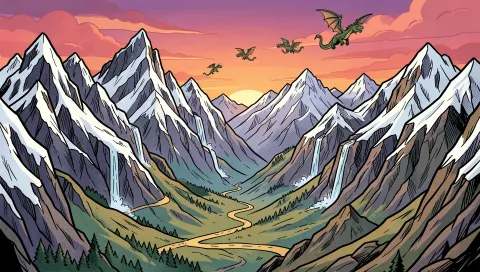
Painted snowy mountains with waterfalls, a winding path along the valley and dragons flying at sunset.

FREE STORY STARTERS · AGES 5–11

Dragon story starters for kids

Here are 24 dragon story starters for children, from a sneezing baby dragon in KS1 to Year 6 dragon riders, with a generator, a character plan and a dragon word bank.

Reviewed by Joshua Younger, Senior Educator, on .

Story starter generator

Only starters that come with three choices for what happens next.

24 starters in this set

Example starter · Dragon · Years 1–2

The baby dragon sneezed. Oops! The cake was on fire.

Prints every starter for the year group and theme chosen above, with the dragon word bank.

Make this into a Litsee story

In Litsee your child turns a first line like this into an illustrated story read aloud: they create the hero and choose what happens next. 7-day free trial; a card is needed to start.

Start a story

The generator picks from a fixed list in your browser. It doesn’t use AI, and nothing you choose is saved or sent anywhere.

All 24 dragon story starters

KS1 (Years 1–2) · ages 5–7

  1. The baby dragon sneezed. Oops! The cake was on fire.
  2. Ruby had a dragon in her bedroom. It was very small and very hungry.
  3. The dragon was sad because it could not breathe fire.Has three “What happens next?” choices
  4. A dragon landed in the playground. Everyone ran inside, except Finn.
  5. The dragon’s egg was gold and warm. It began to crack.
  6. Dragons are not meant to be scared of mice. But this one was.
  7. Every night, a dragon flew past Asha’s window. Tonight, it stopped.
  8. The dragon wanted to go to school. It did not fit through the door.

Years 3–4 · ages 7–9

  1. The last dragon in the kingdom lived in the castle library, and it had read every single book.
  2. Everyone in the village said the dragon on the hill was dangerous. Nobody had actually been to see.
  3. Owen was supposed to be guarding the dragon’s egg. He had only looked away for a second.Has three “What happens next?” choices
  4. When the dragon’s fire went out, the whole mountain grew cold.
  5. Talia found the dragon scale in the stream. It shimmered green, then blue, then a colour she had no name for.
  6. The dragon looked at the knight. The knight looked at the dragon. Then they both burst out laughing.
  7. Grandma said the clouds over the hill were just clouds. But clouds don’t have tails.
  8. The king offered a reward to anyone who could get rid of the dragon. Zainab had a better idea: she would make friends with it.

Years 5–6 · ages 9–11

  1. Dragons had not been seen in Corran Vale for a thousand years, which was why nobody believed Isaac when he said one was living in his loft.
  2. The dragon riders’ academy accepted one new student every hundred years. This year, to everyone’s surprise, it had chosen Bea.
  3. The dragon had grown so lonely that its fire had turned pale blue, said the healer, and there was only one cure.Has three “What happens next?” choices
  4. Every dragon has a true name, and whoever learns it can ask the dragon for one thing. Rowan had just overheard it.
  5. The scale was as big as a dinner plate, hot to the touch and humming faintly, and it had been delivered by first-class post.
  6. For centuries, the dragons and the people of the valley had kept a treaty. This morning, someone had broken it.
  7. Nobody told Ezra that dragons sulk, and that when they sulk, it rains for a week.
  8. The museum’s dragon skeleton had been a fake for as long as anyone could remember. So why had it grown a new tooth?

What happens next? Three choose-your-path starters

Read the starter, read the three choices aloud and let your child pick one, then write that part of the story.

Years 1–2

The dragon was sad because it could not breathe fire.

  1. Ruby helps it practise with a birthday candle.
  2. It finds out that it can breathe bubbles instead.
  3. An old dragon on the hill says it has a secret to share.

Years 3–4

Owen was supposed to be guarding the dragon’s egg. He had only looked away for a second.

  1. The egg has rolled down the hill towards the river.
  2. The egg has hatched, and the baby dragon thinks Owen is its mum.
  3. Someone from the village has taken it to the market.

Years 5–6

The dragon had grown so lonely that its fire had turned pale blue, said the healer, and there was only one cure.

  1. Bea sets off to find another dragon, rumoured to live beyond the northern ice.
  2. The cure turns out to be a song that only the dragon’s old friend knew.
  3. Bea realises that the cure is staying with the dragon herself, even though it means giving something up.

A dragon story recipe

In the best dragon stories, the dragon is a character with feelings, not just a monster to defeat.

  1. 1

    Meet the dragon

    Describe how it looks, sounds and moves, and give it one surprising detail.

  2. 2

    The misunderstanding

    People think the dragon is dangerous, or the dragon thinks people are.

  3. 3

    The friendship

    The hero gets close enough to learn what the dragon really needs or fears.

  4. 4

    The problem

    Something threatens them both: the village wants it gone, its egg is lost, its fire has gone out.

  5. 5

    The solution

    Courage and kindness solve it. The ending shows how the dragon and the people now see each other.

Want to plan it on paper? Use the free story mountain template, fill in the five boxes online and print it.

Dragon words

Twelve words to use in a dragon story, with meanings a child can understand.

scales
the small, hard plates that cover a dragon’s skin
wingspan
the distance from the tip of one wing to the tip of the other
hoard
a secret pile of treasure that someone keeps
lair
the hidden home of a wild creature
smoulder
to burn slowly with smoke but no flame
majestic
grand, beautiful and impressive
talons
long, sharp claws
soar
to fly high and smoothly
fearsome
looking scary, even if you are not
ancient
very, very old
legend
an old story that may or may not be true
shimmer
to shine with a soft light that seems to move

Curriculum links

Where a dragon story fits the National Curriculum in England:

  • “expanded noun phrases to describe and specify [for example, the blue butterfly]”

    Year 2, Writing – vocabulary, grammar and punctuation (statutory)

  • “in narratives, describing settings, characters and atmosphere and integrating dialogue to convey character and advance the action”

    Years 5 and 6, Writing – composition (statutory)

How to use these with your child or class

Dragons are perfect for character writing. Before your child writes, ask them to design their dragon on paper: its size, its colour, what it eats, what it is scared of and one thing nobody knows about it. A dragon that is afraid of mice or secretly loves reading is far more interesting than one that simply breathes fire, and the plan gives the story somewhere to go.

Turn the expected story upside down. Children know the old tale where a knight fights a dragon, so let them question it. What if the dragon is the one in trouble? What if the village has got it wrong? Most of the starters on this page begin with a misunderstanding for exactly this reason, and it steers the story towards friendship and problem solving instead of battles.

Use the dragon to practise description. In Year 2, children learn expanded noun phrases, and a dragon is the ideal subject: “a tiny dragon with sparkly purple wings”, “the old, grumpy dragon on the hill”. In Years 5 and 6, they can describe setting and atmosphere as well as character: the warm, smoky lair, the shadow passing over the village, the silence before the dragon speaks. Ask for one sentence about how the dragon looks and one about how it makes people feel.

Give the dragon a voice. When a dragon talks, children have a reason to write dialogue, and dragons can sound ancient, grumpy, shy or grand. In Key Stage 2, practise punctuating speech by writing a short conversation between the dragon and the hero first, then weaving it into the story. A rule worth sharing: every time someone new speaks, start a new line.

At home, draw first and write second. Younger children can draw their dragon and tell you about it while you jot down their words; those words become the first lines of their story. Fold a sheet of paper into a little book with a cover, and the dragon story becomes something to keep.

In class, a dragon “wanted” poster makes a lively warm-up: pupils describe a dragon the village is looking for, then flip it over and write the dragon’s side of the story. The two versions show how point of view changes the way we see a character, which is a skill they will use well beyond dragon stories.

Worked example dragon plan (Years 5–6)

  • Starter: “Nobody told Ezra that dragons sulk, and that when they sulk, it rains for a week.”
  • Dragon: the size of a bus, sea-green scales, sulks when ignored, secretly wants to be useful.
  • Misunderstanding: the village thinks the rain is a curse.
  • Problem: the harvest will be ruined unless the rain stops.
  • Solution: Ezra gives the dragon a job, drying the hay with warm breath, and the sun comes out.

About this page

Reviewed by Joshua Younger · How it was made · Sources

Sources

The curriculum links on this page are copied word for word from these documents, with the year and section each applies to.

How this page was made

Reviewed by Joshua Younger, Senior Educator, on .

Starters drafted with AI help and checked against the National Curriculum by Litsee. Spotted something to improve? Email info@litsee.com.

The generator picks from the starters shown on these pages, in your browser. It doesn’t use AI, and it doesn’t save or send anything you choose.

Questions parents and teachers ask

How do I describe a dragon in a story?

Start with size, colour and movement, then add one surprising detail and one feeling. Expanded noun phrases such as “the old, grumpy dragon with chipped scales” work well from Year 2, and older children can describe how the dragon changes the atmosphere of a place.

Are these dragon stories suitable for young children?

Yes. The dragons in these starters are characters with feelings, and most stories lead towards friendship and problem solving, not fighting. The KS1 starters are written for ages 5 to 7.

What is a good plot for a dragon story?

Try a misunderstanding: people think the dragon is dangerous, the hero discovers what it really needs, and together they solve a problem. The five-step recipe on this page sets this out.

Can I use these starters with the whole class?

Yes. Use the generator on the whiteboard to give a fresh starter to each group, or print the full set. Nothing is stored, and there is nothing to sign up for.

Turn a starter into an interactive story your child can steer.

In Litsee, your child creates the hero, picks the world and chooses what happens next in an illustrated story that is read aloud.

Start your free trial

7 days free. A card is needed to start, and nothing is charged if you cancel before the trial ends.

See plans and pricing · How Litsee works

Try it in LitseeYour child creates the hero, picks the world and chooses what happens next, in an illustrated story that is read aloud.Start your free trialUse it in classRead an illustrated, narrated story together on the whiteboard, and let the class choose what happens next.Start a free classroom trialSee Litsee for schools