
Winter story starters for kids
- 1 Choose
- 2 Read
- 3 Make
- 4 Keep
Choose your story starter
About Winter
For grown-ups: every starter, the full generator, the curriculum and questions
What your child practises: carrying a story on from its first line: choosing what happens next, what the character does and how it ends, then writing the next page. National Curriculum, Year 2, Writing – composition: “writing narratives about personal experiences and those of others (real and fictional)”.
Here are 24 winter story starters for children aged 5 to 11 about snow, ice, wild animals and long dark evenings, with no Christmas in them, so they work all through January and February too.
Reviewed by Joshua Younger, Education Lead, on .
Every starter: the full generator
Story starter generator
Only starters that come with three choices for what happens next.
Pick a world
 Cloud Kingdom
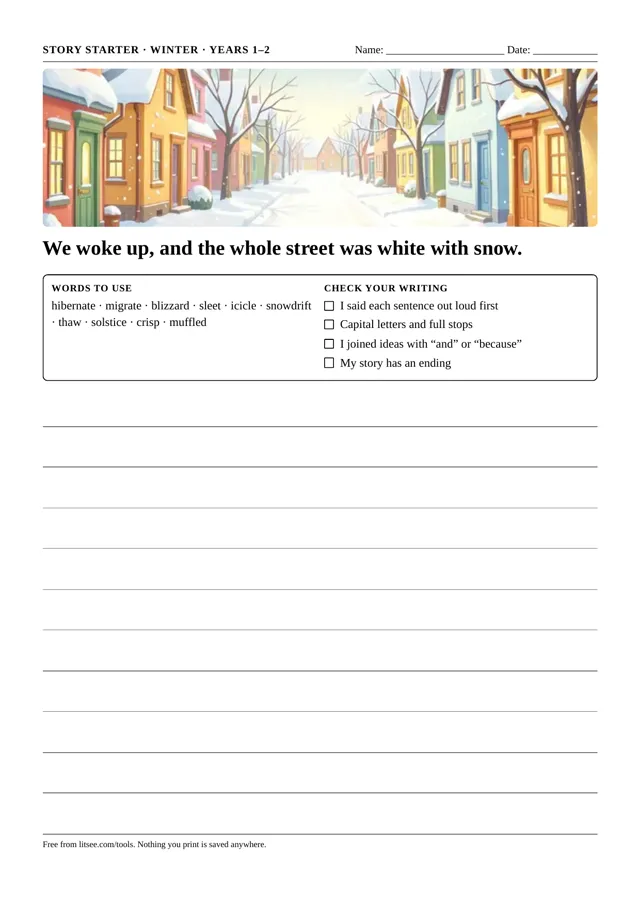
Example starter · Winter · Years 1–2
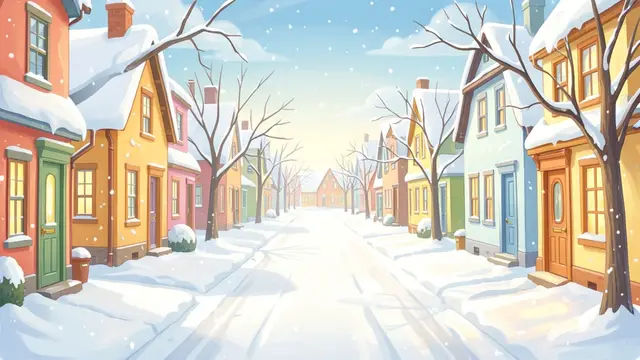
We woke up, and the whole street was white with snow.
Stuck? Say it out loud first. Who is in your story, and what do they want? What goes wrong? How does it end? It doesn’t have to be true.
“Print my story page” puts this starter on an illustrated A4 page, with its words, a checklist for the key stage and lines to carry on writing.
Prints every starter for the year group and theme chosen above, with the winter word bank.
Make this into a Litsee story
In Litsee your child turns a first line like this into an illustrated story read aloud: they create the hero and choose what happens next. 7-day free trial; a card is needed to start.
The generator picks from a fixed list in your browser. It doesn’t use AI, and nothing you choose is saved or sent anywhere.
All 24 winter story starters
KS1 (Years 1–2) · ages 5–7
- 1.We woke up, and the whole street was white with snow.
- 2.A hedgehog was fast asleep in a pile of leaves. Then it sneezed.
- 3.The pond had turned to ice, and a duck was sliding across it.Has three “What happens next?” choices
- 4.Icicles hung from the shed roof. One of them was shaped like a key.
- 5.It was so cold that Dad’s words came out in little clouds.
- 6.The sledge zoomed down the hill and did not stop at the bottom.
- 7.Every day the dark came earlier. Today it came before tea!
- 8.A robin tapped on the kitchen window. It looked hungry.
Years 3–4 · ages 7–9
- 9.Snow had been falling for three days, and the only way to reach the village shop was by sledge.
- 10.Every winter, the same robin came to Tilly’s bird table. This year it brought a friend with one bright blue feather.
- 11.The weather forecast said “light snow”. By lunchtime, the school was surrounded by drifts taller than the teachers.Has three “What happens next?” choices
- 12.When the lake iced over, it made a sound like a whale singing, and Noor wanted to know why.
- 13.In the village of Nordby, the long night had begun: the sun would not rise again for six weeks.
- 14.Frost had drawn feathery patterns all over the bus window, and in the middle of them was a perfect map.
- 15.The hedgehog in the shed should have been asleep until spring, but there it was, wide awake and wearing a woolly hat.
- 16.On the coldest morning of the year, Zak caught a snowflake on his glove, and it did not melt.
Years 5–6 · ages 9–11
- 17.On the longest night of the year, the whole town switched off its lights so that the children could see the stars, and that was when Leon noticed one star moving.
- 18.Nobody in Halsey Bay had ever seen the sea freeze, but on the morning of 2 February the harbour was solid ice and the fishing boats were stuck fast.
- 19.The expedition had planned for snow, wind and cold. It had not planned for the husky running off with the map.Has three “What happens next?” choices
- 20.At the polar research station, there was one rule: when the northern lights appeared, everyone stopped work to watch. Tonight the lights were a colour nobody had a name for.
- 21.Mia thought hibernation was the most boring project in the world, until the dormouse in the classroom woke up three months early.
- 22.The winter market only appeared when the river iced over, and this year, for the first time in a century, it had.
- 23.Grandad had kept a weather diary for sixty winters. The last entry, in shaky capitals, said: “Watch the hill on the first snow.”
- 24.Snow muffled everything (the traffic, the birds, even the school bell), and in the quiet Ellis could hear the river still moving under the ice.
What happens next? Three choose-your-path starters
Read the starter, read the three choices aloud and let your child pick one, then write that part of the story.
Years 1–2
The pond had turned to ice, and a duck was sliding across it.
- The duck slides all the way to a little lost duckling.
- Ruby scatters some seeds so the duck can have breakfast.
- The duck slides into the reeds and finds something shiny.
Years 3–4
The weather forecast said “light snow”. By lunchtime, the school was surrounded by drifts taller than the teachers.
- The class dig a snow tunnel from the classroom door to the hall.
- The head teacher sets a snow-day challenge: build something amazing out of snow.
- A farmer arrives on a tractor to take everyone home, and asks for help on the way.
Years 5–6
The expedition had planned for snow, wind and cold. It had not planned for the husky running off with the map.
- Asha follows the husky’s tracks, which lead somewhere the map never showed.
- The team must find their way using only the stars and what they can remember.
- The husky comes back at sunset, carrying something that changes the whole plan.
A winter story recipe
In a winter story, the weather changes the world and the hero has to change with it. Five steps:
- 1
The change
Show how winter has changed the hero’s world: snow on the road, ice on the pond, dark before teatime.
- 2
The cold makes a problem
A path is blocked, an animal needs shelter, something is lost under the snow or the power goes off.
- 3
Wrap up and set out
The hero gets ready (coat, hat, torch) and goes out into the cold. Use the senses: crunch, sting, glitter, hush.
- 4
Winter know-how
Solve it with real winter knowledge: animals need food and shelter, snow can be shaped, ice melts in the warm.
- 5
Back in the warm
Finish indoors, warm and safe, and contrast the cold outside with the cosy inside.
Want to plan it on paper? Use the free story mountain template, fill in the five boxes online and print it.
Winter words
Twelve words to use in a winter story, with meanings a child can understand.
- hibernate
- to spend the winter in a long, deep sleep, as hedgehogs and dormice do
- migrate
- to travel a long way to a warmer place for the winter, as many birds do
- blizzard
- a storm with strong wind and lots of blowing snow
- sleet
- rain and snow falling together
- icicle
- a hanging spike of ice made by dripping water
- snowdrift
- a deep pile of snow blown together by the wind
- thaw
- when snow and ice warm up and melt
- solstice
- the shortest day of the year, around 21 December in the UK, when the night is longest
- crisp
- cold, dry and fresh, like air on a clear winter morning
- muffled
- quiet and soft, as if wrapped in something
- numb
- so cold that you can hardly feel your fingers or toes
- aurora
- the northern lights: moving curtains of coloured light in the night sky
Curriculum links
Where a winter story fits the National Curriculum in England:
“observe changes across the four seasons”
Year 1, Seasonal changes (statutory)
“observe and describe weather associated with the seasons and how day length varies”
Year 1, Seasonal changes (statutory)
“observe that some materials change state when they are heated or cooled, and measure or research the temperature at which this happens in degrees Celsius (°C)”
Year 4, States of matter (statutory)
“in narratives, describing settings, characters and atmosphere and integrating dialogue to convey character and advance the action”
Years 5 and 6, Writing – composition (statutory)
How to use these with your child or class
In a winter story, the season is the plot. Snow closes a road, ice covers a pond, the dark arrives before teatime, and the hero has to deal with it. That makes winter one of the easiest themes for planning: ask “What has the cold changed?” and “What does your hero need to do about it?” before anyone writes.
These starters have no Christmas, no presents and no festivals in them. That makes them useful in January and February, when the weather is often at its coldest, and for any class or family who wants a seasonal theme that everyone shares. If you want festive stories, the Christmas starters are a separate set.
Winter links neatly to science. In Year 1, children observe the seasons, the weather and how day length changes, so a KS1 winter story can start from a real walk: what did the puddles look like, what time did it get dark? In Year 4, the states of matter topic covers melting and freezing, so stories about ice that melts, snow that sets hard or a river that freezes over can use real science in the plot. Real details make winter stories believable: fresh snow muffles sound, and ice on a lake can make strange singing noises.
Use the senses, especially sound and touch. Snow crunches and squeaks underfoot, cold air stings your cheeks, fingers go numb inside wet gloves. In Years 5 and 6, children can build atmosphere from silence and contrast: the hush of a snowy street, then a warm, bright kitchen. Short sentences suit the cold. Longer ones suit the warmth at the end.
Animals give winter stories a kind heart. Hedgehogs and dormice hibernate, many birds migrate, and robins visit bird tables. A child who helps a hungry robin or finds a sleepy hedgehog has a plot that is gentle and real. It is also a good moment to talk about real-life safety: stories can have ponds that ice over, but children should never walk on ice in real life.
At home, go outside first if you can, and collect three winter words on a short walk. On dark evenings, read a starter by torchlight and tell the story in turns. In class, keep a weather diary for a week in January, then write a story that uses the class’s own observations.
Worked example (Years 3–4)
- Starter: “When the lake iced over, it made a sound like a whale singing, and Noor wanted to know why.”
- What has the cold changed? The lake is covered in ice, and the ducks are standing on it.
- Problem: nobody in the village believes Noor, because the sound stops whenever grown-ups come to listen.
- Winter know-how: Noor records the sound at dawn, when the ice is coldest, and plays it to the park ranger.
- Ending: the ranger explains how ice can sing, and Noor’s recording plays at the village winter fair.
About this page
Reviewed by Joshua Younger · How it works · Sources
Sources
The curriculum links on this page are copied word for word from these documents, with the year and section each applies to.
How it works
Reviewed by Joshua Younger, Education Lead, on .
Every starter is written for a year group and shown on these pages, so you always know what your child will see. The generator runs in your browser, and nothing your child chooses is sent anywhere. A finished story is kept on this device only if they press “Keep it on my shelf”.
Questions parents and teachers ask
Do these winter story starters mention Christmas?
No. They are about snow, ice, animals and long nights, so they suit any family or class and work well in January and February. Festive stories are on the separate Christmas story starters page.
How can I link a winter story to the science curriculum?
In Year 1, children observe the seasons, the weather and day length, so they can write from what they saw on a winter walk. In Year 4, melting and freezing are part of the states of matter topic, which suits stories about ice and snow.
Which winter starters suit KS1?
The first eight starters on this page are written for Years 1 and 2, such as the sneezing hedgehog and the hungry robin. Choose “KS1” and the winter theme in the generator to see only those.
How do I stop a winter story being just a description of snow?
Give the cold a job in the plot. Ask what the snow or ice has blocked, hidden or changed, and what the hero must do about it. Description then supports the story instead of replacing it.
Turn a starter into an interactive story your child can steer.
In Litsee, your child creates the hero, picks the world and chooses what happens next in an illustrated story that is read aloud.
Start your free trial7 days free. A card is needed to start, and nothing is charged if you cancel before the trial ends.