
Football story starters for kids
- 1 Choose
- 2 Read
- 3 Make
- 4 Keep
Choose your story starter
About Football
For grown-ups: every starter, the full generator, the curriculum and questions
What your child practises: carrying a story on from its first line: choosing what happens next, what the character does and how it ends, then writing the next page. National Curriculum, Year 2, Writing – composition: “writing narratives about personal experiences and those of others (real and fictional)”.
Here are 24 football story starters for children aged 5 to 11, from a first match in Year 1 to a Year 6 cup final, with a generator, a story plan and football vocabulary.
Reviewed by Joshua Younger, Education Lead, on .
Every starter: the full generator
Story starter generator
Only starters that come with three choices for what happens next.
Pick a world
 Robot City
Example starter · Football · Years 1–2
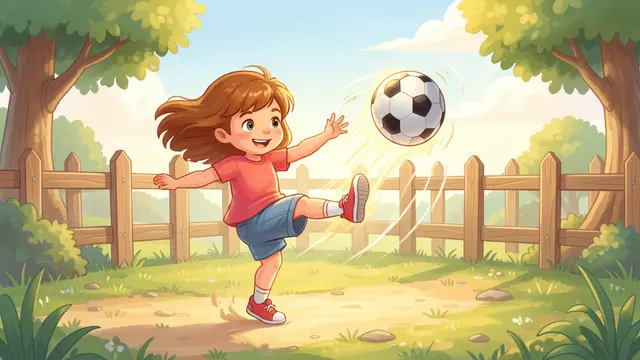
Nia kicked the ball as hard as she could. It flew over the fence!
Stuck? Say it out loud first. Who is in your story, and what do they want? What goes wrong? How does it end? It doesn’t have to be true.
“Print my story page” puts this starter on an illustrated A4 page, with its words, a checklist for the key stage and lines to carry on writing.
Prints every starter for the year group and theme chosen above, with the football word bank.
Make this into a Litsee story
In Litsee your child turns a first line like this into an illustrated story read aloud: they create the hero and choose what happens next. 7-day free trial; a card is needed to start.
The generator picks from a fixed list in your browser. It doesn’t use AI, and nothing you choose is saved or sent anywhere.
All 24 football story starters
KS1 (Years 1–2) · ages 5–7
- 1.Nia kicked the ball as hard as she could. It flew over the fence!
- 2.It was Max’s first football match. His new boots were very shiny.
- 3.The ball rolled into the woods. Jack ran after it.Has three “What happens next?” choices
- 4.Our team had no goalkeeper. Then Grandma put on the gloves.
- 5.It was raining, and the pitch was all mud. Splash! Splat! Slide!
- 6.Ali’s football could talk. It said, “Pass me to your friend!”
- 7.Sophie wanted to play, but the big children said she was too little.
- 8.The whistle blew. The match had started!
Years 3–4 · ages 7–9
- 9.Our team hadn’t won a single match all season, and today we were playing the champions.
- 10.Ellie was the best goalkeeper in Year 4, but she had a secret: she was terrified of penalties.
- 11.Five minutes before the final, the team’s captain, Marcus, still hadn’t arrived.Has three “What happens next?” choices
- 12.The new boy didn’t speak much English, but on the pitch he didn’t need to.
- 13.Jaden had practised his free kick a thousand times against the garage door. Now, with everyone watching, his legs felt like jelly.
- 14.The school had been told it was getting a new football pitch. Nobody expected it to be on the roof.
- 15.“Just pass it!” shouted the whole team. But Callum had a different idea.
- 16.Gran had played for the women’s team in her village in 1975, and she still had the boots to prove it.
Years 5–6 · ages 9–11
- 17.With one minute left and the scores level, the ball landed at the feet of the one player who had never scored a goal.
- 18.Lucia had been captain for two years. Now the coach wanted her best friend to wear the armband.
- 19.The powerchair football team had trained all year for the regional cup. On the morning of the match, their minibus wouldn’t start.Has three “What happens next?” choices
- 20.Everybody said Harbourside Juniors were the worst team in the county. Everybody was about to be proved wrong.
- 21.Dylan scored the winning goal, and only he knew that the ball had touched his hand on the way in.
- 22.The scout from the academy was standing on the touchline, and Tom had just been sent off.
- 23.When the floodlights failed, the match should have been abandoned. Instead, twenty-two players and one very determined referee decided to keep going.
- 24.The trophy had been in Riverside School’s cabinet since 1962. This year, someone was determined to take it home.
What happens next? Three choose-your-path starters
Read the starter, read the three choices aloud and let your child pick one, then write that part of the story.
Years 1–2
The ball rolled into the woods. Jack ran after it.
- He finds a team of rabbits who want to play.
- The ball is stuck high up in a tree.
- A girl he has never met kicks it back to him and asks to join in.
Years 3–4
Five minutes before the final, the team’s captain, Marcus, still hadn’t arrived.
- The coach asks the quietest player in the team to be captain.
- Marcus phones to say he is stuck on a broken-down bus, and the team makes a plan.
- Marcus turns up with someone the team did not expect.
Years 5–6
The powerchair football team had trained all year for the regional cup. On the morning of the match, their minibus wouldn’t start.
- The whole village helps to get the team there on time.
- The team decide to play the match online with the other side, and invent a new way to compete.
- An unlikely driver offers a lift, and the journey becomes its own adventure.
A football story recipe
A football story is rarely about the score. It is about a player who wants something and the match that tests them.
- 1
The player
Who are they and what do they want? To get picked, to score once, to be a good captain, to play at all.
- 2
The setback
Something gets in the way: an injury, a missed penalty, a new team, a falling-out with a friend.
- 3
The training
Show them practising, getting help or learning something new about themselves or the team.
- 4
The big match
Use short sentences and the present tense if you like, so it feels live.
- 5
The real win
The ending can be a goal, but it is better if the player wins something more important: a friend, confidence, respect.
Want to plan it on paper? Use the free story mountain template, fill in the five boxes online and print it.
Football words
Twelve words to use in a football story, with meanings a child can understand.
- tackle
- to try to win the ball from another player
- penalty
- a free shot at goal from a spot in front of the goalkeeper
- referee
- the person who makes sure everyone follows the rules
- captain
- the player who leads the team
- striker
- a player whose main job is to score goals
- defender
- a player who tries to stop the other team scoring
- dribble
- to run with the ball, tapping it with your feet
- tournament
- a competition with many matches
- substitute
- a player who comes on to take another player’s place
- equaliser
- a goal that makes the scores level
- teamwork
- working together to reach the same goal
- sportsmanship
- playing fairly and being kind whether you win or lose
Curriculum links
Where a football story fits the National Curriculum in England:
“the present and past tenses correctly and consistently including the progressive form”
Year 2, Writing – vocabulary, grammar and punctuation (statutory)
“composing and rehearsing sentences orally (including dialogue), progressively building a varied and rich vocabulary and an increasing range of sentence structures”
Years 3 and 4, Writing – composition (statutory)
How to use these with your child or class
Football starters are for the children who say they have nothing to write about. Many of them have watched, played and replayed hundreds of matches in their heads; they know exactly how a last-minute equaliser feels. A football story lets them use that knowledge, and they often write more than usual because they care how it ends.
Start by talking like a commentator. Read a starter aloud, then ask your child to commentate the next thirty seconds of the match out loud: “She’s got the ball, she’s past one defender, she looks up…” Commentary is spoken in the present tense, with short, fast sentences, and it is a brilliant oral rehearsal before writing. Then decide together whether to keep the present tense for excitement or switch to the past tense for a story. In Year 2, keeping that choice consistent is part of the curriculum, so point it out when it wobbles.
Make the story about the player, not just the score. A match report lists goals; a story shows what a player wants and what it costs them. Ask “What is your player scared of?” and “What would winning really mean to them?” The best football stories end with a win that is not on the scoreboard: a friendship mended, a fear faced, a fair decision made even when it meant losing.
Every child can be in a football story. The starters include girls’ and boys’ teams, a grandmother who played in the 1970s, a new pupil who is still learning English and a powerchair football team. When children invent their own team, encourage them to create players with different strengths and personalities, which also gives them more characters to write dialogue for.
Keep real clubs and famous players out of it. Children love writing about their heroes, but invented teams and players give them freedom to decide what happens, and the story stays theirs. A made-up club name with its own colours and nickname is a good five-minute warm-up on its own.
In class, try a “match in three halves”: the build-up (before the match), the action (one key moment, slowed right down) and the final whistle (how the players feel). Slowing down one moment is where the writing gets good. Ask for five sentences about a single kick: the run-up, the sound, the crowd, the ball in the air and the keeper’s dive.
Worked example: slowing down one kick (Years 3–4)
- Starter: “Jaden had practised his free kick a thousand times against the garage door. Now, with everyone watching, his legs felt like jelly.”
- Run-up: He took four steps back, just like in the garden.
- Sound: The crowd went quiet, and all he could hear was his own breathing.
- Moment: His boot struck the ball with a thump.
- Result: The ball curled past the wall, and the keeper’s fingers missed it by a centimetre.
About this page
Reviewed by Joshua Younger · How it works · Sources
Sources
The curriculum links on this page are copied word for word from these documents, with the year and section each applies to.
How it works
Reviewed by Joshua Younger, Education Lead, on .
Every starter is written for a year group and shown on these pages, so you always know what your child will see. The generator runs in your browser, and nothing your child chooses is sent anywhere. A finished story is kept on this device only if they press “Keep it on my shelf”.
Questions parents and teachers ask
How can football help a reluctant writer?
Children who love football already know how a match feels, so they have plenty to say. Let them commentate out loud first, then write. Short, focused tasks such as describing one kick in five sentences work better than a whole match report.
Should a football story be in the past or present tense?
Either works. Present tense feels like live commentary; past tense feels like a story being told. The important thing is to choose one and stick to it, which Year 2 pupils in England are taught to do.
Can children write about real football clubs and players?
It is better to invent them. A made-up team with its own name, colours and players gives children freedom to decide what happens, and the story becomes their own creation.
Are these football stories only for boys?
No. The starters include girls’ teams, mixed teams, a football-playing grandmother and a powerchair football team. Football stories are for anyone who enjoys the game.
Turn a starter into an interactive story your child can steer.
In Litsee, your child creates the hero, picks the world and chooses what happens next in an illustrated story that is read aloud.
Start your free trial7 days free. A card is needed to start, and nothing is charged if you cancel before the trial ends.