Help us improve Litsee

Analytics cookies to improve Litsee? No ads.

With your permission, Google Analytics measures visits and Microsoft Clarity records clicks, scrolling and page interactions, with form inputs and page text masked. We use no advertising cookies.

Change it any time with Cookie settings. Privacy policy · Google privacy · Microsoft privacy

SchoolsStart your free trialStart a free classroom trial
Free tools

Story mountain template (free, printable)

  1. 1 Plan
  2. 2 Tap
  3. 3 Keep

Example Leo and the Wild Storm

  1. OpeningLeo the dragon rider lived in a cave high on a windy hill.
  2. Build-upOne morning, they found an old map with a big red cross on it.
  3. ProblemThen a wild storm blew in, and they were swept far from home.
  4. ResolutionThey took a deep breath and were brave, one small step at a time.
  5. EndingBack home, everyone had a party with music and cake.

Plan your own story!

Free printable story mountain templates

Seven A4 sheets for KS1 and KS2, each in colour or ink-saving black and white. Press Print, or save the PDF. No sign-up, and nothing to pay.

Ink:
Prompts for:

The mountain sheets are landscape. If your printer turns one on its side, choose “Landscape” in the print window, or use the PDF. For a class display, print at A3 from the PDF.

Story mountain planner: write your own plan

Your plan is not saved. Nothing you type here is stored or sent anywhere. It stays on this page only until you close or refresh it, so print your plan when you have finished.

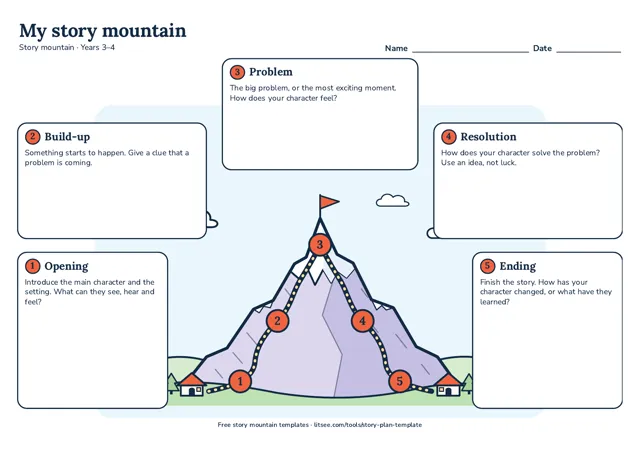
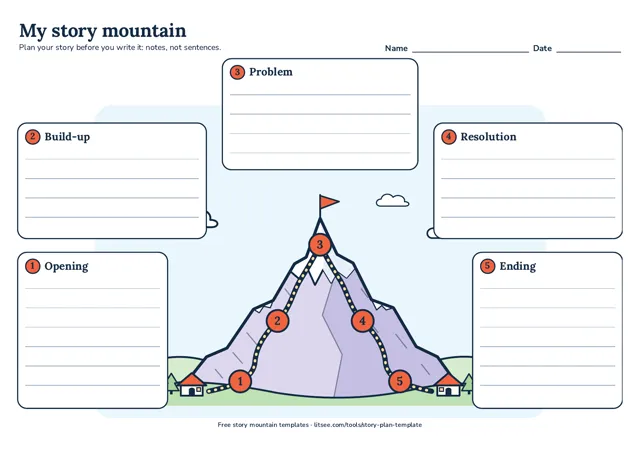
Five stages: opening, build-up, problem, resolution, ending. The prompts change with the year group.

Every box at once, for a quick plan.

0 of 5 parts planned

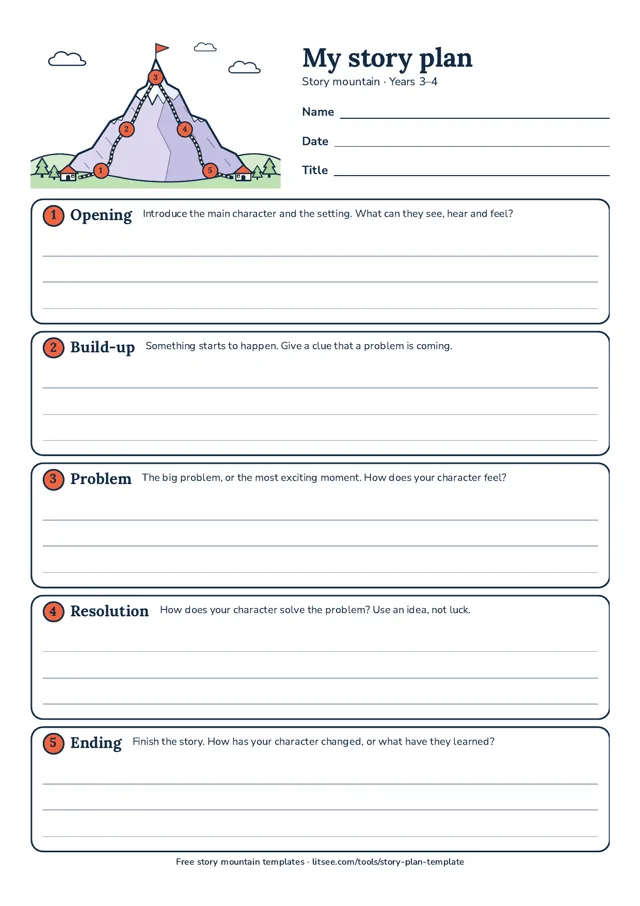
  1. 1 Opening

    Introduce the main character and the setting. What can they see, hear and feel?

  2. 2 Build-up

    Something starts to happen. Give a clue that a problem is coming.

  3. 3 Problem

    The big problem, or the most exciting moment. How does your character feel?

  4. 4 Resolution

    How does your character solve the problem? Use an idea, not luck.

  5. 5 Ending

    Finish the story. How has your character changed, or what have they learned?

Prints one A4 page with the story mountain and the prompts for Years 3–4 (landscape, on the mountain). To keep a copy, choose “Save as PDF” in your browser’s print window.

The five parts of a story mountain

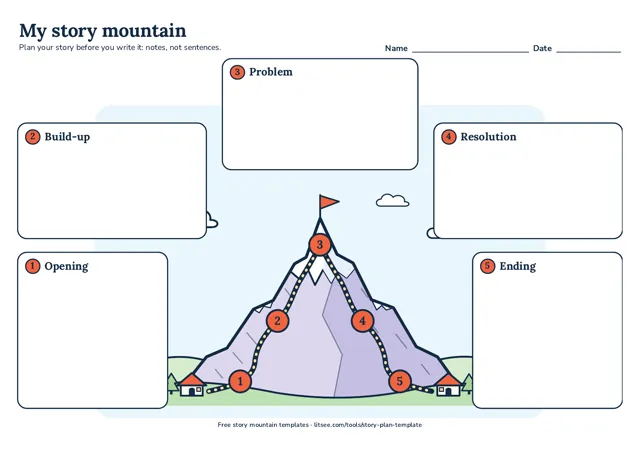
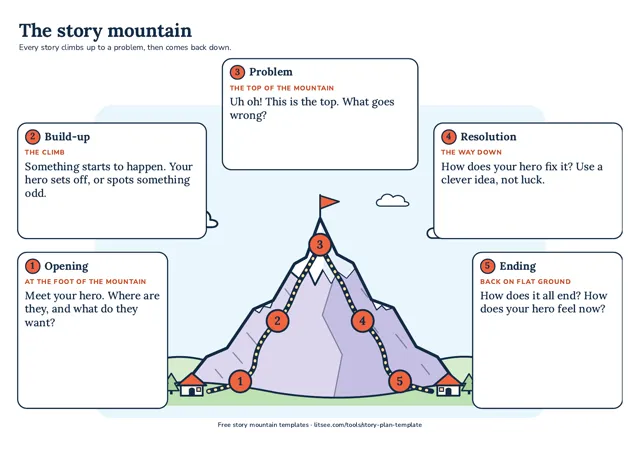
A story mountain shows the shape of a story: calm at the start, rising to the problem at the top, and back down to a settled ending. Each part has a job. Here is what to say to a child at each one, and what the grown-up helping can ask.

  1. Opening

    At the foot of the mountain

    Meet your hero. Where are they, and what do they want?

    For the grown-up helping

    Ask who, where and when. Two sentences are plenty: the opening only has to make us care about the hero before anything happens.

    Openers to borrow:

    • Once upon a time,
    • Early one morning,
    • In a little house by the sea,
  2. Build-up

    The climb

    Something starts to happen. Your hero sets off, or spots something odd.

    For the grown-up helping

    Ask “And then what?” two or three times. A small clue dropped in here makes the problem feel fair when it comes.

    Openers to borrow:

    • One day,
    • Later that morning,
    • Just then,
  3. Problem

    The top of the mountain

    Uh oh! This is the top. What goes wrong?

    For the grown-up helping

    The most exciting moment belongs here, in the middle, not in the last line. Ask how the hero feels, and slow down: this part earns the most words.

    Openers to borrow:

    • Suddenly,
    • Without warning,
    • All at once,
  4. Resolution

    The way down

    How does your hero fix it? Use a clever idea, not luck.

    For the grown-up helping

    Ask “What does your hero do?” The best fixes come from the hero’s own idea, courage or kindness, not from a lucky accident or a grown-up turning up.

    Openers to borrow:

    • Then they had an idea.
    • Thinking quickly,
    • Slowly and carefully,
  5. Ending

    Back on flat ground

    How does it all end? How does your hero feel now?

    For the grown-up helping

    Ask what is different from the opening. A last line that links back to the start makes a story feel finished.

    Openers to borrow:

    • At last,
    • From that day on,
    • Safe at home again,

Worked examples from real Litsee stories

Two free stories from this site, set out on the mountain. In a Litsee story the child chooses what happens, so each one has more than one way down: tap a different ending and watch the last two parts change. The problem stays the same; the hero’s choice changes the rest.

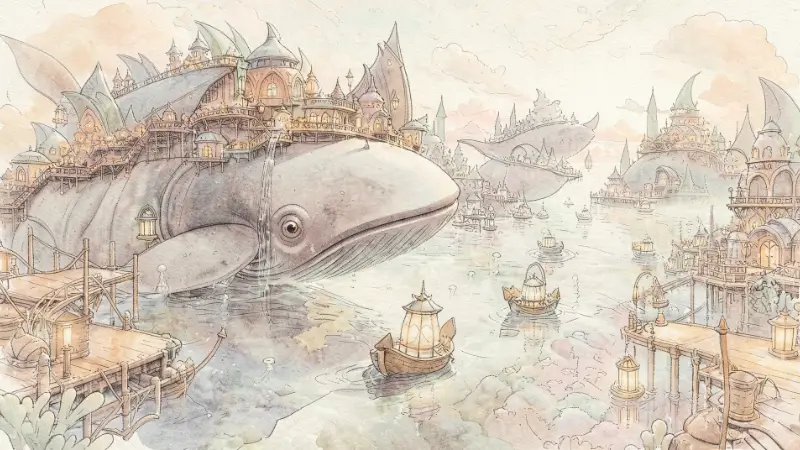
A painted city of little houses and towers on the back of a huge whale, with lantern boats on the calm water.

Ages 5–7

The Whale Who Lost Her Song

Choose the ending:
  1. OpeningWhale City sits on the back of Big Blue, a huge whale. Every evening she sings the little boats home.
  2. Build-upTonight Big Blue is quiet. The boats bob about on the water, lost in the mist.
  3. ProblemBig Blue has a sore throat. She can’t sing at all!
  4. ResolutionThe hero lights every lantern on the jetties. The boats see the glowing path and sail home.
  5. EndingBig Blue blinks happily. “You made a song of lights,” she says.
Read The Whale Who Lost Her Song free
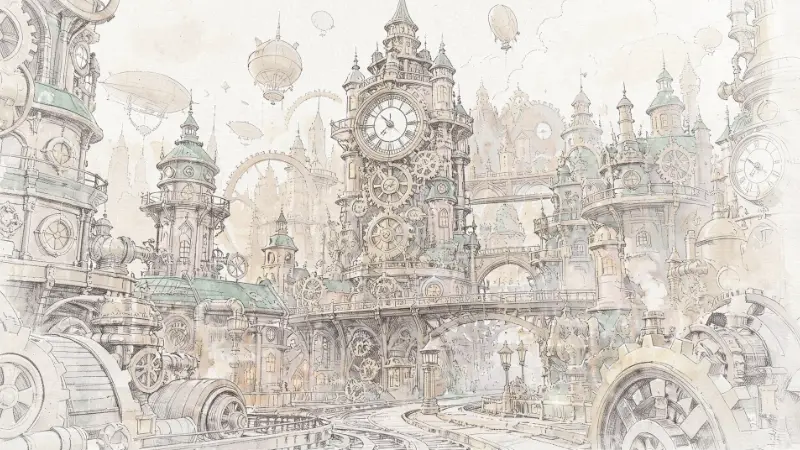
A painted city of towers and turning gears, with a great clock in the middle, bridges, steam pipes and airships in the sky.

Ages 8–10

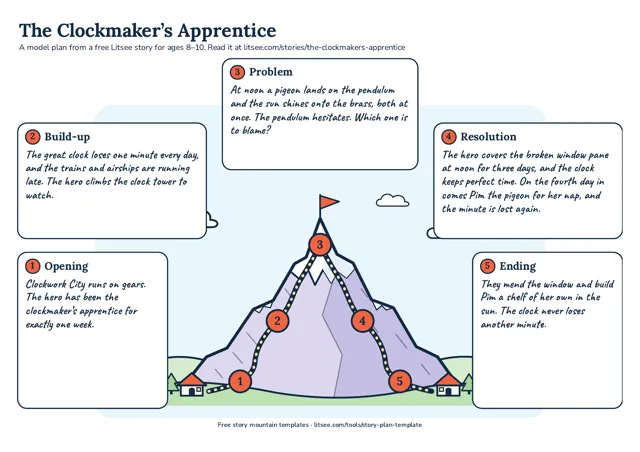
The Clockmaker’s Apprentice

Choose the ending:
  1. OpeningClockwork City runs on gears. The hero has been the clockmaker’s apprentice for exactly one week.
  2. Build-upThe great clock loses one minute every day, and the trains and airships are running late. The hero climbs the clock tower to watch.
  3. ProblemAt noon a pigeon lands on the pendulum and the sun shines onto the brass, both at once. The pendulum hesitates. Which one is to blame?
  4. ResolutionThe hero covers the broken window pane at noon for three days, and the clock keeps perfect time. On the fourth day in comes Pim the pigeon for her nap, and the minute is lost again.
  5. EndingThey mend the window and build Pim a shelf of her own in the sun. The clock never loses another minute.
Read The Clockmaker’s Apprentice free
For grown-ups: which plan for which age, the curriculum and questions

What your child practises: planning a story out loud before writing it: an opening, a build-up, a problem, how it is fixed and an ending. National Curriculum, Year 2, Writing – composition: “planning or saying out loud what they are going to write about”.

Seven free story mountain templates to print on A4 or save as PDFs: blank, with prompts for your child’s year group, lined, a draw-it version for KS1 and more, each in colour or black and white. Or fill the mountain in online and print it; the planner also has a beginning-middle-end plan for KS1 and a five-part boxed-up plan. There is no sign-up, and nothing you type is saved or sent anywhere.

How to use this plan at home or in class

A story plan is a short set of notes a child makes before writing, so that the story has a shape before the sentences start. The National Curriculum builds planning in from the start: Year 2 children plan by saying out loud or writing down what they will write about, Years 3 and 4 discuss and record ideas, and Years 5 and 6 note and develop their initial ideas. A plan on one page is the simplest way to do all of that.

Choose the template by age and confidence. In Litsee’s view, a beginning-middle-end plan suits KS1 and any child new to planning, because three boxes are easy to hold in your head. The story mountain suits most children from Year 2 to Year 6, and its shape shows where the excitement should be: in the middle, not at the end. The five-part boxed-up plan suits Years 4 to 6, when children write in paragraphs; each box becomes one paragraph, and the second column collects the words and sentences they want to use.

Fill the boxes with notes, not sentences. A plan is for thinking, so single words, arrows and quick phrases are fine. In KS1, children can draw in each box and an adult can write the words they say. The prompts in the planner change with the year group: simple questions for KS1, setting and paragraph prompts for Years 3 and 4, and tension, pace and planted details for Years 5 and 6.

Watch the top of the mountain. The most common problem with children’s stories is that the problem arrives in the last paragraph and is solved in one sentence. If the problem box is empty until the end, move it earlier, and make sure the resolution box says how the character solves it. Ask, “What does your character do?”

Using the page is simple. For paper, choose a template near the top, pick colour or black and white, and press Print or PDF. To plan on screen, tap “Plan my own” for ready-made ideas, which suits ages 5 to 7, or type your own notes into the planner and press “Print my plan”: a story mountain prints on the mountain itself. Nothing you type is saved or sent anywhere, so print or copy your notes before you close the page.

Different kinds of writing need different plans. The text-type templates below each have their own plan, a features list for KS1, Years 3–4 and Years 5–6, and a worked example. At home, plan out loud on the walk to school and fill in the boxes afterwards. In class, model a plan on the whiteboard, then print blank plans for the whole class.

Planning in the National Curriculum

  • “planning or saying out loud what they are going to write about”

    Year 2, Writing – composition (statutory)

  • “discussing and recording ideas”

    Years 3 and 4, Writing – composition (statutory)

  • “noting and developing initial ideas, drawing on reading and research where necessary”

    Years 5 and 6, Writing – composition (statutory)

Worked example: Mo and the Runaway Kite

A worked example written for this page, at the level of Years 3–4: first the plan, then the piece written from it.

  1. 1. Opening

    Mo has made a kite for the village kite festival, using Grandad’s old map of the valley as the paper.

  2. 2. Build-up

    On the hill the wind is strong, and Mo’s kite flies higher than all the others. Mo notices the string is fraying.

  3. 3. Problem

    The string snaps. The kite sails away over the woods, with Grandad’s map on it.

  4. 4. Resolution

    Mo watches which way the treetops bend to work out where the wind is taking it, and finds the kite in an apple tree in Mrs Grant’s garden. He knocks and asks for help.

  5. 5. Ending

    The kite is torn and misses the competition, but Mrs Grant was once a kite champion. Next year, she and Mo build one together.

The finished piece: Mo and the Runaway Kite

Mo had made his kite from Grandad’s old map of the valley, and he was sure it was the best kite at the festival.

Up on the hill, the wind tugged hard. Mo’s kite climbed higher than all the others, a little square of rivers and roads against the sky. Then Mo noticed the string. It was fraying.

Snap! The kite leapt free and sailed away over the woods, taking Grandad’s map with it.

Mo didn’t panic. He watched the treetops. They were all bending the same way, towards the village, so he ran that way too, until he spotted a flash of paper in an apple tree in Mrs Grant’s garden. He took a deep breath and knocked on her door.

The kite was too torn to fly in the competition. But Mrs Grant, it turned out, had once been the kite champion of the whole county. “Next year,” she said, “we’ll build one together.”

Plan templates by text type

Each template has its own plan, a features list for KS1, Years 3–4 and Years 5–6, and a worked example.

  • Fiction

    Adventure story template

    To entertain the reader with an exciting journey or quest, in which a hero meets challenges and comes back changed.

  • Fiction

    Traditional tale template

    To entertain, and often to teach a lesson, using patterns passed down by storytellers for generations.

  • Fiction

    Myth template

    To entertain and to explain: a myth tells how something in the world came to be, or shows a hero tested by powerful beings.

  • Recount

    Diary template

    To record events and feelings in the order they happened, written for the writer alone or in role as a character.

  • Letter

    Letter template

    To communicate with a particular reader: to thank, inform, ask, invite, complain or keep in touch.

  • Recount

    Newspaper report template

    To inform readers about a real or imagined event that has just happened, clearly and fairly.

  • Non-fiction

    Non-chronological report template

    To give the reader facts about a topic, organised by subject rather than by time.

  • Non-fiction

    Instructions template

    To tell the reader exactly how to make or do something, step by step, so that they can follow it without help.

  • Non-fiction

    Persuasive writing template

    To convince the reader to agree with a point of view, or to do something.

  • Poetry

    Poem template

    To share a feeling, a picture or an idea in a few carefully chosen words, often to be read aloud or performed.

About this page

How it works · Sources

Sources

The quotations on this page are copied word for word from this document. The prompts, the advice on which plan suits which age, what to say at each part and the worked examples are Litsee’s guidance; the two story examples retell free Litsee stories on this site.

How it works

The planner runs in your browser. Nothing you type is saved, stored or sent anywhere, and it disappears when you close or refresh the page.

Last updated: .

Questions parents and teachers ask

What is a story mountain?

A story mountain is a planning template shaped like a hill. It shows a story’s five parts in order: the opening and build-up on the way up, the problem at the top, and the resolution and ending on the way down. It is one kind of story writing frame: boxes and prompts that help a child plan a story before writing it.

What are the five parts of a story mountain?

Opening, build-up, problem (also called the climax or dilemma), resolution and ending. Each part usually becomes at least one paragraph in KS2.

Story map or story mountain: which suits KS1?

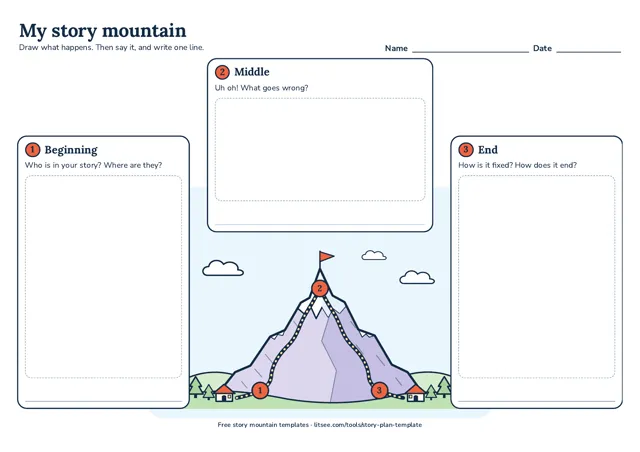
For Year 1, or any child new to planning, start with a story map: draw the story’s journey as small pictures joined by a path, then retell it out loud. The Draw-it mountain template on this page works the same way: a beginning, a middle and an end, with a big space to draw in each. From about Year 2, the story mountain adds the problem and resolution.

Is my plan saved anywhere?

No. The planner runs in your browser and does not save, store or send anything you type. It disappears when you close or refresh the page, so print it, or use your browser’s print option to save it as a PDF.

Can I print a blank story mountain template?

Yes. Press “Print a blank template” at the top of the page for a blank story mountain on one A4 sheet. Underneath are seven templates: blank, with prompts for KS1, Years 3–4 or Years 5–6, with lined boxes, a draw-it version for KS1 and more. Each comes in colour or black and white and as a PDF, with no sign-up.

From plan to story: let your child steer an interactive story.

In Litsee, your child creates the hero, picks the world and chooses what happens next in an illustrated story that is read aloud.

Start your free trial

7 days free. A card is needed to start, and nothing is charged if you cancel before the trial ends.

See plans and pricing · How Litsee works

Try it in LitseeYour child creates the hero, picks the world and chooses what happens next, in an illustrated story that is read aloud.Start your free trialUse it in classRead an illustrated, narrated story together on the whiteboard, and let the class choose what happens next.Start a free classroom trialSee Litsee for schools