
KS1 story starters
- 1 Choose
- 2 Read
- 3 Make
- 4 Keep
Choose your story starter
For Years 1–2 (age 5–7)
For grown-ups: every starter, the full generator, the curriculum and questions
What your child practises: carrying a story on from its first line: choosing what happens next, what the character does and how it ends, then writing the next page. National Curriculum, Year 2, Writing – composition: “writing narratives about personal experiences and those of others (real and fictional)”.
Here are KS1 story starters for Years 1 and 2 (ages 5–7): a generator with 112 starters, how story writing grows from the start of Year 1 to the end of Year 2, example openings with notes, and ways to share one starter across a mixed class.
Reviewed by Joshua Younger, Education Lead, on .
Every starter: the full generator
Story starter generator
Only starters that come with three choices for what happens next.
Pick a world
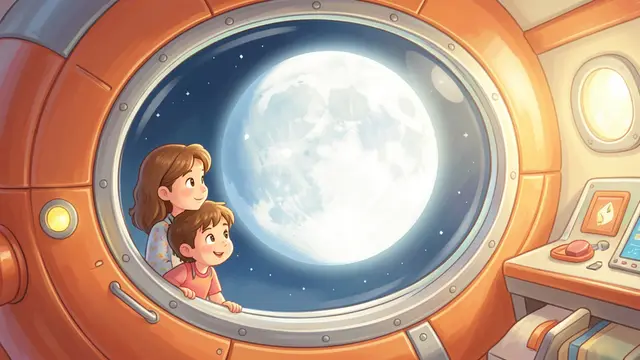 Moon Base
Example starter · Space · Years 1–2
Zara looked out of the rocket window. The Moon was getting bigger and bigger.
Stuck? Say it out loud first. Who is in your story, and what do they want? What goes wrong? How does it end? It doesn’t have to be true.
“Print my story page” puts this starter on an illustrated A4 page, with its words, a checklist for the key stage and lines to carry on writing.
Prints every starter for the year group and theme chosen above.
Make this into a Litsee story
In Litsee your child turns a first line like this into an illustrated story read aloud: they create the hero and choose what happens next. 7-day free trial; a card is needed to start.
The generator picks from a fixed list in your browser. It doesn’t use AI, and nothing you choose is saved or sent anywhere.
One idea, two years
The same story idea, written the way a Year 1 and a Year 2 child might be helped to write it. It shows what “progress” looks like in KS1.
- Year 1The kite went up. It went up and up and up.
- Year 2When the wind blew, Ella’s bright red kite pulled her up into the fluffy clouds.
How story writing grows across KS1
In two years, a child goes from saying a sentence before writing it to planning, checking and reading aloud a short story of their own. Here are five parts of that journey, from the first weeks of Year 1 to the end of Year 2. Our descriptions are a guide to typical steps, not an assessment scale; under each, the statutory wording from the National Curriculum in England.
Talking about the story
- Start of Year 1
- The story lives in talk. A child tells you what happens, you chat about it, and one sentence at a time travels from their voice onto the page.
- End of Year 2
- Children start to judge their own work with a partner or an adult: which part they like best, which word could be better, what the reader still needs to know.
“discuss what they have written with the teacher or other pupils”
Year 1, Writing – composition (statutory)
“evaluating their writing with the teacher and other pupils”
Year 2, Writing – composition (statutory)
Planning
- Start of Year 1
- A plan is spoken or drawn: three quick pictures for the beginning, the middle and the end, with no writing at all.
- End of Year 2
- A few key words go under each picture, including a new word the child wants to use, so the plan keeps hold of their best vocabulary until they need it.
“writing down ideas and/or key words, including new vocabulary”
Year 2, Writing – composition (statutory)
Sentences
- Start of Year 1
- One idea per sentence. Capital letters appear for names and for “I”, and full stops begin to land in the right places.
- End of Year 2
- Sentences change shape on purpose: a question to make the reader wonder, an exclamation such as “What a mess!”, a command in a character’s voice.
“using a capital letter for names of people, places, the days of the week, and the personal pronoun ‘I’”
Year 1, Writing – vocabulary, grammar and punctuation (statutory)
“sentences with different forms: statement, question, exclamation, command”
Year 2, Writing – vocabulary, grammar and punctuation (statutory)
Checking
- Start of Year 1
- Checking means reading it back, finger under each word, to hear whether it makes sense and whether a word is missing.
- End of Year 2
- Checking becomes proof-reading: hunting for a missing full stop, a capital in the wrong place or a word spelled two different ways.
“re-reading what they have written to check that it makes sense”
Year 1, Writing – composition (statutory)
“proof-reading to check for errors in spelling, grammar and punctuation [for example, ends of sentences punctuated correctly]”
Year 2, Writing – composition (statutory)
Sharing
- Start of Year 1
- Reading the story to the class or a grown-up, loudly enough for everyone to hear.
- End of Year 2
- Reading it with expression, so a listener can hear the surprise, the question and the happy ending.
“read aloud their writing clearly enough to be heard by their peers and the teacher”
Year 1, Writing – composition (statutory)
“read aloud what they have written with appropriate intonation to make the meaning clear”
Year 2, Writing – composition (statutory)
What good looks like: two KS1 openings
Two openings to the same starter, one from early in Year 1 and one from late in Year 2. Both were written by Litsee to show the difference: they are not real pupils’ work, and they are not official exemplification or assessment standards.
Starter: “The garden gate had started to sing.”
Example written by Litsee · Start of Year 1
The gate was singing. It sang a song abowt cats. I sang the song to and the cat came.
What is working
- Three sentences in the right order: what happened, what the song was, what happened next.
- Capitals begin every sentence, and “I” is always a capital.
- “abowt” and “to” (for too) follow the sounds the child has learned. Praise the sounds they heard, and teach one spelling, not both.
- “and” joins two ideas in the last sentence.
Next step: Before writing, try the next sentence aloud: what did the cat do?
Example written by Litsee · End of Year 2
When I opened our creaky garden gate, it started to sing a happy, wobbly song. Was it singing to me? I listened carefully because the words were all about a lost red ball. What a funny song it was!
What is working
- Expanded noun phrases (“our creaky garden gate”, “a happy, wobbly song”) help the reader picture the scene.
- “When” and “because” join ideas and explain them.
- A question and an exclamation (“What a funny song it was!”) change the shape of the sentences.
- The tense stays in the past all the way through: opened, started, listened, was.
Next step: Plan the middle in three key words: where is the lost ball, and how does the gate help?
Choosing and differentiating starters for a mixed KS1 class
Choose the starter for the story it sets up, not for the year on the label. If you teach Year 1 and Year 2 together, or a class with a wide spread of writers, one shared starter keeps everyone in the same story and lets the whole class talk about it together. The difference is in what each child does next.
Good whole-class starters at this age are short enough to read aloud twice, name something children can picture, and leave one clear question: who did it, where did it go, what happens now? A sound or a surprise (a knock, a splash, a sneeze) gives younger writers something to act out before they write.
Set the generator above to KS1 for a shared starter, or to Year 1 or Year 2 to narrow the choice. Choose-your-path mode turns the next step into a class vote.
One starter, three ways in
“Someone had left a muddy footprint on the classroom ceiling.”
- More support
- Act the story out with a partner, draw three boxes, then write the middle sentence with an adult, using the stem “It was …” and word cards for muddy, ceiling and footprint.
- On track
- Write three sentences (how it starts, what happens, how it ends) and link two ideas using “and”. Read each one back with a finger under the words.
- Ready for more
- Ask “Who could walk on the ceiling?” and answer it. Use “because” once, and a describing phrase such as “a huge, muddy footprint with five round toes”.
Let children move between the three. A child who started with support but has a sentence ready to go should write it themselves.
Year 1, Year 2 and theme pages
This page covers KS1 as a whole. For a full list of starters, open a year page or a theme.
- Year 1
Twenty very short starters, the Year 1 writing statements and a routine for turning a spoken sentence into a written one.
- Year 2
Twenty longer starters, with practice building noun phrases and explaining with “because” and “when”.
Every theme page has eight KS1 starters, a story recipe and twelve theme words. Pick the one your child or class will care about most:
- Space: rockets, moons and a friendly alien, good for describing what a character can see
- Dinosaur: eggs that rock and dinosaurs in the wrong place, easy to act out
- Mystery: missing teddies and trails of crumbs, each one asking “who did it?”
- Adventure: maps, kites and tiny doors, with a clear journey from beginning to end
- Football: matches, muddy pitches and a ball that talks, for children who would rather be outside
- Dragon: small dragons with big problems and funny mistakes to put right
- Pirate: ships, parrots and treasure, with plenty of names that need capital letters
- Fantasy: wands, fairies and magic that goes slightly wrong
- Christmas: stockings, robins and surprises on the roof (seasonal, so the generator offers them only when you choose Christmas)
- Winter: snow days, icy ponds and sleepy hedgehogs, with no Christmas in them
How to use these with your child or class
Every KS1 story can follow the same four steps: talk, plan, write and edit. Keep them in that order and keep each one short. A whole story fits into two short sessions, one for talking and planning and one for writing and editing; that is our suggestion, not a rule. The worked example below follows one starter through every step.
Talk. Read the starter aloud twice, then ask, “So what happens now?” Your child tells the whole story out loud, as many times as they like, while you listen and ask one or two questions: who is there, what goes wrong, how does it end? Acting it out with toys works well at this age.
Plan. Fold a sheet into three boxes, one each for how it starts, what happens and how it ends, and let your child draw in each. In Year 2, add two or three key words under each picture. The plan is a memory aid, not a piece of writing, so keep it quick.
Write. One sentence at a time: your child says it aloud, puts it on paper, then reads it back to you. If your child gets stuck, point to the next picture and ask them to tell you about it. Scribe or share the writing when handwriting is slowing the story down; the ideas are theirs either way.
Edit. Choose one thing to check, not everything: full stops in Year 1, or one better word in Year 2. Then your child reads the finished story to someone new. That reading is the reward: it is the moment a young child sees themselves as an author.
At home, the steps fit around ordinary life: talk on the walk to school, plan at the kitchen table, write before tea. In class, talk and planning work well in pairs, and the edit can be a quick swap with another table.
Worked example: one starter through all four steps
- Starter: “There was a fish in the paddling pool this morning.”
- Talk: “It came in the rain. It wants to go home to the sea. We take it in a bucket.”
- Plan: three pictures (the fish in the pool, the bucket, the waves) with the key words splash, bucket and waves.
- Write: The fish came in the rain. We put it in a bucket and walked to the sea It swam away with a big splash.
- Edit: reading it back, your child hears that a full stop is missing after “sea” and adds it, then swaps “walked” for “hurried”. Last, the story is read aloud to Grandma.
About this page
Reviewed by Joshua Younger · How it works · Sources
Sources
The curriculum quotations on this page are copied word for word from this document, with the year and section each applies to. The example openings, plans and class ideas are Litsee’s own, written for this page.
How it works
Reviewed by Joshua Younger, Education Lead, on .
Every starter is written for a year group and shown on these pages, so you always know what your child will see. The generator runs in your browser, and nothing your child chooses is sent anywhere. A finished story is kept on this device only if they press “Keep it on my shelf”.
Questions parents and teachers ask
What is KS1?
Key Stage 1 is the first stage of primary school in England after Reception. It covers Year 1 (ages 5–6) and Year 2 (ages 6–7).
How long should a KS1 story be?
As a rough guide, three to five sentences in Year 1 and six to ten in Year 2, always with a beginning, middle and end. That is Litsee’s suggestion; the curriculum sets no length.
Should KS1 children plan a story?
Yes, but by talking and drawing more than writing. Year 1 children are taught to say what they will write about first; Year 2 children plan by saying or jotting down ideas and key words. A three-box picture plan works for both.
How do I use one starter with a mixed Year 1 and Year 2 class?
Share one starter and talk about it together, then vary the task: an acted-out story with one supported sentence, three sentences joined with “and”, or a story that adds “because” and a describing phrase. Let children move up when they are ready.
Which starters should I use with a Reception child?
Use the Year 1 starters, read them aloud and let your child tell the rest of the story while you write it down or they draw it. This page focuses on Years 1 and 2.
Turn a starter into an interactive story your child can steer.
In Litsee, your child creates the hero, picks the world and chooses what happens next in an illustrated story that is read aloud.
Start your free trial7 days free. A card is needed to start, and nothing is charged if you cancel before the trial ends.