

FOR PARENTS AND TEACHERS · YEARS 1–6
Reading comprehension practice, Year 1 to Year 6 (free, with answers)
Here are six short original passages, Year 1 to Year 6, each with questions, answers and the reading skill each question practises. Print them or read on screen; nothing is saved.
Free to print: six practice passages
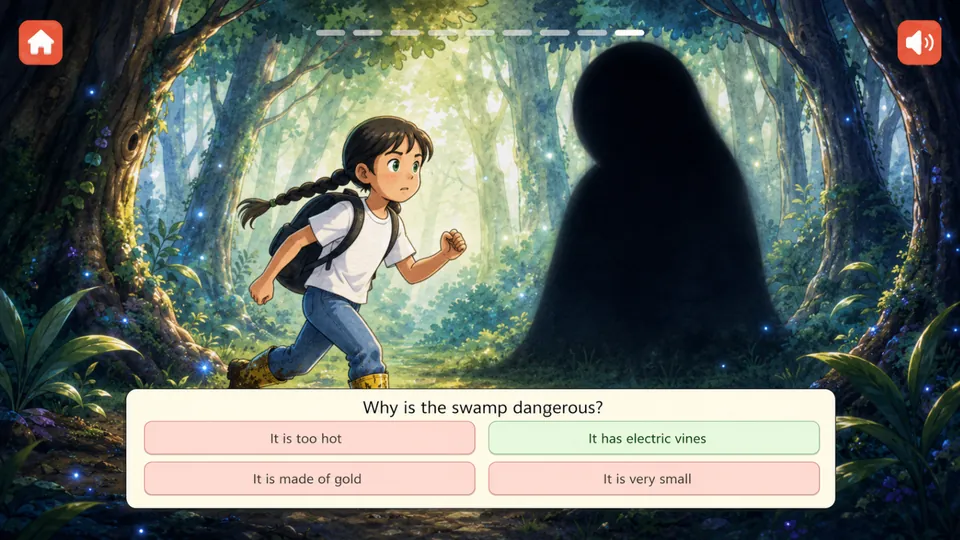
How Litsee helps: illustrated stories with optional questions about what happened, at your child's level.
Start your free trial7 days free. A card is needed to start.
Six passages, one per year group, written at the reading level Litsee uses for each age, with questions on the skills schools teach and answers that explain the clue. Read one together, and stop while it's still fun.
By Joshua Younger, Education Lead · Published · Updated · About this guide
How to use this page
Choose your child's year, read the passage together, then ask the questions out loud. Open an answer only after your child has had a go, and talk about the clue in the text. If a passage is too easy or too hard, try the year either side: these are rough levels, not targets.
On talking about books, the DfE's tips for parents say: “This is a great way to make connections, develop understanding and make reading even more enjoyable.” (DfE).
The six passages
Your choice is kept only in the page address.
Year 1: The lost hat
Pip had a red hat. The wind came. Off went the hat!
It flew over the wall. It landed on a duck. The duck did not mind.
Pip ran to the pond. “Can I have my hat back?” she said. The duck swam off with it.
- What colour was Pip's hat? 1b
Show the answer
Red.
- What happened after the wind came? 1c
Show the answer
Pip's hat blew off, flew over the wall and landed on a duck.
- How do you think Pip felt when the duck swam off? 1d
Show the answer
Cross, sad or surprised: any feeling she might have, with a reason.
Written by Litsee for practice · litsee.com/guides/reading-comprehension-practice
Year 2: The new bike
Sam's new bike was shiny and blue. He had wanted it for a whole year.
On Saturday, Dad held the seat while Sam pedalled down the path. “Don't let go!” Sam shouted.
At the end of the path, Sam looked back. Dad was standing by the gate, waving. He had let go ages ago.
- How long had Sam wanted the bike? 1b
Show the answer
A whole year.
- What does “pedalled” mean? 1a
Show the answer
Pushed the pedals round with his feet to make the bike move.
- What did Sam find out at the end of the path? 1d
Show the answer
That he had been riding on his own: Dad had let go long before, so Sam could ride by himself.
Written by Litsee for practice · litsee.com/guides/reading-comprehension-practice
Year 3: Night at the museum
Our class slept over at the museum. We unrolled our sleeping bags under a dinosaur skeleton so tall that its head disappeared into the shadows.
Just after midnight, I heard a creak. Then another. Mia grabbed my arm. “It's moving,” she whispered.
I switched on my torch. The beam wobbled across the bones, and there, at the dinosaur's feet, was Mr Patel, tiptoeing back from the toilet.
- Where did the class sleep? 2b
Show the answer
In the museum, under a dinosaur skeleton.
- Why did Mia grab the narrator's arm? 2d
Show the answer
She was frightened: she thought the dinosaur was moving.
- Why does the writer say the dinosaur's head “disappeared into the shadows”? 2g
Show the answer
To show how huge and dark it was, which makes the night feel a bit spooky.
Written by Litsee for practice · litsee.com/guides/reading-comprehension-practice
Year 4: Hedgehogs in winter
When the weather turns cold, food becomes hard to find. Hedgehogs survive by hibernating: they build a nest of leaves, curl up and slow their bodies right down.
During hibernation, a hedgehog's heart beats much more slowly and its body cools. It lives on the fat it stored by eating well in the autumn.
You can help by leaving a wild corner in the garden, with a pile of leaves or logs, and by checking bonfires before they are lit.
- What do hedgehogs build their nests from? 2b
Show the answer
Leaves.
- What does “hibernating” mean in this text? 2a
Show the answer
Sleeping through the winter with the body slowed right down.
- Why should people check bonfires before lighting them? 2d
Show the answer
A hedgehog might be hibernating inside the pile of wood or leaves.
Written by Litsee for practice · litsee.com/guides/reading-comprehension-practice
Year 5: The last match
Zara had never missed a penalty. Not in training, not in the park, not even against her brother, who cheated.
Now the whole school was watching. The ball felt heavier than usual. She placed it on the spot, stepped back three paces and stared at the bottom corner, the way she always did.
Then she glanced up. The goalkeeper was grinning, already leaning left. Zara's stomach turned over. She took a breath, ran, and sent the ball high into the right-hand corner.
- Find and copy a phrase that shows Zara felt nervous. 2g
Show the answer
“The ball felt heavier than usual” or “Zara's stomach turned over”.
- Why did Zara change where she aimed? 2d
Show the answer
The goalkeeper was already leaning left, expecting her usual shot, so she aimed the other way.
- How does the first paragraph make the ending more exciting? 2f
Show the answer
It tells us she has never missed, so we worry this could be the first time.
Written by Litsee for practice · litsee.com/guides/reading-comprehension-practice
Year 6: The lighthouse keeper's log
12 March. Storm worse tonight. The lamp has been lit since four o'clock, though it felt like midnight. Waves are breaking over the lower rocks.
13 March. A fishing boat, the Marigold, was sighted at dawn, limping towards the harbour with a torn sail. I signalled the lifeboat. Every crew member was brought ashore.
14 March. Calm at last. The sea is grey and flat, as if nothing happened. Mrs Hale from the village brought bread and would not hear a word of thanks. It is the quiet days that make the long nights bearable.
- What does “limping” suggest about the boat? 2a
Show the answer
It was damaged and moving slowly and unevenly, like an injured animal.
- Summarise what happened over the three days. 2c
Show the answer
A bad storm, a damaged fishing boat rescued with the lifeboat's help, then calm weather and thanks from the village.
- How is the sea on 14 March different from the sea on 12 March? 2h
Show the answer
On 12 March it is wild, with waves breaking over the rocks; on 14 March it is calm, grey and flat.
- Why might Mrs Hale have brought bread? 2d
Show the answer
To thank the keeper for helping save the crew, even though she wouldn't accept the keeper's thanks.
Written by Litsee for practice · litsee.com/guides/reading-comprehension-practice
What the skill codes mean
The codes come from the Standards and Testing Agency's reading test frameworks. Year 1 and 2 questions use the Key Stage 1 codes (STA KS1 framework), and Year 3 to 6 the Key Stage 2 codes (STA KS2 framework).
| Code | Skill |
|---|---|
| 1a | draw on knowledge of vocabulary to understand texts |
| 1b | identify / explain key aspects of fiction and non-fiction texts, such as characters, events, titles and information |
| 1c | identify and explain the sequence of events in texts |
| 1d | make inferences from the text |
| 1e | predict what might happen on the basis of what has been read so far |
| 2a | give / explain the meaning of words in context |
| 2b | retrieve and record information / identify key details from fiction and non-fiction |
| 2c | summarise main ideas from more than one paragraph |
| 2d | make inferences from the text / explain and justify inferences with evidence from the text |
| 2e | predict what might happen from details stated and implied |
| 2f | identify / explain how information / narrative content is related and contributes to meaning as a whole |
| 2g | identify / explain how meaning is enhanced through choice of words and phrases |
| 2h | make comparisons within the text |
The DfE's reading framework cautions that “the domains as a whole should not be used as a framework for teaching reading”, and that doing so “will restrict pupils’ access to the wider national curriculum and is likely to inhibit their enjoyment of reading” (DfE reading framework). The codes are here so you know what each question practises, not to drill one skill at a time.
Getting the most from it
- Ask, don't test. Say “I wonder…” as often as “What is…?”.
- Look back. Encourage your child to find the answer in the text rather than guess.
- Accept good reasons. Inference questions can have more than one good answer if the clue supports it.
- Keep it short. One passage is plenty. Then read something they've chosen.
The national curriculum's aim is for children to “develop the habit of reading widely and often, for both pleasure and information” (DfE national curriculum), so the best comprehension practice is lots of reading of every kind. For inference in particular, see inference at home. For Year 6 tests, see our guide to the SATs reading paper.
Questions people ask
Where can I find free reading comprehension practice for my child?
This page has six short passages we wrote, one for each year from Year 1 to Year 6, with questions and answers you can print. Your child's school reading book and library books work just as well: ask a few questions about what they've read.
What kinds of questions are in comprehension tests?
The STA's test frameworks list the skills: vocabulary, finding information, sequencing or summarising, inference, prediction, and in Key Stage 2 how the text is organised, the effect of word choices and making comparisons. Each question on this page names the skill it practises.
How often should my child do comprehension practice?
There's no official amount. Talking about any book you read together is practice, and it's more enjoyable than worksheets. The DfE's reading framework warns that organising reading around test skills is likely to inhibit children's enjoyment of reading.
Are these passages like the SATs reading paper?
The questions practise the same skills, but the passages are much shorter. The real Year 6 reading paper has longer texts and 50 marks in 60 minutes. Use these for short, relaxed practice, not timed tests.
Sources
- Key stage 1: English reading test framework Standards and Testing Agency, updated 20 May 2024, checked 3 November 2026
- Key stage 2: English reading test framework Standards and Testing Agency, 2015, for tests from 2016, checked 3 November 2026
- National curriculum in England: English programmes of study (key stages 1 and 2) Department for Education, September 2013, updated 16 July 2014, checked 3 November 2026
- The reading framework Department for Education, July 2023, updated 22 September 2023, checked 3 November 2026
- 10 top tips for parents to support children to read Department for Education, 16 July 2020, updated 25 April 2022, checked 3 November 2026
About this guide
Written by Joshua Younger, Education Lead at Litsee, and checked line by line against the sources listed on this page.
All six passages, questions and answers were written by Litsee for this page. The skill codes are copied from the STA's reading test frameworks. Teachers are welcome to print the passages for classroom use.
Spotted something wrong or out of date? Email info@litsee.com and we will fix it. Facts last checked: .
Stories at their level, every day
In Litsee your child picks the hero and decides what happens next, in an illustrated story written for their age.
Start your free trialA card is needed to start the trial, and nothing is charged if you cancel before it ends. See plans and pricing