
FREE INTERACTIVE STORY · AGES 9–11
The Library Under the Sand: a free interactive story
On a dig in the desert ruins, our hero and a young archaeologist uncover a stone tablet carved in three scripts, and a door that will not open. Your child makes two choices about how to decode the tablet, and each path finds a different secret behind the door.
- Reading age 10
- 2 short chapters, 2 choices and 4 endings
- About 3 minutes
- History
Read the story
Choose your hero
Paint it your way
Chapter 1Three ways of writing
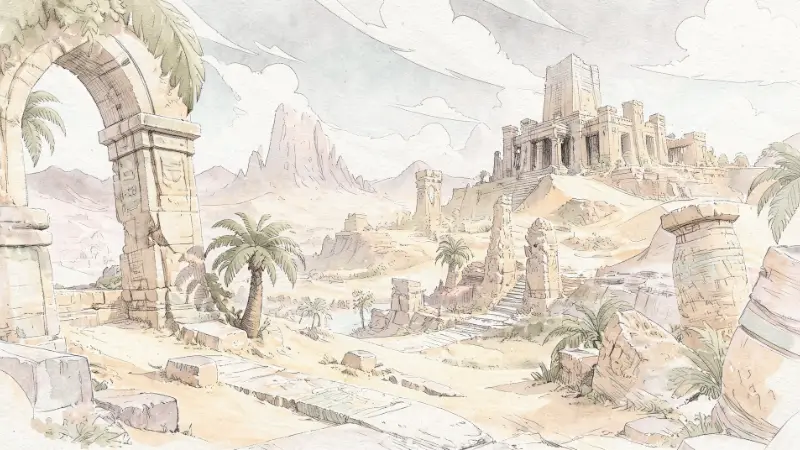
The ruins rose out of the desert like the bones of a forgotten city: broken arches, half-buried pillars and, on the hill, a temple with its doorway sealed by a single slab of stone.
Dr Hana Saleh, a young archaeologist, had been digging here for three seasons. This morning, her brush uncovered something that made her sit back on her heels: a flat tablet, carved in three different kinds of writing.
“The top two are scripts nobody has read for a thousand years,” she said. “But the bottom one is an old form of a language we do know. If all three say the same thing…”
“…then the one we know is a key to the other two,” Ruby finished, feeling a shiver of excitement.
Beside the sealed doorway was a ring of carved symbols, the same as those in the top line of the tablet. Whatever the tablet said, the door was waiting to hear it.
What happens next is up to your child
How should Ruby start decoding?
Questions for grown-ups to ask
Did you spot it?
- EasyHow many kinds of writing were on the tablet?Answer: Three.
- MediumWhy could the known script help read the others?Answer: If all three said the same thing, the known one was a key to the other two.
- HarderDr Saleh says stories carry facts “if you know which parts to trust”. What does she mean?Answer: That old stories passed down in families can hold real information, mixed with parts that changed in the retelling.
Talk about it
- Which ending had the most precious treasure: books, seeds, star maps or paintings? Why?
- Have you ever solved a puzzle by looking for patterns? How did it work?
Words to talk about
- archaeologist
- A person who digs up and studies things from the past.
- script
- A system of writing, such as an alphabet.
- decoding
- Working out what a coded or unknown message means.
- drought
- A long time without rain.
Reading it together
The Library Under the Sand is an archaeology mystery at Litsee’s reading level for age 10, inspired by the real way the Rosetta Stone helped people read Egyptian hieroglyphs: the same message written in a known and an unknown script.
Both choices weigh two kinds of evidence: careful comparison, and an old family story. Talk about when each is useful, and why Dr Saleh doesn’t dismiss Omar’s grandmother’s story.
Make a three-line code together: write a short sentence in English, then in made-up symbols, and see whether someone else can crack it using the English line as the key.
About this story
- Reading age
- 10 (ages 9–11). Written for Litsee’s reading level for age 10, where sentences are mostly 11–20 words long.
- Length
- 2 short chapters, 2 choices and 4 endings. Each way through is 344–365 words.
- Reading time
- About 3 minutes for a 10-year-old reading on their own, at Litsee’s pacing of 130 words a minute for that age. Reading aloud to your child is usually quicker.
- Book band
- Roughly Dark Blue, if your child’s school uses book bands (schemes differ; see our book bands guide).
- Characters
- Dr Hana Saleh, a young archaeologist, Omar, the dig’s cook, who knows the desert
- Theme
- History