Help us improve Litsee

With your permission, Google Analytics measures visits and Microsoft Clarity records clicks, scrolling and page interactions, with form inputs and page text masked. We use no advertising cookies.

Change it any time with Cookie settings. Privacy policy · Google privacy · Microsoft privacy

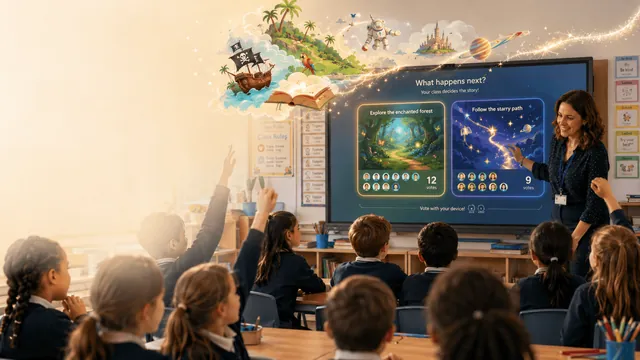
An illustration of a class reading a Litsee story on the whiteboard and voting on what happens next.

FREE TEACHER STORY UNIT · KS1 AND KS2

Library visit story lesson for KS1 and KS2

A class story about the public library, for before or after a class visit. KS1 join the library for the first time and choose a book to borrow; KS2 follow a puzzle trail using the catalogue and the shelves, then write a leaflet persuading a family to join.

When to use it
Any time, and especially before or after a class visit to your local library.
Story world
The Impossible Library
Subject focus
English · Reading for pleasure
Suggested story settings
Genre: Fantasy · Length: 2 chapters · Time: 10–15 minutes

Story feel: Wonder & discovery. Story shape: Quest / journey.

About this unit

This unit celebrates the public library: free to join for children, full of books, audiobooks, comics and newspapers, and open to everyone in the community. It was written for the National Year of Reading’s autumn theme, reading in the community, and works at any time of year. Litsee is not part of the National Year of Reading, and nothing here suggests that its organisers endorse Litsee.

In KS1, our hero visits the library for the first time and finds out that with a library card you can take books home and bring them back for new ones. In KS2, our hero follows a puzzle trail through the library, using the catalogue and the spine labels, and discovers how much a library offers beyond the shelves.

KS1 (Reception to Year 2): My First Library Card

Learning objective

Know what a library is for and how to choose a book to borrow.

Talk questions

  1. What would you like to borrow from the library? Why?
  2. Who could you take with you to the library?

Writing task

Draw your own library card. Write your name and the first book you would borrow.

Suggested story settings: Genre: Fantasy · Length: 2 chapters · Time: 10–15 minutes

The story brief

What the class story is asked to do. “Our hero” is the character your class chooses.

A gentle, happy story for young readers. Our hero visits the public library for the very first time with their class and finds it is full of surprises: a story corner with soft cushions, a shelf of books about dinosaurs, a librarian who does all the voices, and a computer that helps you find any book. Our hero learns that joining the library is free, and that with a library card you can take books home and bring them back for new ones. Everyone is kind and welcoming. Our hero chooses a book to borrow and can't wait to come back with their family. Use simple, repeated phrases children can join in with, such as 'Choose a book, take it home, bring it back and choose some more!'

Word bank

library
a building full of books and other things that anyone can borrow for free
borrow
to take something for a while and then give it back
return
to give or bring something back
librarian
a person who works in a library and helps people find what they want
card
a small, flat card with your name on it, which lets you borrow books

Text-type features: information report

Purpose: to tell the reader facts about a subject. Plan it with the free information report plan template.

Reception to Year 2

  • A title
  • Facts, not a story
  • Headings
  • Labelled pictures

National Curriculum statements

  • “listening to and discussing a wide range of poems, stories and non-fiction at a level beyond that at which they can read independently”

    Year 1, Reading – comprehension (statutory)

  • “being introduced to non-fiction books that are structured in different ways”

    Year 2, Reading – comprehension (statutory)

  • “ask relevant questions to extend their understanding and knowledge”

    Years 1 to 6, Spoken language (statutory)

Sample opening · KS1

A sample written for this page to show the brief in action. It is not the story Litsee writes for your class.

The library had a big glass door that opened all by itself. Whoosh!

Inside, it was bright and quiet and full of books. There were books on high shelves and low shelves. There were books in boxes and books on cushions.

“Welcome!” said the librarian. Her name was Mrs Lee, and she had a badge shaped like a book.

Mrs Lee read a story about a sleepy bear. She did the bear’s voice, all low and growly, and everyone laughed.

“Can we take books home?” asked Malik.

“Yes!” said Mrs Lee. “Joining the library is free. Choose a book, take it home, bring it back and choose some more!”

Model text (WAGOLL)

A model answer to the writing task, pitched at Year 2, written for this page. Read it with the class and find where it meets each success criterion.

My name is Leo and this is my library card.

The first book I would borrow is a big book about whales. I picked it because the blue whale is the biggest animal in the world. I want to find out how loud it can sing.

I will bring it back next week and choose some more!

What makes it good

  • The first book I would borrow is a big book about whales. Answers the task clearly in one full sentence.
  • I picked it because Gives a reason with “because”.

By year group

Reception

Grammar focus: Capital letters and full stops

The library had a big glass door that opened all by itself.

Year 1

Grammar focus: Capital letters and full stops

Inside, it was bright and quiet and full of books.

Year 2

Grammar focus: Expanded noun phrases

Mrs Lee read a story about a sleepy bear.

A week of lessons

  1. Lesson 1

    Hook

    • Bring in a real library card (with any details covered) and a library book with its date stamp or receipt. Ask: what is this card for? Why does the book have a date in it?
    • Talk: What would you like to borrow from the library? Why?
  2. Lesson 2

    Plan

    • Talk: Who could you take with you to the library?
    • Words: library, borrow, return, librarian, card.
  3. Lesson 3

    Draft

    • Write: Draw your own library card. Write your name and the first book you would borrow.
  4. Lesson 4

    Edit

    • Grammar focus. Capital letters and full stops: “Inside, it was bright and quiet and full of books.”
  5. Lesson 5

    Publish

    • Make a class “library” of the cards on the wall, and use them to borrow real books from the book corner all week.
The printed plan adds the planning frame and the full steps for each lesson.

Support, core and stretch sheets

Support

Draw your library card. Write your name and copy the title of a book from the book corner.

Core

Draw your own library card. Write your name and the first book you would borrow.

Stretch

Write two sentences about the book you would borrow and why you picked it.

Vocabulary mat

One A4 page for every table: the word bank with its meanings, sentence stems, useful words and grammar words.

KS2 (Years 3 to 6): The Library That Never Closes

Learning objective

Use a library's catalogue and shelves to find books, and explain why libraries matter to a community.

Talk questions

  1. What surprised you most about what a library offers?
  2. How could you help someone in your family join the library?

Writing task

Write a short leaflet persuading a family to join the library: three reasons, and one book you would recommend.

Suggested story settings: Genre: Fantasy · Length: 2 chapters · Time: 10–15 minutes

The story brief

What the class story is asked to do. “Our hero” is the character your class chooses.

A curious, uplifting story for older primary readers. Our hero's class visits their local public library and discovers it is far more than shelves of books: audiobooks, comics and graphic novels, newspapers in many languages, homework help, a code club, a quiet corner and a busy children's area. Guided by a friendly librarian, our hero follows a puzzle trail through the library, using the catalogue, the spine labels and the shelves to find clues. They find out that joining is free, that a library card works across the whole local library service, and that libraries belong to everyone in the community. The title's promise comes true: a library never really closes, because the stories you borrow come home with you. Keep it warm and full of wonder, with no danger. End with our hero planning a return visit with their family and recommending a book to a friend.

Word bank

catalogue
a list of everything a library has, which you can search to find where a book is
borrow
to take something home for a set time and bring it back
community
the people who live in a place, and the places and services they share
audiobook
a recording of a book being read aloud, which you can listen to
recommend
to tell someone that something is good and why they might like it

Text-type features: persuasive letter

Purpose: to persuade someone to agree or act. Plan it with the free persuasive letter plan template.

Years 3 and 4

  • Opening: what I want and why
  • A paragraph for each reason
  • Persuasive words: surely, definitely, everyone
  • A question to the reader
  • A strong closing

Years 5 and 6

  • A clear point of view in the opening
  • Reasons backed with evidence
  • Answering the other side
  • Modal verbs and adverbs of possibility
  • A formal, polite register
  • A call to action

National Curriculum statements

  • “reading books that are structured in different ways and reading for a range of purposes”

    Years 3 and 4, Reading – comprehension (statutory)

  • “retrieve, record and present information from non-fiction”

    Years 5 and 6, Reading – comprehension (statutory)

  • “identifying the audience for and purpose of the writing, selecting the appropriate form and using other similar writing as models for their own”

    Years 5 and 6, Writing – composition (statutory)

Sample opening · KS2

A sample written for this page to show the brief in action. It is not the story Litsee writes for your class.

“Your first clue,” said the librarian, handing our hero a folded card, “is on the shelves. You’ll need the catalogue to find it.”

The card said only: Find the book about the boy who grew a tree in his bedroom.

Our hero sat down at the catalogue computer and typed tree. Two hundred and twelve results. They typed tree bedroom. Three. The second one had a picture of a boy peering out from a tangle of leaves.

Beside it was a code: JF HAR.

“J for junior,” said the librarian, who had wandered over with a trolley of returns, “F for fiction, and HAR for the first three letters of the author’s name. Every book has one on its spine.”

Our hero followed the signs past the audiobooks, the comics and a quiet table where a man was reading a newspaper in Polish, to the junior fiction shelves. H. HA. HAR. And there, tucked inside the book, was a second card.

Model text (WAGOLL)

A model answer to the writing task, pitched at Year 5, written for this page. Read it with the class and find where it meets each success criterion.

Join the Library: It’s Free!

Did you know that every child in our town can join the library without paying a penny? Here are three reasons your family should sign up this weekend.

1. Endless books. Whether you love dinosaurs, detective stories or knitting, there is a shelf for you, and when you have finished, you can swap them for new ones.

2. More than books. You can borrow audiobooks for long car journeys, read comics in the comfy corner and even join a code club on Saturdays.

3. It belongs to everyone. The library is a warm, friendly place where nobody minds if you just sit and read.

My recommendation: The Tree in My Bedroom. You will never look at an apple pip in the same way again.

What makes it good

  • Did you know that every child in our town can join the library without paying a penny? Hooks the reader with a question and a surprising fact.
  • Whether you love dinosaurs, detective stories or knitting A list with commas shows the range on offer.

By year group

Year 3

Grammar focus: Conjunctions to join clauses

Whether you love dinosaurs, detective stories or knitting, there is a shelf for you, and when you have finished, you can swap them for new ones.

Year 4

Grammar focus: Conjunctions to join clauses

The library is a warm, friendly place where nobody minds if you just sit and read.

Year 5

Grammar focus: Modal verbs and degrees of possibility

Here are three reasons your family should sign up this weekend.

Year 6

Grammar focus: Formal and informal language

A week of lessons

  1. Lesson 1

    Hook

    • Give each table a spine label (such as JF HAR or 598 BIR) with no book attached. Can they work out what kind of book it belongs to before you reveal the answer?
    • Talk: What surprised you most about what a library offers?
  2. Lesson 2

    Plan

    • Talk: How could you help someone in your family join the library?
    • Words: catalogue, borrow, community, audiobook, recommend.
  3. Lesson 3

    Draft

    • Write: Write a short leaflet persuading a family to join the library: three reasons, and one book you would recommend.
  4. Lesson 4

    Edit

    • Grammar focus. Conjunctions to join clauses: “The library is a warm, friendly place where nobody minds if you just sit and read.”
  5. Lesson 5

    Publish

    • Send the best leaflets home with the library’s address and opening times, or ask the library if it would like to display them.
The printed plan adds the planning frame and the full steps for each lesson.

Support, core and stretch sheets

Support

Write three reasons to join the library, one per box, using the sentence stems.

Core

Write a short leaflet persuading a family to join the library: three reasons, and one book you would recommend.

Stretch

Write the leaflet for one family member in particular (a grandparent, a toddler, a teenager), choosing reasons that would persuade them.

Vocabulary mat

One A4 page for every table: the word bank with its meanings, sentence stems, useful words and grammar words.

Teaching notes

Book a class visit with your local library if you can: many library services welcome school groups and will help children join. GOV.UK’s “Find your local library” service gives the details for your council.

Send a short note home saying that public libraries are free for children to join, with the address and opening times of your nearest library. Some families have never been and will be glad of the invitation.

For KS1, make library cards in class: each child draws their card, writes their name and the first book they would borrow. Then play “choose a book, take it home, bring it back” with your class library.

For KS2, practise the catalogue skills in the story with your school library or the library service’s online catalogue: search by title, by author and by subject, then find the book from its spine label. Children then write a leaflet persuading a family to join.

Printable lesson sheet

One A4 page for each key stage, ready for your planning folder: the story title, objective, story settings, talk questions, writing task, word bank with meanings, success criteria, curriculum statements and the sample opening to read aloud. Printing this page prints only the two sheets.

About this page

How it works · Sources

Sources

The curriculum quotations are copied word for word from these documents. Dates were checked on 29 October 2026.

About this page

Built from Litsee’s curriculum data. The story titles, briefs, objectives, talk questions, writing tasks, word lists and story settings come from the seasonal class-story packs in the Litsee app; the text-type features come from the app’s curriculum data; the National Curriculum quotations are quoted word for word from the Department for Education’s documents. The word meanings, sample openings and teaching notes were written for this page, and every date was checked against the source named beside it. Ideas or corrections? Email info@litsee.com.

Last updated: .

Questions parents and teachers ask

Is it free for children to join a public library?

Yes. Public libraries in the UK are free for children to join. Use GOV.UK’s “Find your local library” service to find yours.

Should I teach this before or after a library visit?

Either works. Before a visit, the stories tell children what to expect; after it, they help children remember what they found and plan a return visit with their families.

Is Litsee part of the National Year of Reading?

No. This unit was written for the National Year of Reading’s autumn theme of reading in the community, but Litsee is not part of it and is not endorsed by its organisers.

Run this as a live class story in Litsee

In Litsee, a seasonal brief like this becomes an illustrated, narrated class story. You preview the first chapter before reading it with your class, and the class chooses what happens next together.

Library visit story unit · KS1 (Reception to Year 2)

My First Library Card

Learning objective: Know what a library is for and how to choose a book to borrow.

Suggested story settings: Genre: Fantasy · Length: 2 chapters · Time: 10–15 minutes · Story world: The Impossible Library

Talk questions

  1. What would you like to borrow from the library? Why?
  2. Who could you take with you to the library?

Writing task

Draw your own library card. Write your name and the first book you would borrow.

Word bank

library
a building full of books and other things that anyone can borrow for free
borrow
to take something for a while and then give it back
return
to give or bring something back
librarian
a person who works in a library and helps people find what they want
card
a small, flat card with your name on it, which lets you borrow books

Success criteria (information report)

Reception to Year 2: I can write facts. I can use a heading. I can label a picture.

National Curriculum statements

  • “listening to and discussing a wide range of poems, stories and non-fiction at a level beyond that at which they can read independently” (Year 1, Reading – comprehension (statutory))
  • “being introduced to non-fiction books that are structured in different ways” (Year 2, Reading – comprehension (statutory))
  • “ask relevant questions to extend their understanding and knowledge” (Years 1 to 6, Spoken language (statutory))

Sample opening (written for litsee.com, to read aloud)

The library had a big glass door that opened all by itself. Whoosh!

Inside, it was bright and quiet and full of books. There were books on high shelves and low shelves. There were books in boxes and books on cushions.

“Welcome!” said the librarian. Her name was Mrs Lee, and she had a badge shaped like a book.

Mrs Lee read a story about a sleepy bear. She did the bear’s voice, all low and growly, and everyone laughed.

“Can we take books home?” asked Malik.

“Yes!” said Mrs Lee. “Joining the library is free. Choose a book, take it home, bring it back and choose some more!”

Notes

Free from litsee.com/teachers/story-units/library-visit

Library visit story unit · KS2 (Years 3 to 6)

The Library That Never Closes

Learning objective: Use a library's catalogue and shelves to find books, and explain why libraries matter to a community.

Suggested story settings: Genre: Fantasy · Length: 2 chapters · Time: 10–15 minutes · Story world: The Impossible Library

Talk questions

  1. What surprised you most about what a library offers?
  2. How could you help someone in your family join the library?

Writing task

Write a short leaflet persuading a family to join the library: three reasons, and one book you would recommend.

Word bank

catalogue
a list of everything a library has, which you can search to find where a book is
borrow
to take something home for a set time and bring it back
community
the people who live in a place, and the places and services they share
audiobook
a recording of a book being read aloud, which you can listen to
recommend
to tell someone that something is good and why they might like it

Success criteria (persuasive letter)

Years 3 and 4: I can give a reason in each paragraph. I can use persuasive words. I can end strongly.

Years 5 and 6: I can back my reasons with evidence. I can answer the other side. I can use modal verbs and a formal register.

National Curriculum statements

  • “reading books that are structured in different ways and reading for a range of purposes” (Years 3 and 4, Reading – comprehension (statutory))
  • “retrieve, record and present information from non-fiction” (Years 5 and 6, Reading – comprehension (statutory))
  • “identifying the audience for and purpose of the writing, selecting the appropriate form and using other similar writing as models for their own” (Years 5 and 6, Writing – composition (statutory))

Sample opening (written for litsee.com, to read aloud)

“Your first clue,” said the librarian, handing our hero a folded card, “is on the shelves. You’ll need the catalogue to find it.”

The card said only: Find the book about the boy who grew a tree in his bedroom.

Our hero sat down at the catalogue computer and typed tree. Two hundred and twelve results. They typed tree bedroom. Three. The second one had a picture of a boy peering out from a tangle of leaves.

Beside it was a code: JF HAR.

“J for junior,” said the librarian, who had wandered over with a trolley of returns, “F for fiction, and HAR for the first three letters of the author’s name. Every book has one on its spine.”

Our hero followed the signs past the audiobooks, the comics and a quiet table where a man was reading a newspaper in Polish, to the junior fiction shelves. H. HA. HAR. And there, tucked inside the book, was a second card.

Notes

Free from litsee.com/teachers/story-units/library-visit

Try it in LitseeYour child creates the hero, picks the world and chooses what happens next, in an illustrated story that is read aloud.Start your free trialUse it in classRead an illustrated, narrated story together on the whiteboard, and let the class choose what happens next.Start a free classroom trialSee Litsee for schools