Help us improve Litsee

With your permission, Google Analytics measures visits and Microsoft Clarity records clicks, scrolling and page interactions, with form inputs and page text masked. We use no advertising cookies.

Change it any time with Cookie settings. Privacy policy · Google privacy · Microsoft privacy

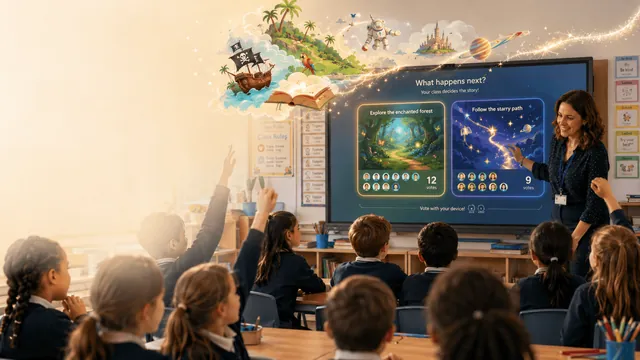
An illustration of a class reading a Litsee story on the whiteboard and voting on what happens next.

FREE TEACHER STORY UNIT · KS1 AND KS2

Easter story writing for KS1 and KS2 – lesson plan

A gentle Easter class story for the last weeks of the spring term. KS1 follow picture clues round the Easter Egg Garden and write a clue of their own; KS2 solve a trail of riddles that leads to signs of new life and old traditions, then write a riddle with at least two clues.

When to use it
The last two weeks of the spring term, before the Easter holidays.
Date
In 2027, Good Friday is Friday 26 March and Easter Monday is Monday 29 March, both bank holidays, so Easter Sunday is 28 March. Most schools in England break up just before. Source
Story world
Easter Egg Garden
Subject focus
Religious Education · Festivals
Suggested story settings
Genre: Mystery · Length: 2 chapters · Time: 10–15 minutes

Story feel: Wonder & discovery. Story shape: Problem to solve.

About this unit

This unit is a spring egg hunt about new life and sharing. Both stories are set in the Easter Egg Garden, among painted eggs, daffodils, chicks and blossom, and both end with everyone sharing the eggs so that nobody is left out.

In KS1, the picture clue cards for the village egg hunt have blown away, and children follow the clues they find while noticing signs of spring. In KS2, someone has swapped the clues for riddles, and each answer leads to a sign of new life or an old tradition. A kind neighbour explains, in one sentence, that for Christians Easter is the most important festival of the year, when they celebrate their belief that Jesus rose to new life, and that many other people enjoy Easter as a spring holiday. Nothing describes the crucifixion or any suffering.

Litsee’s notes for this pack ask a Christian RE lead to check the one sentence about why Easter matters to Christians, and that families who do not mark Easter always have the signs-of-spring story. That check is planned and has not happened yet; we will say so here when it has.

KS1 (Reception to Year 2): Look High, Look Low

Learning objective

Follow and give simple directions, and describe signs of new life in spring.

Talk questions

  1. Where did our hero look for the eggs? Can you give a friend a clue to find something in our classroom?
  2. How did the friends make sure everyone was included?

Writing task

Draw and decorate an egg. Write a clue for where it is hidden: 'Look under the ___.'

Suggested story settings: Genre: Mystery · Length: 2 chapters · Time: 10–15 minutes

The story brief

What the class story is asked to do. “Our hero” is the character your class chooses.

An Easter story for young readers. In the Easter Egg Garden, the painted eggs for the village egg hunt are hidden, but the picture clue cards have blown away in the spring wind. Our hero and their friends follow the clues they find around the garden: under the daffodils, beside the nest, behind the wheelbarrow, near the pond with the ducklings. On the way they notice signs of new life: chicks hatching, lambs, buds and blossom. When one little friend finds no eggs at all, everyone shares, so the hunt ends with everyone happy. Use a repeated line children can join in with: 'Look high, look low, where did the eggs go?' Keep it gentle and joyful.

Word bank

Easter
a spring festival; for Christians it is the most important festival of the year
egg hunt
a game where painted or chocolate eggs are hidden for people to find
clue
a hint that helps you find something or work something out
hatch
to break out of an egg, as a chick does
share
to let other people have some of something, so that everyone has enough

Text-type features: instructions

Purpose: to tell someone how to do or make something. Plan it with the free instructions plan template.

Reception to Year 2

  • A title that says 'How to…'
  • What you need
  • Numbered steps
  • Bossy verbs at the start

National Curriculum statements

  • “recognising and joining in with predictable phrases”

    Year 1, Reading – comprehension (statutory)

  • “give well-structured descriptions, explanations and narratives for different purposes, including for expressing feelings”

    Years 1 to 6, Spoken language (statutory)

  • “writing for different purposes”

    Year 2, Writing – composition (statutory)

Sample opening · KS1

A sample written for this page to show the brief in action. It is not the story Litsee writes for your class.

It was the morning of the egg hunt in the Easter Egg Garden. The sun was shining and the daffodils were nodding.

But whoosh! A spring wind blew across the garden, and all the picture clue cards flew away.

“Oh no,” said Ruby. “How will we find the eggs now?”

Kai spotted a card stuck in the hedge. It had a picture of a yellow flower.

“Look high, look low, where did the eggs go?” they sang, and they ran to the daffodils.

There, between the green stalks, sat a blue egg with white spots. And nearby, in a nest, three fluffy chicks went cheep, cheep, cheep.

Model text (WAGOLL)

A model answer to the writing task, pitched at Year 2, written for this page. Read it with the class and find where it meets each success criterion.

Look under the big flowerpot by the door.

First, find the yellow daffodils.

Then look behind the wheelbarrow, and your egg is waiting!

What makes it good

  • Look under the big flowerpot by the door. A bossy verb and a precise place word.
  • First, find the yellow daffodils. “First” and “then” put the steps in order.

By year group

Reception

Grammar focus: Capital letters and full stops

It was the morning of the egg hunt in the Easter Egg Garden.

Year 1

Grammar focus: Capital letters and full stops

The sun was shining and the daffodils were nodding.

Year 2

Grammar focus: Statements, questions, exclamations and commands

But whoosh!

A week of lessons

  1. Lesson 1

    Hook

    • Hide one decorated paper egg in the classroom and give the class a single picture clue. Can they find it? Then read how the clue cards blew away.
    • Talk: Where did our hero look for the eggs? Can you give a friend a clue to find something in our classroom?
  2. Lesson 2

    Plan

    • Talk: How did the friends make sure everyone was included?
    • Words: Easter, egg hunt, clue, hatch, share.
  3. Lesson 3

    Draft

    • Write: Draw and decorate an egg. Write a clue for where it is hidden: 'Look under the ___.'
  4. Lesson 4

    Edit

    • Grammar focus. Capital letters and full stops: “The sun was shining and the daffodils were nodding.”
  5. Lesson 5

    Publish

    • Hide the decorated eggs around the classroom and use the children’s clues for a class egg hunt.
The printed plan adds the planning frame and the full steps for each lesson.

Support, core and stretch sheets

Support

Draw and decorate an egg. Choose a place word from the mat and copy: “Look under the ___.”

Core

Draw and decorate an egg. Write a clue for where it is hidden: 'Look under the ___.'

Stretch

Write a two-step clue using “first” and “then”, so a friend can find your egg.

Vocabulary mat

One A4 page for every table: the word bank with its meanings, sentence stems, useful words and grammar words.

KS2 (Years 3 to 6): The Riddle of the Painted Eggs

Learning objective

Explain how Easter is celebrated and why it is important to Christians, and write riddles that use clues and wordplay.

Talk questions

  1. Which riddle was hardest to solve? Which clues helped most?
  2. Why is Easter important to Christians? What other ways do people enjoy Easter?

Writing task

Write your own riddle for an egg's hiding place, with at least two clues and a question at the end.

Suggested story settings: Genre: Mystery · Length: 2 chapters · Time: 10–15 minutes

The story brief

What the class story is asked to do. “Our hero” is the character your class chooses.

An Easter story for older primary readers. In the Easter Egg Garden, the village is getting ready for its Easter egg hunt and spring fair, but someone has swapped all the clues for riddles. Our hero teams up with friends to solve them, each riddle leading to a sign of new life (seeds sprouting, a robin's nest, frogspawn, blossom) and to an old tradition: painting eggs, rolling eggs down a hill, hot cross buns at the bakery. Through a kind neighbour, explain simply and respectfully that for Christians Easter is the most important festival of the year, when they celebrate their belief that Jesus rose to new life, and that many other people enjoy Easter as a spring holiday. Do not describe the crucifixion or any suffering. End with the riddle-setter revealed as a friendly grandparent and the whole village sharing the eggs.

Word bank

riddle
a puzzle written as a question or a rhyme, with clues to help you guess the answer
tradition
a custom or way of doing things that people have kept up for a long time
celebrate
to do something special and enjoyable for an important day
Christian
someone who follows Christianity, the faith of people who believe in the teachings of Jesus
new life
young plants and animals that appear in spring, such as buds, lambs and chicks

Text-type features: poem

Purpose: to share a feeling or picture with the reader. Plan it with the free poem plan template.

Years 3 and 4

  • A clear shape: lines and verses
  • Repetition for effect
  • Similes
  • Sound: rhyme or alliteration
  • Precise verbs

Years 5 and 6

  • Form chosen on purpose
  • Imagery: similes, metaphors and personification
  • Sound devices
  • A turn or change at the end
  • Every word earning its place

National Curriculum statements

  • “discussing words and phrases that capture the reader’s interest and imagination”

    Years 3 and 4, Reading – comprehension (statutory)

  • “discuss and evaluate how authors use language, including figurative language, considering the impact on the reader”

    Years 5 and 6, Reading – comprehension (statutory)

  • “selecting appropriate grammar and vocabulary, understanding how such choices can change and enhance meaning”

    Years 5 and 6, Writing – composition (statutory)

Sample opening · KS2

A sample written for this page to show the brief in action. It is not the story Litsee writes for your class.

The egg hunt was meant to start at ten. At five to ten, Mrs Osei from the bakery came running up the path, waving a handful of cards.

“Somebody’s been at the clues,” she puffed. “Every single one is a riddle!”

Jayden took the top card and read it aloud: “I start as a dot in a wobbly ball, with no legs, no arms and no tail at all. Look in the water where it’s quiet and cold: what will I be when the spring grows old?”

“Water,” said Mei at once. “So, the pond.”

“A dot in a wobbly ball,” said Jayden slowly. “Frogspawn! And by the end of spring, it’s a frog.”

They raced to the pond. Floating at the edge, beside a clump of frogspawn, was a painted egg and another riddle card, tied with a yellow ribbon. Mei looked back at the garden, full of blossom and birdsong. Whoever had set these riddles knew the garden very well indeed.

Model text (WAGOLL)

A model answer to the writing task, pitched at Year 5, written for this page. Read it with the class and find where it meets each success criterion.

I have a mouth but never speak,

I wear green fingers, long and sleek.

My bed is earth, so dark and deep,

all winter long I lie asleep,

Then, when the robins start to sing,

I wave my yellow trumpet: spring!

Your egg is hiding at my feet.

What flower am I? Come and meet!

What makes it good

  • I have a mouth but never speak A clue that plays with a double meaning: the flower’s trumpet is its “mouth”.
  • all winter long I lie asleep An accurate clue: a daffodil bulb rests underground through the winter.
  • What flower am I? Ends with the question the reader must answer.

By year group

Year 3

Grammar focus: Conjunctions to join clauses

Look in the water where it’s quiet and cold: what will I be when the spring grows old?

Year 4

Grammar focus: Expanded noun phrases

Floating at the edge, beside a clump of frogspawn, was a painted egg and another riddle card, tied with a yellow ribbon.

Year 5

Grammar focus: Expanded noun phrases

Floating at the edge, beside a clump of frogspawn, was a painted egg and another riddle card, tied with a yellow ribbon.

Year 6

Grammar focus: Synonyms and antonyms

A week of lessons

  1. Lesson 1

    Hook

    • Write a short riddle on the board for an object in the classroom, and let the class solve it. Ask: which words were the best clues?
    • Talk: Which riddle was hardest to solve? Which clues helped most?
  2. Lesson 2

    Plan

    • Talk: Why is Easter important to Christians? What other ways do people enjoy Easter?
    • Words: riddle, tradition, celebrate, Christian, new life.
  3. Lesson 3

    Draft

    • Write: Write your own riddle for an egg's hiding place, with at least two clues and a question at the end.
  4. Lesson 4

    Edit

    • Grammar focus. Expanded noun phrases: “Floating at the edge, beside a clump of frogspawn, was a painted egg and another riddle card, tied with a yellow ribbon.”
  5. Lesson 5

    Publish

    • Run a riddle trail round the playground, with each riddle leading to the next card.
The printed plan adds the planning frame and the full steps for each lesson.

Support, core and stretch sheets

Support

Write a riddle with two clues, using “I am…” and “You can find me…”, and a question at the end.

Core

Write your own riddle for an egg's hiding place, with at least two clues and a question at the end.

Stretch

Write a riddle in rhyming couplets, with one clue that plays with a word’s double meaning.

Vocabulary mat

One A4 page for every table: the word bank with its meanings, sentence stems, useful words and grammar words.

Teaching notes

Families celebrate Easter in different ways, and some do not mark it at all. Keep the talk on spring, new life and sharing, which every child can join in with, and offer the signs-of-spring unit to families who prefer their child not to take part in a festival unit.

For KS1, hide picture clue cards around the classroom or playground before the lesson. Children follow them in pairs, giving each other directions with “under”, “behind”, “next to” and “near”, then write a clue for their own decorated egg.

For KS2, read the frogspawn riddle twice and pull out how it works: clues about what the thing looks like, where it is and what it does, with a question at the end. Children then write a riddle for an egg’s hiding place and test it on a partner before the final draft.

If your school teaches the Christian Easter story in RE, keep it there. The KS2 story gives one sentence about why Easter matters to Christians, and you can add more from your RE syllabus.

Printable lesson sheet

One A4 page for each key stage, ready for your planning folder: the story title, objective, story settings, talk questions, writing task, word bank with meanings, success criteria, curriculum statements and the sample opening to read aloud. Printing this page prints only the two sheets.

About this page

How it works · Sources

Sources

The curriculum quotations are copied word for word from these documents. Dates were checked on 29 October 2026.

About this page

Built from Litsee’s curriculum data. The story titles, briefs, objectives, talk questions, writing tasks, word lists and story settings come from the seasonal class-story packs in the Litsee app; the text-type features come from the app’s curriculum data; the National Curriculum quotations are quoted word for word from the Department for Education’s documents. The word meanings, sample openings and teaching notes were written for this page, and every date was checked against the source named beside it. Ideas or corrections? Email info@litsee.com.

Last updated: .

Questions parents and teachers ask

When is Easter 2027?

Easter Sunday is 28 March 2027. Good Friday is Friday 26 March and Easter Monday is Monday 29 March, and both are bank holidays in England and Wales.

Does the Easter story include the crucifixion?

No. The KS2 story gives one simple sentence about why Easter is important to Christians, and nothing describes the crucifixion or suffering. Your RE syllabus covers the rest.

Is there an Easter alternative for families who do not celebrate it?

Yes. The signs-of-spring unit has a meadow story with no festival in it, written for the same weeks.

Run this as a live class story in Litsee

In Litsee, a seasonal brief like this becomes an illustrated, narrated class story. You preview the first chapter before reading it with your class, and the class chooses what happens next together.

Easter story unit · KS1 (Reception to Year 2)

Look High, Look Low

Learning objective: Follow and give simple directions, and describe signs of new life in spring.

Suggested story settings: Genre: Mystery · Length: 2 chapters · Time: 10–15 minutes · Story world: Easter Egg Garden

Talk questions

  1. Where did our hero look for the eggs? Can you give a friend a clue to find something in our classroom?
  2. How did the friends make sure everyone was included?

Writing task

Draw and decorate an egg. Write a clue for where it is hidden: 'Look under the ___.'

Word bank

Easter
a spring festival; for Christians it is the most important festival of the year
egg hunt
a game where painted or chocolate eggs are hidden for people to find
clue
a hint that helps you find something or work something out
hatch
to break out of an egg, as a chick does
share
to let other people have some of something, so that everyone has enough

Success criteria (instructions)

Reception to Year 2: I can write a 'How to' title. I can number my steps. I can start with a bossy verb.

National Curriculum statements

  • “recognising and joining in with predictable phrases” (Year 1, Reading – comprehension (statutory))
  • “give well-structured descriptions, explanations and narratives for different purposes, including for expressing feelings” (Years 1 to 6, Spoken language (statutory))
  • “writing for different purposes” (Year 2, Writing – composition (statutory))

Sample opening (written for litsee.com, to read aloud)

It was the morning of the egg hunt in the Easter Egg Garden. The sun was shining and the daffodils were nodding.

But whoosh! A spring wind blew across the garden, and all the picture clue cards flew away.

“Oh no,” said Ruby. “How will we find the eggs now?”

Kai spotted a card stuck in the hedge. It had a picture of a yellow flower.

“Look high, look low, where did the eggs go?” they sang, and they ran to the daffodils.

There, between the green stalks, sat a blue egg with white spots. And nearby, in a nest, three fluffy chicks went cheep, cheep, cheep.

Notes

Free from litsee.com/teachers/story-units/easter

Easter story unit · KS2 (Years 3 to 6)

The Riddle of the Painted Eggs

Learning objective: Explain how Easter is celebrated and why it is important to Christians, and write riddles that use clues and wordplay.

Suggested story settings: Genre: Mystery · Length: 2 chapters · Time: 10–15 minutes · Story world: Easter Egg Garden

Talk questions

  1. Which riddle was hardest to solve? Which clues helped most?
  2. Why is Easter important to Christians? What other ways do people enjoy Easter?

Writing task

Write your own riddle for an egg's hiding place, with at least two clues and a question at the end.

Word bank

riddle
a puzzle written as a question or a rhyme, with clues to help you guess the answer
tradition
a custom or way of doing things that people have kept up for a long time
celebrate
to do something special and enjoyable for an important day
Christian
someone who follows Christianity, the faith of people who believe in the teachings of Jesus
new life
young plants and animals that appear in spring, such as buds, lambs and chicks

Success criteria (poem)

Years 3 and 4: I can write in verses. I can use a simile. I can use repetition for effect.

Years 5 and 6: I can use imagery. I can choose my form on purpose. I can end with a turn.

National Curriculum statements

  • “discussing words and phrases that capture the reader’s interest and imagination” (Years 3 and 4, Reading – comprehension (statutory))
  • “discuss and evaluate how authors use language, including figurative language, considering the impact on the reader” (Years 5 and 6, Reading – comprehension (statutory))
  • “selecting appropriate grammar and vocabulary, understanding how such choices can change and enhance meaning” (Years 5 and 6, Writing – composition (statutory))

Sample opening (written for litsee.com, to read aloud)

The egg hunt was meant to start at ten. At five to ten, Mrs Osei from the bakery came running up the path, waving a handful of cards.

“Somebody’s been at the clues,” she puffed. “Every single one is a riddle!”

Jayden took the top card and read it aloud: “I start as a dot in a wobbly ball, with no legs, no arms and no tail at all. Look in the water where it’s quiet and cold: what will I be when the spring grows old?”

“Water,” said Mei at once. “So, the pond.”

“A dot in a wobbly ball,” said Jayden slowly. “Frogspawn! And by the end of spring, it’s a frog.”

They raced to the pond. Floating at the edge, beside a clump of frogspawn, was a painted egg and another riddle card, tied with a yellow ribbon. Mei looked back at the garden, full of blossom and birdsong. Whoever had set these riddles knew the garden very well indeed.

Notes

Free from litsee.com/teachers/story-units/easter

Try it in LitseeYour child creates the hero, picks the world and chooses what happens next, in an illustrated story that is read aloud.Start your free trialUse it in classRead an illustrated, narrated story together on the whiteboard, and let the class choose what happens next.Start a free classroom trialSee Litsee for schools