Help us improve Litsee

With your permission, Google Analytics measures visits and Microsoft Clarity records clicks, scrolling and page interactions, with form inputs and page text masked. We use no advertising cookies.

Change it any time with Cookie settings. Privacy policy · Google privacy · Microsoft privacy

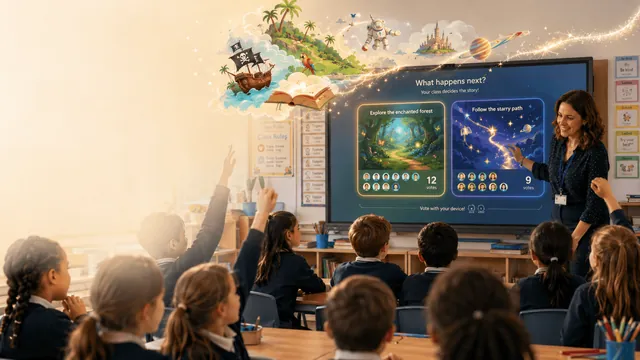
An illustration of a class reading a Litsee story on the whiteboard and voting on what happens next.

FREE TEACHER STORY UNIT · KS1 AND KS2

Ramadan and Eid story lesson for KS1 and KS2

A calm, warm class story for Ramadan and Eid al-Fitr, written with Muslim families in mind. KS1 follow Yusuf’s good deeds jar from one new moon to the next; KS2 help Amira’s class fill a lantern of good deeds and write an Eid card and a short explanation of what the month means to many Muslim families.

When to use it
During Ramadan and in the days around Eid al-Fitr, which in 2027 fall in February and March. The dates follow the new moon: check them with the families in your class.
Story world
Crescent Moon Street
Subject focus
Religious Education · Festivals
Suggested story settings
Genre: Friendship · Length: 2 chapters · Time: 10–15 minutes

Story feel: Calm & cosy. Story shape: Character change.

About this unit

Ramadan is the ninth month of the Islamic calendar, a special month for Muslims. Many Muslim families mark it with prayer, reading the Qur’an, giving to charity and doing extra kind things for others, and grown-ups fast from dawn to sunset. Eid al-Fitr celebrates the end of the month, when the new crescent moon is seen, with new clothes, visits to family and friends, small presents and the greeting “Eid Mubarak”.

The stories are calm and joyful and keep the focus on kindness, giving and family. As the briefs ask, nothing centres on food, and fasting is never shown as a challenge or something children must do. In KS1, Yusuf fills a jar with good deeds. In KS2, Amira explains the month in her own words while our hero helps her organise a collection for a local charity.

Litsee’s notes for this pack ask for the story briefs to be checked by a Muslim parent or educator, including the respectful words (Ramadan Mubarak, Eid Mubarak) and that nothing centres on food or treats fasting as a challenge. That check is planned and has not happened yet; we will say so here when it has.

KS1 (Reception to Year 2): The Moon We Waited For

Learning objective

Describe how some Muslim families mark Ramadan and Eid, and why kindness and giving matter to them.

Talk questions

  1. What did Yusuf put in his good deeds jar?
  2. How did Yusuf's family know when Ramadan and Eid began?

Writing task

Draw a moon and star lantern. Write one kind thing for a good deeds jar: 'I can ___.'

Suggested story settings: Genre: Friendship · Length: 2 chapters · Time: 10–15 minutes

The story brief

What the class story is asked to do. “Our hero” is the character your class chooses.

A Ramadan and Eid story for young readers, written with Muslim families in mind. Our hero's friend Yusuf and his family look out for the thin new crescent moon that tells them Ramadan has begun. During Ramadan, Yusuf's family hang star and moon lanterns, read together, pray at home and do extra kind things: Yusuf fills a jar with good deeds, like helping a neighbour and giving books to children who need them. Grown-ups in the family fast in the daytime; Yusuf is still small, so he does not, and that is fine. Do not centre the story on food or eating, never show anyone pressured or judged about fasting, and keep prayer simple, without detail. At the end of the month everyone looks for the new moon again, and it is Eid: new clothes, visiting family and friends, small presents and saying 'Eid Mubarak'. Keep it calm, warm and joyful.

Word bank

Ramadan
a special month for Muslims, when many families pray, read, give and do extra kind things
Eid
a happy celebration; Eid al-Fitr comes at the end of Ramadan
crescent moon
the thin, curved shape of the moon when it is new
lantern
a light inside a case of paper, metal or glass, which you can hang up or carry
kindness
being gentle, friendly and helpful to other people

Text-type features: information report

Purpose: to tell the reader facts about a subject. Plan it with the free information report plan template.

Reception to Year 2

  • A title
  • Facts, not a story
  • Headings
  • Labelled pictures

National Curriculum statements

  • “being encouraged to link what they read or hear read to their own experiences”

    Year 1, Reading – comprehension (statutory)

  • “drawing on what they already know or on background information and vocabulary provided by the teacher”

    Year 1, Reading – comprehension (statutory)

  • “writing for different purposes”

    Year 2, Writing – composition (statutory)

Sample opening · KS1

A sample written for this page to show the brief in action. It is not the story Litsee writes for your class.

Yusuf pressed his nose to the window. The sky was turning pink and gold.

“There!” said Mum, pointing. A thin new moon hung over the rooftops, like a silver smile.

“Ramadan has begun,” said Yusuf. He hung a star lantern in the window, and Grandad hung a moon one beside it.

On the kitchen table stood an empty jar. “This is my good deeds jar,” Yusuf told Ellie. “Every time I do something kind, I put in a paper star.”

The next day, Yusuf helped Mrs Price carry her shopping. He put a star in the jar. Then he gave three of his books to the children’s centre. Three more stars!

Model text (WAGOLL)

A model answer to the writing task, pitched at Year 2, written for this page. Read it with the class and find where it meets each success criterion.

I can help my little sister tidy her toys.

I can give a book I have finished to the children’s centre.

Then I can put two stars in the jar, and it will start to sparkle!

What makes it good

  • I can help my little sister tidy her toys. Finishes the starter with a real kind act.
  • Then I can put two stars in the jar Uses “then” to show what happens next.

By year group

Reception

Grammar focus: Capital letters and full stops

Yusuf pressed his nose to the window.

Year 1

Grammar focus: Capital letters and full stops

The sky was turning pink and gold.

Year 2

Grammar focus: Expanded noun phrases

A thin new moon hung over the rooftops, like a silver smile.

A week of lessons

  1. Lesson 1

    Hook

    • Cut out a thin paper crescent moon and hold it up to the window. Ask: have you ever seen the moon look like this? Then read how Yusuf’s family waited for it.
    • Talk: What did Yusuf put in his good deeds jar?
  2. Lesson 2

    Plan

    • Talk: How did Yusuf's family know when Ramadan and Eid began?
    • Words: Ramadan, Eid, crescent moon, lantern, kindness.
  3. Lesson 3

    Draft

    • Write: Draw a moon and star lantern. Write one kind thing for a good deeds jar: 'I can ___.'
  4. Lesson 4

    Edit

    • Grammar focus. Capital letters and full stops: “The sky was turning pink and gold.”
  5. Lesson 5

    Publish

    • Fill a class good deeds jar with the children’s stars, and read some aloud at the end of each day.
The printed plan adds the planning frame and the full steps for each lesson.

Support, core and stretch sheets

Support

Draw a moon and star lantern. Choose a kind word from the mat and copy: “I can ___.”

Core

Draw a moon and star lantern. Write one kind thing for a good deeds jar: 'I can ___.'

Stretch

Write two kind things for the good deeds jar, and say who each one would help.

Vocabulary mat

One A4 page for every table: the word bank with its meanings, sentence stems, useful words and grammar words.

KS2 (Years 3 to 6): The Lantern of Good Deeds

Learning objective

Explain how and why many Muslims mark Ramadan and Eid al-Fitr, using respectful vocabulary.

Talk questions

  1. Why do you think giving and kindness are so important during Ramadan?
  2. How did the class's lantern of good deeds help others? What could we add to one?

Writing task

Write an Eid card message for a friend, then a short paragraph explaining what Ramadan and Eid mean to many Muslim families.

Suggested story settings: Genre: Friendship · Length: 2 chapters · Time: 10–15 minutes

The story brief

What the class story is asked to do. “Our hero” is the character your class chooses.

A Ramadan and Eid story for older primary readers, written with Muslim families in mind. During Ramadan, our hero's friend Amira and her family mark the month with prayer, reading the Qur'an, giving to charity and doing kind things for others; the grown-ups fast from dawn to sunset, and children may try a little fasting only if their family chooses. Amira's class makes a lantern of good deeds, adding a paper star for every kind act, and our hero helps Amira organise a collection of books and warm clothes for a local charity. Through Amira, explain simply and respectfully that Ramadan is a special month for Muslims, a time to be thankful, patient and generous, and that Eid al-Fitr celebrates its end when the new crescent moon is seen. Do not centre the story on food or eating, never show fasting as a challenge or a competition, and do not describe worship in detail. End on Eid morning with family, friends, new clothes and 'Eid Mubarak', and the lantern full of stars.

Word bank

Ramadan
the ninth month of the Islamic calendar, a time for Muslims to be thankful, patient and generous
Eid al-Fitr
the festival that celebrates the end of Ramadan, when the new crescent moon is seen
charity
giving money, things or time to help people who need it
crescent
a curved shape, thin at both ends, like the moon when it is new
generous
happy to give or share more than you have to

Text-type features: letter to a character

Purpose: to tell someone about events and ask questions. Plan it with the free letter to a character plan template.

Years 3 to 6

  • Address and date
  • Greeting and sign-off
  • Paragraphs for each idea
  • Questions for the reader
  • A friendly voice

National Curriculum statements

  • “identifying the audience for and purpose of the writing, selecting the appropriate form and using other similar writing as models for their own”

    Years 5 and 6, Writing – composition (statutory)

  • “select and use appropriate registers for effective communication”

    Years 1 to 6, Spoken language (statutory)

  • “drawing inferences such as inferring characters’ feelings, thoughts and motives from their actions, and justifying inferences with evidence”

    Years 3 and 4, Reading – comprehension (statutory)

Sample opening · KS2

A sample written for this page to show the brief in action. It is not the story Litsee writes for your class.

On the first Monday of Ramadan, a paper lantern appeared on the wall of Class 4, with nothing on it at all.

“It’s a lantern of good deeds,” Amira explained to the class. “Every time someone does something kind, they add a star.”

“Is that what Ramadan is about?” asked Theo. “Being kind?”

Amira thought about it. “It’s a special month for Muslims. In my family we pray, we read the Qur’an together, and we try to be more patient and more generous than usual. The grown-ups fast in the daytime. And we give to people who need it.”

That afternoon, Amira and Theo stood by a cardboard box in the school hall. A sign on the front said: Books and warm clothes for the community centre.

By home time, the box held two picture books, a scarf and a single glove. Theo looked at it doubtfully. Amira smiled. “It’s only day one,” she said.

Model text (WAGOLL)

A model answer to the writing task, pitched at Year 5, written for this page. Read it with the class and find where it meets each success criterion.

Eid Mubarak, Amira! I hope you have a wonderful day with your family, and that your new clothes are as sparkly as you wanted.

What Ramadan and Eid mean to many Muslim families

Ramadan is a special month for Muslims. Many Muslims use it as a time to pray, read the Qur’an and be especially kind and generous, and grown-ups fast from dawn until sunset. Amira told me that in her family they also try to be more patient, which she says is the hardest part.

Giving is a big part of the month. Many families give to charity, and our class collected books and warm clothes for the community centre.

Eid al-Fitr celebrates the end of Ramadan, when the new crescent moon is seen. For Amira’s family, it is a day for visiting relatives, new clothes, small presents and saying “Eid Mubarak” to everyone they meet.

What makes it good

  • Many Muslims use it as a time to pray Says “many Muslims”, describing other people’s beliefs respectfully.
  • Amira told me that in her family Lets a friend speak for her own family, not for everyone.
  • Eid al-Fitr celebrates the end of Ramadan, when the new crescent moon is seen. A clear, accurate explanation in one sentence.

By year group

Year 3

Grammar focus: Conjunctions to join clauses

Eid al-Fitr celebrates the end of Ramadan, when the new crescent moon is seen.

Year 4

Grammar focus: Conjunctions to join clauses

Eid al-Fitr celebrates the end of Ramadan, when the new crescent moon is seen.

Year 5

Grammar focus: Expanded noun phrases

On the first Monday of Ramadan, a paper lantern appeared on the wall of Class 4, with nothing on it at all.

Year 6

Grammar focus: Paragraphs and headings

A week of lessons

  1. Lesson 1

    Hook

    • Put an empty paper lantern on the wall with a pile of paper stars beside it. Tell the class it will fill up as people notice kind acts during the week.
    • Talk: Why do you think giving and kindness are so important during Ramadan?
  2. Lesson 2

    Plan

    • Talk: How did the class's lantern of good deeds help others? What could we add to one?
    • Words: Ramadan, Eid al-Fitr, charity, crescent, generous.
  3. Lesson 3

    Draft

    • Write: Write an Eid card message for a friend, then a short paragraph explaining what Ramadan and Eid mean to many Muslim families.
  4. Lesson 4

    Edit

    • Grammar focus. Conjunctions to join clauses: “Eid al-Fitr celebrates the end of Ramadan, when the new crescent moon is seen.”
  5. Lesson 5

    Publish

    • Display the Eid cards and explanations around the lantern of good deeds, and share them with families before Eid.
The printed plan adds the planning frame and the full steps for each lesson.

Support, core and stretch sheets

Support

Write an Eid card message with “Eid Mubarak” and one kind wish for your friend.

Core

Write an Eid card message for a friend, then a short paragraph explaining what Ramadan and Eid mean to many Muslim families.

Stretch

Write the explanation using “many Muslims” and “for my friend’s family” to show you are describing other people’s beliefs respectfully.

Vocabulary mat

One A4 page for every table: the word bank with its meanings, sentence stems, useful words and grammar words.

Teaching notes

Talk to your Muslim families before you teach the unit. Some children will be glad to share how their family marks Ramadan and Eid, and others will prefer not to. Never ask a child to speak for all Muslims, and never ask a child whether they are fasting.

Many Muslim pupils and staff are fasting in the daytime during Ramadan, so keep the unit away from food: no tasting activities, and no chapters about meals. Many Muslim pupils are also absent on Eid itself, so plan the Eid writing for the days before or after.

For KS1, make a class good deeds jar and add a paper star for each kind act you notice during the week. Children choose one kind thing they could do and finish the sentence “I can ___.” for their own star.

For KS2, collect Amira’s respectful phrases (“in my family”, “we try to”, “for Muslims it is”) before children write their explanation. If some families prefer their child not to take part in a festival unit, the signs-of-spring unit is written for the same weeks.

Printable lesson sheet

One A4 page for each key stage, ready for your planning folder: the story title, objective, story settings, talk questions, writing task, word bank with meanings, success criteria, curriculum statements and the sample opening to read aloud. Printing this page prints only the two sheets.

About this page

How it works · Sources

Sources

The curriculum quotations are copied word for word from these documents. Dates were checked on 29 October 2026.

About this page

Built from Litsee’s curriculum data. The story titles, briefs, objectives, talk questions, writing tasks, word lists and story settings come from the seasonal class-story packs in the Litsee app; the text-type features come from the app’s curriculum data; the National Curriculum quotations are quoted word for word from the Department for Education’s documents. The word meanings, sample openings and teaching notes were written for this page, and every date was checked against the source named beside it. Ideas or corrections? Email info@litsee.com.

Last updated: .

Questions parents and teachers ask

When are Ramadan and Eid in 2027?

Ramadan is expected to begin in early February 2027 and Eid al-Fitr in early March. The exact dates depend on the new moon being seen, and families may follow different dates, so check with the Muslim families in your class or your local mosque.

Does the story talk about fasting?

Only simply: grown-ups in the family fast in the daytime, and children may try a little only if their family chooses. The stories never show fasting as a challenge or a competition, and nothing centres on food.

Is this unit suitable for RE?

It works as a story-led introduction to Ramadan and Eid in English or RE lessons. Check it against your school’s RE syllabus, which sets what your pupils learn about Islam.

Is there a version for children who do not celebrate festivals?

Yes. The signs-of-spring unit has a meadow story with no festival in it, and it is written for the same weeks of the year.

Run this as a live class story in Litsee

In Litsee, a seasonal brief like this becomes an illustrated, narrated class story. You preview the first chapter before reading it with your class, and the class chooses what happens next together.

Ramadan and Eid story unit · KS1 (Reception to Year 2)

The Moon We Waited For

Learning objective: Describe how some Muslim families mark Ramadan and Eid, and why kindness and giving matter to them.

Suggested story settings: Genre: Friendship · Length: 2 chapters · Time: 10–15 minutes · Story world: Crescent Moon Street

Talk questions

  1. What did Yusuf put in his good deeds jar?
  2. How did Yusuf's family know when Ramadan and Eid began?

Writing task

Draw a moon and star lantern. Write one kind thing for a good deeds jar: 'I can ___.'

Word bank

Ramadan
a special month for Muslims, when many families pray, read, give and do extra kind things
Eid
a happy celebration; Eid al-Fitr comes at the end of Ramadan
crescent moon
the thin, curved shape of the moon when it is new
lantern
a light inside a case of paper, metal or glass, which you can hang up or carry
kindness
being gentle, friendly and helpful to other people

Success criteria (information report)

Reception to Year 2: I can write facts. I can use a heading. I can label a picture.

National Curriculum statements

  • “being encouraged to link what they read or hear read to their own experiences” (Year 1, Reading – comprehension (statutory))
  • “drawing on what they already know or on background information and vocabulary provided by the teacher” (Year 1, Reading – comprehension (statutory))
  • “writing for different purposes” (Year 2, Writing – composition (statutory))

Sample opening (written for litsee.com, to read aloud)

Yusuf pressed his nose to the window. The sky was turning pink and gold.

“There!” said Mum, pointing. A thin new moon hung over the rooftops, like a silver smile.

“Ramadan has begun,” said Yusuf. He hung a star lantern in the window, and Grandad hung a moon one beside it.

On the kitchen table stood an empty jar. “This is my good deeds jar,” Yusuf told Ellie. “Every time I do something kind, I put in a paper star.”

The next day, Yusuf helped Mrs Price carry her shopping. He put a star in the jar. Then he gave three of his books to the children’s centre. Three more stars!

Notes

Free from litsee.com/teachers/story-units/ramadan-eid

Ramadan and Eid story unit · KS2 (Years 3 to 6)

The Lantern of Good Deeds

Learning objective: Explain how and why many Muslims mark Ramadan and Eid al-Fitr, using respectful vocabulary.

Suggested story settings: Genre: Friendship · Length: 2 chapters · Time: 10–15 minutes · Story world: Crescent Moon Street

Talk questions

  1. Why do you think giving and kindness are so important during Ramadan?
  2. How did the class's lantern of good deeds help others? What could we add to one?

Writing task

Write an Eid card message for a friend, then a short paragraph explaining what Ramadan and Eid mean to many Muslim families.

Word bank

Ramadan
the ninth month of the Islamic calendar, a time for Muslims to be thankful, patient and generous
Eid al-Fitr
the festival that celebrates the end of Ramadan, when the new crescent moon is seen
charity
giving money, things or time to help people who need it
crescent
a curved shape, thin at both ends, like the moon when it is new
generous
happy to give or share more than you have to

Success criteria (letter to a character)

Years 3 to 6: I can lay out a letter. I can use a paragraph for each idea. I can ask questions.

National Curriculum statements

  • “identifying the audience for and purpose of the writing, selecting the appropriate form and using other similar writing as models for their own” (Years 5 and 6, Writing – composition (statutory))
  • “select and use appropriate registers for effective communication” (Years 1 to 6, Spoken language (statutory))
  • “drawing inferences such as inferring characters’ feelings, thoughts and motives from their actions, and justifying inferences with evidence” (Years 3 and 4, Reading – comprehension (statutory))

Sample opening (written for litsee.com, to read aloud)

On the first Monday of Ramadan, a paper lantern appeared on the wall of Class 4, with nothing on it at all.

“It’s a lantern of good deeds,” Amira explained to the class. “Every time someone does something kind, they add a star.”

“Is that what Ramadan is about?” asked Theo. “Being kind?”

Amira thought about it. “It’s a special month for Muslims. In my family we pray, we read the Qur’an together, and we try to be more patient and more generous than usual. The grown-ups fast in the daytime. And we give to people who need it.”

That afternoon, Amira and Theo stood by a cardboard box in the school hall. A sign on the front said: Books and warm clothes for the community centre.

By home time, the box held two picture books, a scarf and a single glove. Theo looked at it doubtfully. Amira smiled. “It’s only day one,” she said.

Notes

Free from litsee.com/teachers/story-units/ramadan-eid

Try it in LitseeYour child creates the hero, picks the world and chooses what happens next, in an illustrated story that is read aloud.Start your free trialUse it in classRead an illustrated, narrated story together on the whiteboard, and let the class choose what happens next.Start a free classroom trialSee Litsee for schools