
Help us improve Litsee

With your permission, Google Analytics measures visits and Microsoft Clarity records clicks, scrolling and page interactions, with form inputs and page text masked. We use no advertising cookies.

Change it any time with Cookie settings. Privacy policy · Google privacy · Microsoft privacy

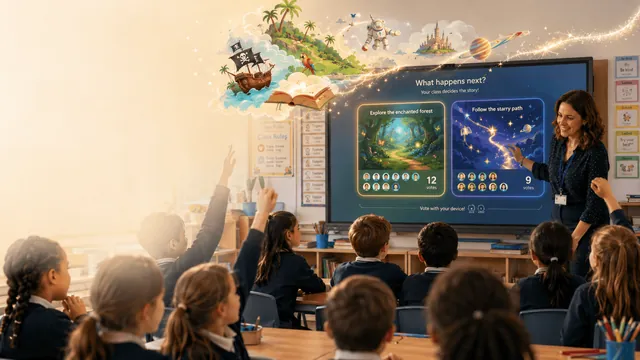
An illustration of a class reading a Litsee story on the whiteboard and voting on what happens next.

FREE TEACHER STORY UNIT · KS2

Volcano story lesson for KS2

A calm island mystery for the volcanoes and earthquakes topic in Years 3 to 6. Our hero helps young scientists read the clues that a dormant volcano is waking, and the village makes a careful plan in good time. Children write an explanation of how a volcano erupts.

When to use it
Any time during your volcanoes and earthquakes topic in Years 3 to 6.
Story world
Ember Island
Subject focus
Geography · Volcanoes and earthquakes
Suggested story settings
Genre: Mystery · Length: 2 chapters · Time: 10–15 minutes

Story feel: Wonder & discovery. Story shape: Problem to solve.

About this unit

This unit shows volcanoes through the eyes of the scientists who watch them. The story is a mystery: tiny earthquakes, warm springs and a puff of steam are clues that something is changing deep underground, and the team must work out what they mean.

The story is calm and careful. The village moves in good time, nobody is hurt, and the eruption makes new land where the lava meets the sea. It is a way into the real science of magma, the crust and tectonic plates without frightening anyone.

KS2 (Years 3 to 6): The Waking Mountain

Learning objective

Explain how volcanoes form and erupt, and how scientists help people stay safe.

Talk questions

  1. Which clues told the scientists that the volcano was waking up?
  2. Why was it important that the village made a plan early?

Writing task

Write an explanation of how a volcano erupts, with a labelled diagram, using cause-and-effect words and at least three words from the word bank.

Suggested story settings: Genre: Mystery · Length: 2 chapters · Time: 10–15 minutes

The story brief

What the class story is asked to do. “Our hero” is the character your class chooses.

An island mystery for older primary readers. Our hero joins a team of young scientists at a small observatory on Ember Island, where a dormant volcano has started to show signs of waking: tiny earthquakes, warm springs and a puff of steam from the top. The team read the clues from their instruments, explain how magma rises through the crust, and help the village make a calm, careful plan. Everyone moves to the far side of the island in good time, and the volcano erupts gently, safely, far from anyone, making new land where its lava meets the sea. Show science, planning and teamwork. Nobody is hurt, and nothing is frightening.

Word bank

magma
hot melted rock under the ground
lava
melted rock that comes out of a volcano
erupt
to burst out suddenly
crust
the Earth's hard outer layer
dormant
asleep for now, but not finished

Text-type features: explanation

Purpose: to explain how or why something happens.

Years 3 and 4

  • A question title and an opening statement
  • Steps in time order
  • Words that show cause: because, so, therefore
  • Present tense
  • A diagram

Years 5 and 6

  • An opening that sets out the question
  • Paragraphs that follow cause and effect
  • Technical words with a glossary
  • Present tense, often passive
  • A summary at the end

National Curriculum statements

  • “using a wide range of devices to build cohesion within and across paragraphs”

    Years 5 and 6, Writing – composition (statutory)

  • “identifying how language, structure and presentation contribute to meaning”

    Years 5 and 6, Reading – comprehension (statutory)

  • “in non-narrative material, using simple organisational devices [for example, headings and sub-headings]”

    Years 3 and 4, Writing – composition (statutory)

  • “describe and understand key aspects of: physical geography, including: climate zones, biomes and vegetation belts, rivers, mountains, volcanoes and earthquakes, and the water cycle”

    Key stage 2, Geography (statutory)

Sample opening · KS2

A sample written for this page to show the brief in action. It is not the story Litsee writes for your class.

The line on the screen had been flat for years. Now, every few minutes, it gave a tiny wiggle.

“Earthquakes,” said Tomás, the youngest scientist at the observatory, pointing. “Very small ones. Too small to feel. But there are more of them every day.”

Our hero looked out of the window. Ember Island was green and quiet. Goats grazed on the slopes, and fishing boats bobbed in the harbour. Above it all rose the mountain, its top hidden in a soft white cloud.

“Is that cloud or steam?” asked our hero.

Tomás picked up his binoculars and looked for a long time. “That,” he said slowly, “is a very good question.”

That afternoon, they drove up the mountain road to check the warm springs. The water, which had always been cool, was now as warm as a bath.

Model text (WAGOLL)

A model answer to the writing task, pitched at Year 5, written for this page. Read it with the class and find where it meets each success criterion.

How Does a Volcano Erupt?

A volcano is an opening in the Earth’s crust where melted rock, gases and ash can escape. Many volcanoes form where two tectonic plates meet.

Deep underground, rock is so hot that some of it melts. This melted rock is called magma. Because magma is lighter than the solid rock around it, it slowly rises and collects in a magma chamber under the volcano.

As more magma gathers, the pressure builds. The ground may swell, small earthquakes may shake the area, and gases may escape as steam.

Eventually, the pressure becomes too great, and the magma bursts up through the vent. Once it reaches the surface, it is called lava.

A volcano that has not erupted for a long time, but could erupt again, is called dormant. Scientists watch dormant volcanoes closely, so that people can be warned in good time.

What makes it good

  • Because magma is lighter than the solid rock around it A subordinate clause explains the cause.
  • As more magma gathers, the pressure builds. Shows a process step by step.
  • Once it reaches the surface, it is called lava. Explains the difference between two easily confused words.

By year group

Year 3

Grammar focus: Conjunctions to join clauses

Year 4

Grammar focus: Conjunctions to join clauses

Year 5

Grammar focus: Words for time, place and cause

Year 6

Grammar focus: The passive voice

Ember Island was green and quiet.

A week of lessons

  1. Lesson 1

    Hook

    • Show a photograph of a volcano with a small plume of steam and ask: is this volcano asleep or awake? What clues would you need to be sure?
    • Talk: Which clues told the scientists that the volcano was waking up?
  2. Lesson 2

    Plan

    • Talk: Why was it important that the village made a plan early?
    • Words: magma, lava, erupt, crust, dormant.
  3. Lesson 3

    Draft

    • Write: Write an explanation of how a volcano erupts, with a labelled diagram, using cause-and-effect words and at least three words from the word bank.
  4. Lesson 4

    Edit

    • Grammar focus. Conjunctions to join clauses: “The owl smiled because she knew the way.”
  5. Lesson 5

    Publish

    • Turn the explanations and diagrams into a class “observatory handbook” for the next team of young scientists.
The printed plan adds the planning frame and the full steps for each lesson.

Support, core and stretch sheets

Support

Explain how a volcano erupts in four steps, using the diagram labels: magma, crust, vent, lava.

Core

Write an explanation of how a volcano erupts, with a labelled diagram, using cause-and-effect words and at least three words from the word bank.

Stretch

Add a section on how scientists know a volcano is waking, linking each clue to what is happening underground.

Vocabulary mat

One A4 page for every table: the word bank with its meanings, sentence stems, useful words and grammar words.

Teaching notes

Show the layers of the Earth with a simple cross-section (crust, mantle, core) and add the magma chamber under the volcano. Children who can point to where magma comes from write clearer explanations.

Make a list of the story’s clues (small earthquakes, warm water, steam, the ground rising) and match each to what is happening underground. This is how real volcano scientists work.

Keep the tone calm. The story’s message is that scientists watch volcanoes carefully so that people can plan ahead. If children ask about real eruptions, focus on how warnings and planning help people stay safe.

Printable lesson sheet

One A4 page, ready for your planning folder: the story title, objective, story settings, talk questions, writing task, word bank with meanings, success criteria, curriculum statements and the sample opening to read aloud. Printing this page prints only that sheet.

About this page

How it works · Sources

About this page

Built from Litsee’s curriculum data. The topic words and their meanings, the year groups and the history, geography and science statements come from the topic data in the Litsee app, quoted word for word from the Department for Education’s documents; the text-type features and English quotations come from the app’s curriculum data. The story briefs, objectives, questions, tasks, sample openings, model texts and teaching notes were written for this page. Ideas or corrections? Email info@litsee.com.

Last updated: .

Questions parents and teachers ask

Is the volcano story right for younger children?

No. The village makes a calm plan and moves in good time, nobody is hurt, and the eruption happens far from anyone.

Which year groups is the volcanoes unit for?

Years 3 to 6. Volcanoes and earthquakes are part of the physical geography in the KS2 curriculum.

Is there a volcanoes word bank?

Yes. The volcanoes and earthquakes word bank has the topic words with child-friendly meanings, more nouns, verbs and adjectives, and a printable word mat.

Run this as a live class story in Litsee

In Litsee, a seasonal brief like this becomes an illustrated, narrated class story. You preview the first chapter before reading it with your class, and the class chooses what happens next together.

Volcanoes story unit · KS2 (Years 3 to 6)

The Waking Mountain

Learning objective: Explain how volcanoes form and erupt, and how scientists help people stay safe.

Suggested story settings: Genre: Mystery · Length: 2 chapters · Time: 10–15 minutes · Story world: Ember Island

Talk questions

  1. Which clues told the scientists that the volcano was waking up?
  2. Why was it important that the village made a plan early?

Writing task

Write an explanation of how a volcano erupts, with a labelled diagram, using cause-and-effect words and at least three words from the word bank.

Word bank

magma
hot melted rock under the ground
lava
melted rock that comes out of a volcano
erupt
to burst out suddenly
crust
the Earth's hard outer layer
dormant
asleep for now, but not finished

Success criteria (explanation)

Years 3 and 4: I can open with what it is. I can use words that show cause. I can write in the present tense.

Years 5 and 6: I can explain cause and effect. I can use technical words and a glossary. I can use the passive where it helps.

National Curriculum statements

  • “using a wide range of devices to build cohesion within and across paragraphs” (Years 5 and 6, Writing – composition (statutory))
  • “identifying how language, structure and presentation contribute to meaning” (Years 5 and 6, Reading – comprehension (statutory))
  • “in non-narrative material, using simple organisational devices [for example, headings and sub-headings]” (Years 3 and 4, Writing – composition (statutory))
  • “describe and understand key aspects of: physical geography, including: climate zones, biomes and vegetation belts, rivers, mountains, volcanoes and earthquakes, and the water cycle” (Key stage 2, Geography (statutory))

Sample opening (written for litsee.com, to read aloud)

The line on the screen had been flat for years. Now, every few minutes, it gave a tiny wiggle.

“Earthquakes,” said Tomás, the youngest scientist at the observatory, pointing. “Very small ones. Too small to feel. But there are more of them every day.”

Our hero looked out of the window. Ember Island was green and quiet. Goats grazed on the slopes, and fishing boats bobbed in the harbour. Above it all rose the mountain, its top hidden in a soft white cloud.

“Is that cloud or steam?” asked our hero.

Tomás picked up his binoculars and looked for a long time. “That,” he said slowly, “is a very good question.”

That afternoon, they drove up the mountain road to check the warm springs. The water, which had always been cool, was now as warm as a bath.

Notes

Free from litsee.com/teachers/story-units/volcanoes-and-earthquakes

Try it in LitseeYour child creates the hero, picks the world and chooses what happens next, in an illustrated story that is read aloud.Start your free trialUse it in classRead an illustrated, narrated story together on the whiteboard, and let the class choose what happens next.Start a free classroom trialSee Litsee for schools