Help us improve Litsee

With your permission, Google Analytics measures visits and Microsoft Clarity records clicks, scrolling and page interactions, with form inputs and page text masked. We use no advertising cookies.

Change it any time with Cookie settings. Privacy policy · Google privacy · Microsoft privacy

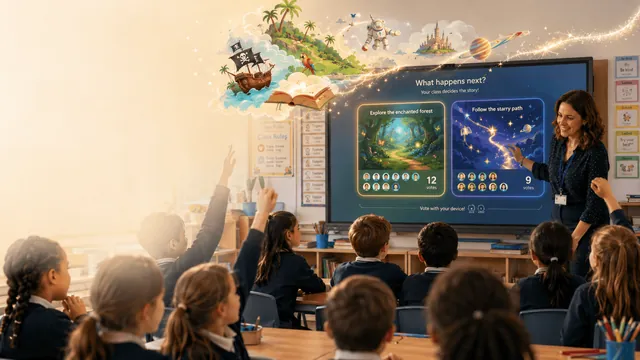
An illustration of a class reading a Litsee story on the whiteboard and voting on what happens next.

FREE TEACHER STORY UNIT · KS1 AND KS2

Dinosaur story lesson for KS1 and KS2

A fossil adventure for every year group. In KS1, a glowing fossil opens a window to the time of the dinosaurs and our hero helps a young herbivore find her herd; in KS2, our hero finds a large fossil in a cliff with a young palaeontologist and explains how fossils form.

When to use it
Any time, and especially for rocks and fossils in Year 3 science or evolution in Year 6.
Story world
Fossil Bay
Subject focus
Science · Rocks and fossils
Suggested story settings
Genre: Adventure · Length: 2 chapters · Time: 10–15 minutes

Story feel: Wonder & discovery. Story shape: Quest / journey.

About this unit

Dinosaurs are a favourite with almost every class. This unit uses that excitement to teach the science behind them: what fossils are, how they form in layers of rock over millions of years, and what they tell us about living things that are now extinct.

The KS1 story is pure wonder, with a friendly herbivore and nothing scary. The KS2 story is a careful discovery on the coast, modelled on how real fossil finds are made, studied and given to museums.

KS1 (Reception to Year 2): The Glowing Fossil

Learning objective

Describe what a fossil is and name some dinosaurs that ate plants or meat.

Talk questions

  1. What clues helped our hero find Fern’s herd?
  2. How do we know about dinosaurs if no one has ever seen one?

Writing task

Draw Fern and her herd. Write one sentence: 'Fern is a herbivore, so she eats ___.'

Suggested story settings: Genre: Adventure · Length: 2 chapters · Time: 10–15 minutes

The story brief

What the class story is asked to do. “Our hero” is the character your class chooses.

A fossil hunt for young readers. On the beach at Fossil Bay, our hero finds a stone with a curly shell pattern that glows when they hold it. It opens a window into the time of the dinosaurs, and our hero steps through to meet a young herbivore called Fern, who has lost her herd. They follow giant footprints across a fern-covered valley until they find Fern’s family, munching leaves by a lake. Wonder and discovery, nothing scary: the only carnivore they see is far away and fast asleep. End back on the beach with the fossil, now just a stone again, in our hero’s pocket.

Word bank

fossil
the remains of a living thing, kept in rock for a very long time
extinct
no longer alive anywhere
herbivore
an animal that eats only plants
carnivore
an animal that eats meat
palaeontologist
a scientist who studies fossils

Text-type features: adventure story

Purpose: to entertain. Plan it with the free adventure story plan template.

Reception to Year 2

  • A beginning, a middle and an end
  • A character who wants something
  • A problem to solve
  • Describing words for people and places

National Curriculum statements

  • “predicting what might happen on the basis of what has been read so far”

    Year 1, Reading – comprehension (statutory)

  • “drawing on what they already know or on background information and vocabulary provided by the teacher”

    Year 2, Reading – comprehension (statutory)

  • “sequencing sentences to form short narratives”

    Year 1, Writing – composition (statutory)

Sample opening · KS1

A sample written for this page to show the brief in action. It is not the story Litsee writes for your class.

The beach at Fossil Bay was full of stones. Grey stones, brown stones, round stones and flat stones.

But one stone was different. It had a curly pattern on it, like a snail shell, and when our hero picked it up, it began to glow.

“A fossil!” our hero whispered.

The glow grew brighter and brighter, and then, pop, a round window opened in the air. Through it, our hero could see tall ferns, a sparkling lake and a little green dinosaur with a long neck, looking lost.

Our hero stepped through the window. “Hello,” they said softly. “Are you all right?”

“I’m Fern,” said the dinosaur. “I can’t find my herd.”

Model text (WAGOLL)

A model answer to the writing task, pitched at Year 2, written for this page. Read it with the class and find where it meets each success criterion.

Fern is a herbivore, so she eats leaves and ferns.

She has a long neck to reach the tallest trees.

Her herd munches all day by the sparkling lake.

What makes it good

  • Fern is a herbivore, so she eats leaves and ferns. Uses a word from the word bank and explains it with “so”.
  • the sparkling lake A describing word that helps the reader see the place.

By year group

Reception

Grammar focus: Capital letters and full stops

The beach at Fossil Bay was full of stones.

Year 1

Grammar focus: Capital letters and full stops

Grey stones, brown stones, round stones and flat stones.

Year 2

Grammar focus: Expanded noun phrases

Through it, our hero could see tall ferns, a sparkling lake and a little green dinosaur with a long neck, looking lost.

A week of lessons

  1. Lesson 1

    Hook

    • Hide a few shells and a toy dinosaur in a tray of sand. Children dig carefully with paintbrushes, like real fossil hunters, before you read.
    • Talk: What clues helped our hero find Fern’s herd?
  2. Lesson 2

    Plan

    • Talk: How do we know about dinosaurs if no one has ever seen one?
    • Words: fossil, extinct, herbivore, carnivore, palaeontologist.
  3. Lesson 3

    Draft

    • Write: Draw Fern and her herd. Write one sentence: 'Fern is a herbivore, so she eats ___.'
  4. Lesson 4

    Edit

    • Grammar focus. Capital letters and full stops: “Grey stones, brown stones, round stones and flat stones.”
  5. Lesson 5

    Publish

    • Make a class “dinosaur valley” display with the herd pictures and sentences.
The printed plan adds the planning frame and the full steps for each lesson.

Support, core and stretch sheets

Support

Draw Fern and her herd. Copy and finish: “Fern is a herbivore, so she eats ___.”

Core

Draw Fern and her herd. Write one sentence: 'Fern is a herbivore, so she eats ___.'

Stretch

Write two sentences: one about a herbivore and one about a carnivore, and say what each one eats.

Vocabulary mat

One A4 page for every table: the word bank with its meanings, sentence stems, useful words and grammar words.

KS2 (Years 3 to 6): The Cliff’s Secret

Learning objective

Explain how fossils form and what they tell us about living things from millions of years ago.

Talk questions

  1. How did the palaeontologist work out what the fossil was?
  2. Why do you think it matters to report a fossil find to a museum?

Writing task

Write an explanation of how a fossil forms, step by step, using time words and the words cause and effect, with a labelled diagram.

Suggested story settings: Genre: Adventure · Length: 2 chapters · Time: 10–15 minutes

The story brief

What the class story is asked to do. “Our hero” is the character your class chooses.

A fossil adventure for older primary readers. Our hero joins a young palaeontologist on a fossil-hunting walk along the cliffs at Fossil Bay after a storm has washed away part of the cliff. They find the edge of a large fossil in the rock. Through careful work, notes and a little imagination, the story shows how fossils form when living things are trapped in layers of rock over millions of years, and what fossils tell us about creatures that are now extinct. Weave in accurate facts and the real history of fossil hunting on the coast. End with the fossil safely in a museum and our hero’s name on the label as the finder.

Word bank

fossil
the remains of a living thing, kept in rock for a very long time
extinct
no longer alive anywhere
palaeontologist
a scientist who studies fossils
herbivore
an animal that eats only plants
carnivore
an animal that eats meat

Text-type features: explanation

Purpose: to explain how or why something happens.

Years 3 and 4

  • A question title and an opening statement
  • Steps in time order
  • Words that show cause: because, so, therefore
  • Present tense
  • A diagram

Years 5 and 6

  • An opening that sets out the question
  • Paragraphs that follow cause and effect
  • Technical words with a glossary
  • Present tense, often passive
  • A summary at the end

National Curriculum statements

  • “retrieve, record and present information from non-fiction”

    Years 5 and 6, Reading – comprehension (statutory)

  • “using a wide range of devices to build cohesion within and across paragraphs”

    Years 5 and 6, Writing – composition (statutory)

  • “in non-narrative material, using simple organisational devices [for example, headings and sub-headings]”

    Years 3 and 4, Writing – composition (statutory)

  • “describe in simple terms how fossils are formed when things that have lived are trapped within rock”

    Year 3, Science (statutory)

  • “recognise that living things have changed over time and that fossils provide information about living things that inhabited the Earth millions of years ago”

    Year 6, Science (statutory)

Sample opening · KS2

A sample written for this page to show the brief in action. It is not the story Litsee writes for your class.

The storm had blown itself out overnight, and in the morning the beach at Fossil Bay looked different. A slice of the cliff had slumped onto the sand, leaving a fresh grey face of rock.

“After a storm is the best time to look,” said Priya, crouching beside the fallen clay. She was a palaeontologist at the local museum, and she had a rucksack full of brushes, notebooks and bubble wrap. “The sea does the digging for us.”

Our hero walked slowly along the bottom of the cliff, keeping well back from the rock face as Priya had asked. Then something caught their eye: a row of dark, curved shapes in the stone, each one the size of a hand, like the knuckles of an enormous fist.

“Priya,” they called. “I think you should see this.”

Priya looked for a long time without saying anything. Then she took out her notebook. “Those are vertebrae,” she said quietly. “Part of a backbone. Something big lived here, a very long time ago.”

Model text (WAGOLL)

A model answer to the writing task, pitched at Year 5, written for this page. Read it with the class and find where it meets each success criterion.

How Does a Fossil Form?

A fossil is the remains or the trace of a living thing, kept in rock for millions of years. Most fossils form in four steps.

First, an animal or plant dies and sinks to the bottom of a sea or lake. The soft parts rot away, leaving only the hard parts, such as bones, teeth or shells.

Next, layers of mud and sand settle on top. Over a very long time, more layers build up, and their weight presses the lower layers into rock.

Then, water seeping through the rock slowly replaces the bones with minerals. As a result, the bones turn into stone but keep their shape.

Finally, the rock is lifted and worn away by wind, rain or the sea, until the fossil appears at the surface, where a palaeontologist might find it.

Fossils matter because they show us living things that are now extinct, and how life on Earth has changed.

What makes it good

  • First, an animal or plant dies Time words put the steps in order.
  • As a result, the bones turn into stone Shows cause and effect.
  • Fossils matter because Ends by explaining why the topic matters.

By year group

Year 3

Grammar focus: Conjunctions to join clauses

Fossils matter because they show us living things that are now extinct, and how life on Earth has changed.

Year 4

Grammar focus: Conjunctions to join clauses

Fossils matter because they show us living things that are now extinct, and how life on Earth has changed.

Year 5

Grammar focus: Words for time, place and cause

Then something caught their eye: a row of dark, curved shapes in the stone, each one the size of a hand, like the knuckles of an enormous fist.

Year 6

Grammar focus: The passive voice

Finally, the rock is lifted and worn away by wind, rain or the sea, until the fossil appears at the surface, where a palaeontologist might find it.

A week of lessons

  1. Lesson 1

    Hook

    • Show a photograph of a real ichthyosaur fossil in a museum. Ask: how did an animal turn into stone? What would have to happen?
    • Talk: How did the palaeontologist work out what the fossil was?
  2. Lesson 2

    Plan

    • Talk: Why do you think it matters to report a fossil find to a museum?
    • Words: fossil, extinct, palaeontologist, herbivore, carnivore.
  3. Lesson 3

    Draft

    • Write: Write an explanation of how a fossil forms, step by step, using time words and the words cause and effect, with a labelled diagram.
  4. Lesson 4

    Edit

    • Grammar focus. Conjunctions to join clauses: “Fossils matter because they show us living things that are now extinct, and how life on Earth has changed.”
  5. Lesson 5

    Publish

    • Set up a class fossil museum, with each explanation displayed beside its diagram as the label.
The printed plan adds the planning frame and the full steps for each lesson.

Support, core and stretch sheets

Support

Explain how a fossil forms in four numbered steps, each starting with a time word.

Core

Write an explanation of how a fossil forms, step by step, using time words and the words cause and effect, with a labelled diagram.

Stretch

Add a paragraph explaining what fossils tell us about extinct animals, and a glossary of three words.

Vocabulary mat

One A4 page for every table: the word bank with its meanings, sentence stems, useful words and grammar words.

Teaching notes

Make fossils in class with modelling clay and shells, or a salt dough “cast”. Children who have pressed a shell into clay understand how a print is left behind, which is the first step in how fossils form.

Show the layers of rock with a stack of coloured paper or a jar of sand and soil. Older layers are lower down, which is why a palaeontologist can tell roughly how old a fossil is.

Talk about the real history of fossil hunting on the English coast, such as the discoveries of Mary Anning in Lyme Regis two hundred years ago, and how she worked out what the creatures were from careful observation.

Printable lesson sheet

One A4 page for each key stage, ready for your planning folder: the story title, objective, story settings, talk questions, writing task, word bank with meanings, success criteria, curriculum statements and the sample opening to read aloud. Printing this page prints only the two sheets.

About this page

How it works · Sources

About this page

Built from Litsee’s curriculum data. The topic words and their meanings, the year groups and the history, geography and science statements come from the topic data in the Litsee app, quoted word for word from the Department for Education’s documents; the text-type features and English quotations come from the app’s curriculum data. The story briefs, objectives, questions, tasks, sample openings, model texts and teaching notes were written for this page. Ideas or corrections? Email info@litsee.com.

Last updated: .

Questions parents and teachers ask

Is the dinosaur story gentle enough for Reception?

No. The KS1 story is about helping a young herbivore find her herd, and the only meat-eater is far away and asleep. The KS2 story is a careful fossil discovery.

Which year groups is the dinosaurs unit for?

Reception to Year 6. It links to rocks and fossils in Year 3 science and to evolution and inheritance in Year 6.

Is there a dinosaurs word bank?

Yes. The dinosaurs and fossils word bank has the topic words with child-friendly meanings, more nouns, verbs and adjectives, and a printable word mat.

Run this as a live class story in Litsee

In Litsee, a seasonal brief like this becomes an illustrated, narrated class story. You preview the first chapter before reading it with your class, and the class chooses what happens next together.

Dinosaurs and fossils story unit · KS1 (Reception to Year 2)

The Glowing Fossil

Learning objective: Describe what a fossil is and name some dinosaurs that ate plants or meat.

Suggested story settings: Genre: Adventure · Length: 2 chapters · Time: 10–15 minutes · Story world: Fossil Bay

Talk questions

  1. What clues helped our hero find Fern’s herd?
  2. How do we know about dinosaurs if no one has ever seen one?

Writing task

Draw Fern and her herd. Write one sentence: 'Fern is a herbivore, so she eats ___.'

Word bank

fossil
the remains of a living thing, kept in rock for a very long time
extinct
no longer alive anywhere
herbivore
an animal that eats only plants
carnivore
an animal that eats meat
palaeontologist
a scientist who studies fossils

Success criteria (adventure story)

Reception to Year 2: I can write a beginning, a middle and an end. I can use describing words. I can use capital letters and full stops.

National Curriculum statements

  • “predicting what might happen on the basis of what has been read so far” (Year 1, Reading – comprehension (statutory))
  • “drawing on what they already know or on background information and vocabulary provided by the teacher” (Year 2, Reading – comprehension (statutory))
  • “sequencing sentences to form short narratives” (Year 1, Writing – composition (statutory))

Sample opening (written for litsee.com, to read aloud)

The beach at Fossil Bay was full of stones. Grey stones, brown stones, round stones and flat stones.

But one stone was different. It had a curly pattern on it, like a snail shell, and when our hero picked it up, it began to glow.

“A fossil!” our hero whispered.

The glow grew brighter and brighter, and then, pop, a round window opened in the air. Through it, our hero could see tall ferns, a sparkling lake and a little green dinosaur with a long neck, looking lost.

Our hero stepped through the window. “Hello,” they said softly. “Are you all right?”

“I’m Fern,” said the dinosaur. “I can’t find my herd.”

Notes

Free from litsee.com/teachers/story-units/dinosaurs-and-fossils

Dinosaurs and fossils story unit · KS2 (Years 3 to 6)

The Cliff’s Secret

Learning objective: Explain how fossils form and what they tell us about living things from millions of years ago.

Suggested story settings: Genre: Adventure · Length: 2 chapters · Time: 10–15 minutes · Story world: Fossil Bay

Talk questions

  1. How did the palaeontologist work out what the fossil was?
  2. Why do you think it matters to report a fossil find to a museum?

Writing task

Write an explanation of how a fossil forms, step by step, using time words and the words cause and effect, with a labelled diagram.

Word bank

fossil
the remains of a living thing, kept in rock for a very long time
extinct
no longer alive anywhere
palaeontologist
a scientist who studies fossils
herbivore
an animal that eats only plants
carnivore
an animal that eats meat

Success criteria (explanation)

Years 3 and 4: I can open with what it is. I can use words that show cause. I can write in the present tense.

Years 5 and 6: I can explain cause and effect. I can use technical words and a glossary. I can use the passive where it helps.

National Curriculum statements

  • “retrieve, record and present information from non-fiction” (Years 5 and 6, Reading – comprehension (statutory))
  • “using a wide range of devices to build cohesion within and across paragraphs” (Years 5 and 6, Writing – composition (statutory))
  • “in non-narrative material, using simple organisational devices [for example, headings and sub-headings]” (Years 3 and 4, Writing – composition (statutory))
  • “describe in simple terms how fossils are formed when things that have lived are trapped within rock” (Year 3, Science (statutory))
  • “recognise that living things have changed over time and that fossils provide information about living things that inhabited the Earth millions of years ago” (Year 6, Science (statutory))

Sample opening (written for litsee.com, to read aloud)

The storm had blown itself out overnight, and in the morning the beach at Fossil Bay looked different. A slice of the cliff had slumped onto the sand, leaving a fresh grey face of rock.

“After a storm is the best time to look,” said Priya, crouching beside the fallen clay. She was a palaeontologist at the local museum, and she had a rucksack full of brushes, notebooks and bubble wrap. “The sea does the digging for us.”

Our hero walked slowly along the bottom of the cliff, keeping well back from the rock face as Priya had asked. Then something caught their eye: a row of dark, curved shapes in the stone, each one the size of a hand, like the knuckles of an enormous fist.

“Priya,” they called. “I think you should see this.”

Priya looked for a long time without saying anything. Then she took out her notebook. “Those are vertebrae,” she said quietly. “Part of a backbone. Something big lived here, a very long time ago.”

Notes

Free from litsee.com/teachers/story-units/dinosaurs-and-fossils

Try it in LitseeYour child creates the hero, picks the world and chooses what happens next, in an illustrated story that is read aloud.Start your free trialUse it in classRead an illustrated, narrated story together on the whiteboard, and let the class choose what happens next.Start a free classroom trialSee Litsee for schools