
The Dragon Who Wouldn’t Fly: a free interactive story
Ages 8–10 · Reading age 9 · About 2 minutes · Questions to print · Feelings, a brave plan and sheets
- Read
- Choose
- Keep
 Choose the hero and the paint
Choose your hero
Paint it your way
Chapter 1Feet on the ground
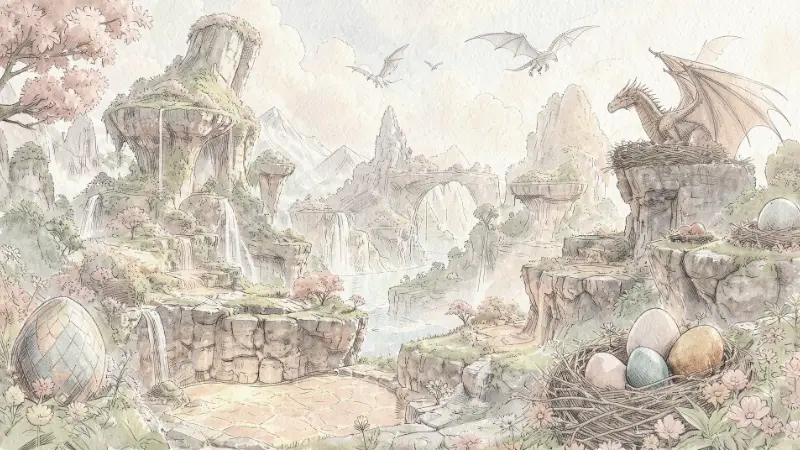
The Dragon Sanctuary was a valley of waterfalls and blossom trees, where young dragons hatched in nests on the cliffs and learned to fly over the river.
Every autumn, before the strong winds came, each young dragon made a first flight across the valley. The whole sanctuary came out to watch and cheer.
This year, Ember was the only young dragon who hadn’t flown. She sat on her ledge with her wings folded tight, watching the others swoop and tumble.
“What if I’m no good at it?” she asked Archie quietly. “Everyone will be watching. I’d rather just walk.”
Warden Aziz, who ran the sanctuary, gave Archie a small nod. “Ember trusts you,” he said. “Perhaps you can help.”
You choose what happens next
What should Archie do first?
How does Ember feel? Make a brave plan, then print it
Read the story first. Then try these together. They work on a class whiteboard, a tablet or a phone, and nothing is kept or sent.
How does Ember feel?
Read what happens. Which word fits how Ember feels? Tap one. There is no wrong answer.
Moment 1 of 5 · Chapter 1: Feet on the ground
Ember sits on her ledge and watches the others fly.
Make a brave plan
Everyone feels nervous sometimes, even dragons. Pick something that feels big for you, and one of Ember’s ways to help.
If a worry feels very big, tell a grown-up you trust.
1. What feels big for you?
2. Which of Ember’s ways could help?
Ember took a deep breath before she flew. The NHS suggests “taking 3 deep, slow breaths, breathing in for a count of 3 and out for 3”. (NHS: Anxiety in children)
This is a gentle way to start a conversation, not a test. Let your child choose; “Something else” lets them keep their worry to themselves.
The NHS says:
Just like adults, children and young people feel worried and anxious at times.
Listen to them carefully to understand their feelings.
Try not to make assumptions or dismiss their worries.
If your child's anxiety is severe, persists and interferes with their everyday life, it's a good idea to get some help.
A visit to a GP is a good place to start.
Source: NHS: Anxiety in children (opened 20 November 2026).
Three free sheets to print
Each sheet is one A4 page, in colour or black and white, with no sign-up. “Print” opens your printer’s window with that sheet; “PDF” saves the same sheet as a file.
How Ember felt
The Dragon Who Wouldn’t Fly
Name
Draw Ember’s face at each moment. Pick a word, then write how you can tell.
Feeling words: worried · shy · calm · happy · excited · proud
1 Ember sits on her ledge and watches the others fly.
My word:
How I can tell:
2 Ember thinks about the crowd watching her.
My word:
How I can tell:
3 Ember tries again and again in the quiet meadow.
My word:
How I can tell:
4 Ember stands on the edge at sunrise.
My word:
How I can tell:
5 Ember lands after her first flight.
My word:
How I can tell:
Free from litsee.com/stories/the-dragon-who-wouldnt-fly
How Ember felt
Five moments from the story. Draw Ember’s face, pick a feeling word and write how you can tell.
A4 · Year 2 to Year 5
My brave plan
The Dragon Who Wouldn’t Fly
Name
Something that feels big:
Ember’s way I will try:
My stepping stones. Colour one in when you have tried it.
- 1
- 2
- 3
- 4
Someone who can help me:
Breathe like Ember. The NHS suggests “taking 3 deep, slow breaths, breathing in for a count of 3 and out for 3”. (NHS: Anxiety in children)
If a worry feels very big, tell a grown-up you trust.
Free from litsee.com/stories/the-dragon-who-wouldnt-fly
My brave plan
Four stepping stones to something that feels big. If you made a plan above, it prints filled in.
A4 · Ages 5 to 11
Talk-about-it cards
The Dragon Who Wouldn’t Fly
Name
Cut out the cards. Take turns to pick one and talk about it. There are no wrong answers.
Why do you think Ember’s wings went stiff?
The hero sat with Ember and said nothing for a while. Why can that help?
Which ending was the bravest? Why?
Is it still brave if nobody is watching?
How did the other young dragons help Ember?
What would you say to Ember on her ledge?
Have you ever done something a bit at a time? What was it?
Who could you talk to if something felt big?
Free from litsee.com/stories/the-dragon-who-wouldnt-fly
Talk-about-it cards
Eight question cards to cut out, for home, circle time or a reading group.
A4 · Year 1 to Year 6
How the story works: two choices, four endings
Every reader starts on Ember’s ledge. The first choice is listen first or practise first; the second picks the way through. Each ending is a different kind of brave.
Chapter 1
Feet on the ground
Choice 1: What should the hero do first?
A Sit with Ember and find out what worries her
Chapter 2
What Ember said
Choice 2: Which worry should the hero help with?
- Ask for a first flight with no crowdEnding 1A flight at dawn
- Find a way to keep the egg companyEnding 2The egg-sitter
B Help Ember practise in a quiet place
Chapter 2
The quiet meadow
Choice 2: How should Ember get ready for the river?
- Ask the other young dragons to fly beside herEnding 3Wing to wing
- Cross the river in small steps, rock to rockEnding 4Rock by rock
Talking about how a character feels, and showing how you can tell, is in the National Curriculum for English: drawing inferences such as inferring characters’ feelings, thoughts and motives from their actions, and justifying inferences with evidence
(Years 3 and 4, reading) and give well-structured descriptions, explanations and narratives for different purposes, including for expressing feelings
(Years 1 to 6, spoken language). Sources: The national curriculum in England: English programmes of study, key stages 1 and 2 (GOV.UK).
For grown-ups: about the story, questions to ask, new words and how to read it together
At the Dragon Sanctuary, every young dragon makes a first flight before the autumn winds, but Ember would rather stay on the ground. Our hero makes two choices about how to help, and the four endings show four different kinds of courage.
Free interactive story · ages 8–10
- Reading age 9
- 2 short chapters, 2 choices and 4 endings
- About 2 minutes
- Friendship
Questions for grown-ups to ask
Did you spot it?
- EasyWhat did every young dragon do before the autumn winds?Answer: Made a first flight across the valley.
- MediumWhat were Ember’s two worries?Answer: Flying in front of a crowd, and leaving her brother, who hadn’t hatched yet.
- HarderEmber says “That was mine” after flying at dawn. What does she mean?Answer: That the flight felt like her own achievement, done her way, not a performance for other people.
Talk about it
- Each ending shows a different way of being brave. Which one is most like you?
- In “What Ember said”, the hero listens without talking. Why can that help someone who is worried?
With lines to write on, and no answers.
Words to talk about
- sanctuary
- A safe place where animals are looked after.
- soared
- Flew high and smoothly.
- admitted
- Said something true that was a bit hard to say.
- speckled
- Covered in small spots.
Reading it together
The Dragon Who Wouldn’t Fly is a friendship story about nerves, written at Litsee’s reading level for age 9. It never makes Ember’s worry seem silly: each path takes it seriously and finds a different, gentle way through.
The first choice is between listening first and doing something practical; the second between solving one worry or another, or between going it alone and going together. Talk about which your child would choose for themselves.
If your child has something coming up that worries them (a performance, a new school, a swimming lesson), the story is a kind way to start that conversation.
About this story
- Reading age
- 9 (ages 8–10). Written for Litsee’s reading level for age 9, where sentences are mostly 10–18 words long.
- Length
- 2 short chapters, 2 choices and 4 endings. Each way through is 287–299 words.
- Reading time
- About 2 minutes for a 9-year-old reading on their own, at Litsee’s pacing of 120 words a minute for that age. Reading aloud to your child is usually quicker.
- Book band
- Roughly Grey, if your child’s school uses book bands (schemes differ; see our book bands guide).
- Characters
- Ember, a young dragon, Warden Aziz, who runs the sanctuary, Ember’s little brother, still in his egg
- Theme
- Friendship
About this story
Written for litsee.com by the Litsee team, The Dragon Who Wouldn’t Fly was drafted with AI help and checked against Litsee’s reading level for age 9.
Pictures of the Dragon Sanctuary: from the Litsee app, painted with AI image tools and hand-picked by the Litsee team. “Read to me” plays an AI voice recorded in advance.
Last updated: .
Questions parents and teachers ask
Are the dragons frightening?
No. The sanctuary is peaceful, the dragons are young and friendly, and the story is about helping a friend feel brave.
What age is it for?
Ages 8 to 10, at Litsee’s reading level for age 9. Younger children enjoy it read aloud.
Can it help a child who is nervous about something?
It can be a gentle way to start talking. Under the story, “Make a brave plan” turns Ember’s four ways of being brave into small steps towards something your child finds big. The NHS says: “Just like adults, children and young people feel worried and anxious at times.” If a worry is strong or gets in the way of everyday life, it adds: “A visit to a GP is a good place to start.”
Can my child choose who the story is about?
Yes. Archie leads The Dragon Who Wouldn’t Fly unless your child picks another of the 15 heroes above it. That hero’s name then fills every page, and “Put them in the pictures” paints them into the Dragon Sanctuary. Nothing is typed, saved or sent.
Now let your child make a story of their own.
In Litsee, your child creates the hero, picks the world and chooses what happens next in an illustrated story that is read aloud.
Start your free trial7 days free. A card is needed to start, and nothing is charged if you cancel before the trial ends.