Help us improve Litsee

With your permission, Google Analytics measures visits and Microsoft Clarity records clicks, scrolling and page interactions, with form inputs and page text masked. We use no advertising cookies.

Change it any time with Cookie settings. Privacy policy · Google privacy · Microsoft privacy

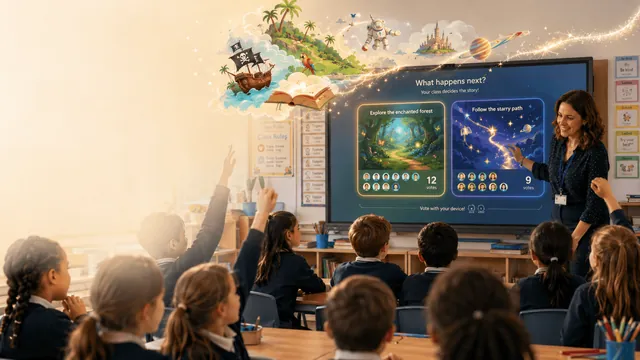
An illustration of a class reading a Litsee story on the whiteboard and voting on what happens next.

FREE TEACHER STORY UNIT · KS1 AND KS2

Bonfire Night story writing for KS1 and KS2 – lesson plan

A sparkly Bonfire Night class story with firework safety woven into what the characters do. KS1 help Sparkle the dog feel calm at home before the display; KS2 stay calm and tell a grown-up when a sparkler is dropped near the rope, then write a safety leaflet for younger children.

When to use it
The days before and after 5 November, including the first days back after half term.
Date
Bonfire Night is on 5 November every year. In 2026 it falls on Thursday 5 November, and many local displays are held on the weekend before or after. Source
Story world
Bonfire Night Hill
Subject focus
PSHE · Keeping safe
Suggested story settings
Genre: Friendship · Length: 2 chapters · Time: 10–15 minutes

Story feel: Wonder & discovery. Story shape: Problem to solve.

About this unit

This unit is about enjoying Bonfire Night safely and looking after each other, pets included. The safety points are not a list of rules at the end: they are things the characters do in the story, such as standing behind the rope, wearing gloves for sparklers and putting finished sparklers in a bucket of water.

In KS1, our hero helps a little dog called Sparkle, who is worried by the bangs, before setting off to the town display. In KS2, our hero is helping on a stall when a younger child wanders too close and drops a sparkler, and children see that staying calm and telling a grown-up is the responsible choice. Neither story has a guy on the bonfire, and nobody gets hurt.

KS1 (Reception to Year 2): Sparkle and the Big Bang

Learning objective

Describe simple ways to stay safe around fireworks and sparklers, and how to help a frightened pet.

Talk questions

  1. What did the characters do to stay safe at the fireworks?
  2. How did they help Sparkle feel calm? How can we help someone who is scared?

Writing task

Draw the fireworks. Write one safety sentence: 'At the fireworks I will ___.'

Suggested story settings: Genre: Friendship · Length: 2 chapters · Time: 10–15 minutes

The story brief

What the class story is asked to do. “Our hero” is the character your class chooses.

A Bonfire Night story for young readers. Our hero goes to the town firework display with friends and family. A little dog called Sparkle is worried by the loud bangs, so our hero helps Sparkle feel calm and safe at home before the display. Weave in simple firework safety gently, as things the characters do rather than rules: only grown-ups light fireworks, everyone stands behind the rope, sparklers are held with gloves at arm's length and put in a bucket of water when they finish. End with everyone safe and happy, watching the colours light up the sky. Do not include burning a 'guy' or anyone getting hurt.

Word bank

firework
a small tube that shoots up and bursts into bright colours and bangs in the sky
sparkler
a thin metal stick that fizzes with tiny sparks when a grown-up lights it
safe
protected, so that nothing bad can happen to you
gloves
warm coverings for your hands, with a space for each finger
bucket
a round container with a handle, used to carry water or sand

Text-type features: instructions

Purpose: to tell someone how to do or make something. Plan it with the free instructions plan template.

Reception to Year 2

  • A title that says 'How to…'
  • What you need
  • Numbered steps
  • Bossy verbs at the start

National Curriculum statements

  • “participate in discussion about what is read to them, taking turns and listening to what others say”

    Year 1, Reading – comprehension (statutory)

  • “composing a sentence orally before writing it”

    Year 1, Writing – composition (statutory)

  • “writing for different purposes”

    Year 2, Writing – composition (statutory)

Sample opening · KS1

A sample written for this page to show the brief in action. It is not the story Litsee writes for your class.

It was Bonfire Night. Mia could hear the first pops and fizzes far away.

Under the table, Sparkle the little dog gave a tiny whimper. Her ears were flat and her tail was tucked in.

“It’s all right, Sparkle,” said Mia softly. She closed the curtains and turned on some gentle music. Dad made a cosy den with a blanket, and Mia put Sparkle’s favourite squeaky toy inside.

Sparkle sniffed the toy. Then she curled up and wagged her tail, just a little.

“Now we can go,” said Mia, pulling on her gloves. “We stand behind the rope, and only grown-ups light the fireworks.”

Model text (WAGOLL)

A model answer to the writing task, pitched at Year 2, written for this page. Read it with the class and find where it meets each success criterion.

At the fireworks I will stand behind the rope with my family.

I will wear my gloves when I hold a sparkler and put it in the bucket of water when it stops fizzing.

Only grown-ups light the fireworks because they are hot and loud.

What makes it good

  • At the fireworks I will stand behind the rope Finishes the sentence starter with a clear safety action.
  • because they are hot and loud Gives a reason with “because”.

By year group

Reception

Grammar focus: Capital letters and full stops

It was Bonfire Night.

Year 1

Grammar focus: Capital letters and full stops

Mia could hear the first pops and fizzes far away.

Year 2

Grammar focus: Statements, questions, exclamations and commands

A week of lessons

  1. Lesson 1

    Hook

    • Show a pair of gloves, a sparkler (unlit, in its packet) and a bucket of water. Ask: what could these three things have to do with each other? Then read the opening.
    • Talk: What did the characters do to stay safe at the fireworks?
  2. Lesson 2

    Plan

    • Talk: How did they help Sparkle feel calm? How can we help someone who is scared?
    • Words: firework, sparkler, safe, gloves, bucket.
  3. Lesson 3

    Draft

    • Write: Draw the fireworks. Write one safety sentence: 'At the fireworks I will ___.'
  4. Lesson 4

    Edit

    • Grammar focus. Capital letters and full stops: “Mia could hear the first pops and fizzes far away.”
  5. Lesson 5

    Publish

    • Make a class safety display of the fireworks pictures and sentences, and share it with Reception before Bonfire Night.
The printed plan adds the planning frame and the full steps for each lesson.

Support, core and stretch sheets

Support

Draw the fireworks. Choose a safety word from the mat and copy: “At the fireworks I will ___.”

Core

Draw the fireworks. Write one safety sentence: 'At the fireworks I will ___.'

Stretch

Write two safety sentences and give a reason for one of them with “because”.

Vocabulary mat

One A4 page for every table: the word bank with its meanings, sentence stems, useful words and grammar words.

KS2 (Years 3 to 6): The Night the Sky Lit Up

Learning objective

Explain how to stay safe around fireworks and why rules help keep a community safe.

Talk questions

  1. What did our hero do when something went wrong? Why was telling a grown-up the right choice?
  2. Which firework safety rules did you spot in the story?

Writing task

Write a short safety leaflet for younger children about enjoying fireworks safely, with a title, three clear tips and a friendly closing line.

Suggested story settings: Genre: Friendship · Length: 2 chapters · Time: 10–15 minutes

The story brief

What the class story is asked to do. “Our hero” is the character your class chooses.

A Bonfire Night story for older primary readers. Our hero helps run a stall at the community firework display on Bonfire Night Hill. When a younger child wanders too close to the rope and a sparkler is dropped on the grass, our hero stays calm, tells a grown-up and helps put things right. Weave in real firework safety naturally through the plot: only adults light fireworks, keep behind the safety rope, sparklers need gloves, one at a time, held at arm's length and put in water afterwards, and pets should be kept safely indoors. You may mention very briefly that Bonfire Night remembers events from over 400 years ago, without any violence. Do not include burning a 'guy'. End with a spectacular, safe display.

Word bank

display
a show put on for people to watch, such as fireworks set off by trained grown-ups
spectacular
amazing to look at, in a big and exciting way
responsible
doing the right thing because you know it matters, even when no one asks you to
distance
how far one thing is from another
precaution
something you do before a problem happens, to stop it happening

Text-type features: instructions

Purpose: to tell someone how to do or make something. Plan it with the free instructions plan template.

Years 3 to 6

  • A goal in the title
  • A list of what you need
  • Numbered steps in order
  • Command verbs and time words
  • A tip or warning

National Curriculum statements

  • “identifying the audience for and purpose of the writing, selecting the appropriate form and using other similar writing as models for their own”

    Years 5 and 6, Writing – composition (statutory)

  • “in non-narrative material, using simple organisational devices [for example, headings and sub-headings]”

    Years 3 and 4, Writing – composition (statutory)

  • “using further organisational and presentational devices to structure text and to guide the reader [for example, headings, bullet points, underlining]”

    Years 5 and 6, Writing – composition (statutory)

Sample opening · KS2

A sample written for this page to show the brief in action. It is not the story Litsee writes for your class.

From the hot chocolate stall at the top of Bonfire Night Hill, Kofi could see the whole field: the long white rope, the marshals in yellow jackets and, far beyond them, the fireworks waiting in their frames.

“Sparklers in five minutes,” called Mrs Adeyemi from the next stall. “Gloves on, one each, and the buckets are by the gate.”

Kofi was stirring a fresh pan when he noticed a small boy in a red bobble hat. He had slipped away from his family and was wandering along the rope, much closer to the fireworks than anyone was meant to be. In his gloved hand, a sparkler fizzed and spat.

Then it slipped from his fingers and landed, hissing, on the grass.

Kofi didn’t shout and he didn’t run. He put down the spoon, turned to the nearest marshal and pointed. “Excuse me,” he said, as calmly as he could. “That little boy needs a grown-up.”

Model text (WAGOLL)

A model answer to the writing task, pitched at Year 5, written for this page. Read it with the class and find where it meets each success criterion.

Sparkle Safely! Your Bonfire Night Guide

Bonfire Night is full of colour and fizz. Follow these three tips so that everyone, including your pets, has a brilliant night.

1. Stay behind the rope. Fireworks are lit by trained grown-ups, and the rope keeps everyone a safe distance away.

2. Gloves on for sparklers. Hold one sparkler at a time at arm’s length, and when it stops sparkling, pop it straight into a bucket of water.

3. Keep pets indoors. Close the curtains and leave some quiet music on, so that your dog or cat feels calm and cosy.

Enjoy the show, and have a spectacular, safe Bonfire Night!

What makes it good

  • Sparkle Safely! Your Bonfire Night Guide A catchy title that tells the reader what the leaflet is for.
  • Hold one sparkler at a time at arm’s length A bossy verb opens a clear, precise instruction.
  • so that your dog or cat feels calm and cosy Explains the reason behind the tip.

By year group

Year 3

Grammar focus: Words for time, place and cause

“Sparklers in five minutes,” called Mrs Adeyemi from the next stall.

Year 4

Grammar focus: Expanded noun phrases

Kofi was stirring a fresh pan when he noticed a small boy in a red bobble hat.

Year 5

Grammar focus: Words for time, place and cause

Then it slipped from his fingers and landed, hissing, on the grass.

Year 6

Grammar focus: Paragraphs and headings

A week of lessons

  1. Lesson 1

    Hook

    • Show a real firework safety leaflet from your local fire and rescue service. Ask: who is it written for, and how can you tell?
    • Talk: What did our hero do when something went wrong? Why was telling a grown-up the right choice?
  2. Lesson 2

    Plan

    • Talk: Which firework safety rules did you spot in the story?
    • Words: display, spectacular, responsible, distance, precaution.
  3. Lesson 3

    Draft

    • Write: Write a short safety leaflet for younger children about enjoying fireworks safely, with a title, three clear tips and a friendly closing line.
  4. Lesson 4

    Edit

    • Grammar focus. Expanded noun phrases: “Kofi was stirring a fresh pan when he noticed a small boy in a red bobble hat.”
  5. Lesson 5

    Publish

    • Give the leaflets to a Reception or Year 1 class to take home before the weekend of the displays.
The printed plan adds the planning frame and the full steps for each lesson.

Support, core and stretch sheets

Support

Write three safety tips, one per box, each starting with a bossy verb (Wear, Stand, Keep).

Core

Write a short safety leaflet for younger children about enjoying fireworks safely, with a title, three clear tips and a friendly closing line.

Stretch

Add a short section for grown-ups about keeping pets calm, and choose a title that would make a younger child want to read on.

Vocabulary mat

One A4 page for every table: the word bank with its meanings, sentence stems, useful words and grammar words.

Teaching notes

Teach the safety points the way the briefs do: as things people in the story do. After reading, ask children to spot each safe choice and act it out with a partner, such as pulling on gloves, holding a pretend sparkler at arm’s length and dropping it into the bucket.

Some children find fireworks loud and unsettling, and some have pets who do. Use the KS1 talk question about helping someone who is scared as a calm circle time on what helps us feel better, and never ask a child to describe their own fears in front of the class.

For KS2, look at a real public safety leaflet together before writing (your local fire and rescue service publishes firework safety advice) and list its features: a clear title, short tips that start with a verb, pictures and a friendly ending. Then children write their own leaflet for a Reception or Year 1 class.

If children ask why we have Bonfire Night, keep it to a sentence or two, as the KS2 brief does: it remembers a plan against King James I and Parliament in 1605 that was discovered and stopped, and people lit bonfires to celebrate that the King was safe.

Printable lesson sheet

One A4 page for each key stage, ready for your planning folder: the story title, objective, story settings, talk questions, writing task, word bank with meanings, success criteria, curriculum statements and the sample opening to read aloud. Printing this page prints only the two sheets.

About this page

How it works · Sources

Sources

The curriculum quotations are copied word for word from these documents. Dates were checked on 29 October 2026.

About this page

Built from Litsee’s curriculum data. The story titles, briefs, objectives, talk questions, writing tasks, word lists and story settings come from the seasonal class-story packs in the Litsee app; the text-type features come from the app’s curriculum data; the National Curriculum quotations are quoted word for word from the Department for Education’s documents. The word meanings, sample openings and teaching notes were written for this page, and every date was checked against the source named beside it. Ideas or corrections? Email info@litsee.com.

Last updated: .

Questions parents and teachers ask

When is Bonfire Night 2026?

Bonfire Night is on Thursday 5 November 2026. Many local displays are held on the nearest weekend, so check your area’s dates before you plan around a display.

Do the stories include burning a guy?

No. Both briefs leave the guy out, and nobody gets hurt. The stories are about enjoying fireworks safely and looking after each other, including pets.

Can this unit be our firework safety lesson?

It works as a gentle, story-led introduction, because the safety points are woven into what the characters do. For your school’s full safety teaching, follow your PSHE scheme.

Run this as a live class story in Litsee

In Litsee, a seasonal brief like this becomes an illustrated, narrated class story. You preview the first chapter before reading it with your class, and the class chooses what happens next together.

Bonfire Night story unit · KS1 (Reception to Year 2)

Sparkle and the Big Bang

Learning objective: Describe simple ways to stay safe around fireworks and sparklers, and how to help a frightened pet.

Suggested story settings: Genre: Friendship · Length: 2 chapters · Time: 10–15 minutes · Story world: Bonfire Night Hill

Talk questions

  1. What did the characters do to stay safe at the fireworks?
  2. How did they help Sparkle feel calm? How can we help someone who is scared?

Writing task

Draw the fireworks. Write one safety sentence: 'At the fireworks I will ___.'

Word bank

firework
a small tube that shoots up and bursts into bright colours and bangs in the sky
sparkler
a thin metal stick that fizzes with tiny sparks when a grown-up lights it
safe
protected, so that nothing bad can happen to you
gloves
warm coverings for your hands, with a space for each finger
bucket
a round container with a handle, used to carry water or sand

Success criteria (instructions)

Reception to Year 2: I can write a 'How to' title. I can number my steps. I can start with a bossy verb.

National Curriculum statements

  • “participate in discussion about what is read to them, taking turns and listening to what others say” (Year 1, Reading – comprehension (statutory))
  • “composing a sentence orally before writing it” (Year 1, Writing – composition (statutory))
  • “writing for different purposes” (Year 2, Writing – composition (statutory))

Sample opening (written for litsee.com, to read aloud)

It was Bonfire Night. Mia could hear the first pops and fizzes far away.

Under the table, Sparkle the little dog gave a tiny whimper. Her ears were flat and her tail was tucked in.

“It’s all right, Sparkle,” said Mia softly. She closed the curtains and turned on some gentle music. Dad made a cosy den with a blanket, and Mia put Sparkle’s favourite squeaky toy inside.

Sparkle sniffed the toy. Then she curled up and wagged her tail, just a little.

“Now we can go,” said Mia, pulling on her gloves. “We stand behind the rope, and only grown-ups light the fireworks.”

Notes

Free from litsee.com/teachers/story-units/bonfire-night

Bonfire Night story unit · KS2 (Years 3 to 6)

The Night the Sky Lit Up

Learning objective: Explain how to stay safe around fireworks and why rules help keep a community safe.

Suggested story settings: Genre: Friendship · Length: 2 chapters · Time: 10–15 minutes · Story world: Bonfire Night Hill

Talk questions

  1. What did our hero do when something went wrong? Why was telling a grown-up the right choice?
  2. Which firework safety rules did you spot in the story?

Writing task

Write a short safety leaflet for younger children about enjoying fireworks safely, with a title, three clear tips and a friendly closing line.

Word bank

display
a show put on for people to watch, such as fireworks set off by trained grown-ups
spectacular
amazing to look at, in a big and exciting way
responsible
doing the right thing because you know it matters, even when no one asks you to
distance
how far one thing is from another
precaution
something you do before a problem happens, to stop it happening

Success criteria (instructions)

Years 3 to 6: I can list what you need. I can use command verbs. I can use time words.

National Curriculum statements

  • “identifying the audience for and purpose of the writing, selecting the appropriate form and using other similar writing as models for their own” (Years 5 and 6, Writing – composition (statutory))
  • “in non-narrative material, using simple organisational devices [for example, headings and sub-headings]” (Years 3 and 4, Writing – composition (statutory))
  • “using further organisational and presentational devices to structure text and to guide the reader [for example, headings, bullet points, underlining]” (Years 5 and 6, Writing – composition (statutory))

Sample opening (written for litsee.com, to read aloud)

From the hot chocolate stall at the top of Bonfire Night Hill, Kofi could see the whole field: the long white rope, the marshals in yellow jackets and, far beyond them, the fireworks waiting in their frames.

“Sparklers in five minutes,” called Mrs Adeyemi from the next stall. “Gloves on, one each, and the buckets are by the gate.”

Kofi was stirring a fresh pan when he noticed a small boy in a red bobble hat. He had slipped away from his family and was wandering along the rope, much closer to the fireworks than anyone was meant to be. In his gloved hand, a sparkler fizzed and spat.

Then it slipped from his fingers and landed, hissing, on the grass.

Kofi didn’t shout and he didn’t run. He put down the spoon, turned to the nearest marshal and pointed. “Excuse me,” he said, as calmly as he could. “That little boy needs a grown-up.”

Notes

Free from litsee.com/teachers/story-units/bonfire-night

Try it in LitseeYour child creates the hero, picks the world and chooses what happens next, in an illustrated story that is read aloud.Start your free trialUse it in classRead an illustrated, narrated story together on the whiteboard, and let the class choose what happens next.Start a free classroom trialSee Litsee for schools