Help us improve Litsee

With your permission, Google Analytics measures visits and Microsoft Clarity records clicks, scrolling and page interactions, with form inputs and page text masked. We use no advertising cookies.

Change it any time with Cookie settings. Privacy policy · Google privacy · Microsoft privacy

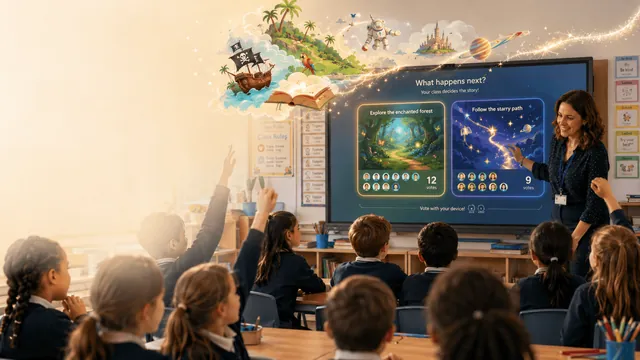
An illustration of a class reading a Litsee story on the whiteboard and voting on what happens next.

FREE TEACHER STORY UNIT · KS1 AND KS2

Autumn story writing for KS1 and KS2 – lesson plan

A golden autumn woodland class story for September to November, with no Halloween in it. KS1 help Hazel the hedgehog find one last shiny conker before she curls up for the winter; KS2 relight the oldest lantern in Autumn Lantern Wood and write a description with all five senses and a simile.

When to use it
From the middle of September to the end of November, and a calm choice for the week of Halloween.
Story world
Autumn Lantern Wood
Subject focus
English · Narrative writing
Suggested story settings
Genre: Animal Story · Length: 2 chapters · Time: 10–15 minutes

Story feel: Calm & cosy. Story shape: Quest / journey.

About this unit

This unit is about the season itself: shorter days, crunchy leaves, conkers and acorns, birds on the move and animals getting ready for the cold. It has no Halloween in it, so it suits a class or a school that would rather not mark Halloween, and it works just as well in the first weeks of the autumn term.

In KS1, Hazel the hedgehog and our hero walk a lantern-lit path, noticing autumn changes and joining in with a repeated “Crunch, crunch, crunch”. In KS2, a squirrel, an old badger and our hero relight the wood’s oldest lantern before the first frost, and the story carries simple, accurate nature facts that children can check in a book afterwards.

KS1 (Reception to Year 2): Hedgehog's Lantern Walk

Learning objective

Notice and describe seasonal changes in autumn using adjectives and the senses.

Talk questions

  1. What changes did you notice in the woods? Have you seen any of them near school?
  2. How did the animals help each other get ready for winter?

Writing task

Draw an autumn leaf or conker. Write one sentence about it using a describing word: 'I can see a ___ leaf.'

Suggested story settings: Genre: Animal Story · Length: 2 chapters · Time: 10–15 minutes

The story brief

What the class story is asked to do. “Our hero” is the character your class chooses.

An autumn story for young readers, with no Halloween content. As the evenings grow darker, a little hedgehog called Hazel is getting ready to sleep through the winter, but first she wants to find the very last shiny conker for her friends. Our hero helps Hazel along a lantern-lit woodland path, noticing autumn changes on the way: crunchy leaves, acorns, mushrooms, birds flying south and squirrels hiding nuts. Everyone helps each other. End with a cosy goodnight as Hazel curls up in her leafy nest. Use simple, repeated sounds young children can join in with, such as 'Crunch, crunch, crunch'.

Word bank

autumn
the season after summer, when leaves change colour and fall and the days get shorter
conker
the shiny brown seed of a horse chestnut tree
crunchy
making a loud, crisp sound when you step on it or bite it
hedgehog
a small animal with prickly spines on its back that sleeps through the winter
acorn
the small nut of an oak tree, which sits in a little cup

Text-type features: adventure story

Purpose: to entertain. Plan it with the free adventure story plan template.

Reception to Year 2

  • A beginning, a middle and an end
  • A character who wants something
  • A problem to solve
  • Describing words for people and places

National Curriculum statements

  • “expanded noun phrases to describe and specify [for example, the blue butterfly]”

    Year 2, Writing – vocabulary, grammar and punctuation (statutory)

  • “recognising and joining in with predictable phrases”

    Year 1, Reading – comprehension (statutory)

  • “sequencing sentences to form short narratives”

    Year 1, Writing – composition (statutory)

Sample opening · KS1

A sample written for this page to show the brief in action. It is not the story Litsee writes for your class.

Crunch, crunch, crunch went the leaves in Autumn Lantern Wood.

Hazel the hedgehog was sleepy. Soon she would curl up for the winter. But first she wanted to find one last shiny conker for her friends.

“I will help you,” said Leo, and he held up his lantern.

Crunch, crunch, crunch. They found a red leaf. They found an acorn in a little cup. They found a squirrel, busy hiding nuts.

“Have you seen a shiny conker?” asked Hazel.

The squirrel pointed up the path with her fluffy tail. “Under the big horse chestnut tree!”

Crunch, crunch, crunch, off they went.

Model text (WAGOLL)

A model answer to the writing task, pitched at Year 2, written for this page. Read it with the class and find where it meets each success criterion.

I can see a crunchy red leaf.

It has sharp points like a star and a thin brown stalk.

When I step on it, it goes crunch, crunch, crunch!

What makes it good

  • a crunchy red leaf Two describing words before the noun.
  • like a star Compares the leaf to something else.

By year group

Reception

Grammar focus: Capital letters and full stops

Crunch, crunch, crunch went the leaves in Autumn Lantern Wood.

Year 1

Grammar focus: Capital letters and full stops

Hazel the hedgehog was sleepy.

Year 2

Grammar focus: Expanded noun phrases

They found a red leaf.

A week of lessons

  1. Lesson 1

    Hook

    • Fill a tray with autumn finds (leaves, conkers, acorns, pine cones) under a cloth. Children feel one without looking and describe it to a partner before they see it.
    • Talk: What changes did you notice in the woods? Have you seen any of them near school?
  2. Lesson 2

    Plan

    • Talk: How did the animals help each other get ready for winter?
    • Words: autumn, conker, crunchy, hedgehog, acorn.
  3. Lesson 3

    Draft

    • Write: Draw an autumn leaf or conker. Write one sentence about it using a describing word: 'I can see a ___ leaf.'
  4. Lesson 4

    Edit

    • Grammar focus. Capital letters and full stops: “Hazel the hedgehog was sleepy.”
  5. Lesson 5

    Publish

    • Make a class autumn tree: each child’s leaf and sentence hangs from its branches in the corridor.
The printed plan adds the planning frame and the full steps for each lesson.

Support, core and stretch sheets

Support

Draw a leaf or conker. Choose a describing word from the mat and copy: “I can see a ___ leaf.”

Core

Draw an autumn leaf or conker. Write one sentence about it using a describing word: 'I can see a ___ leaf.'

Stretch

Write two sentences about your leaf or conker, using two different describing words and “and”.

Vocabulary mat

One A4 page for every table: the word bank with its meanings, sentence stems, useful words and grammar words.

KS2 (Years 3 to 6): The Last Lantern of Autumn

Learning objective

Use descriptive language and accurate nature facts to bring a seasonal setting to life.

Talk questions

  1. How did the characters plan and work together to solve the problem?
  2. Which facts about autumn did you learn from the story? Which could you check in a book?

Writing task

Write a short description of an autumn place you know, using all five senses and at least one simile.

Suggested story settings: Genre: Animal Story · Length: 2 chapters · Time: 10–15 minutes

The story brief

What the class story is asked to do. “Our hero” is the character your class chooses.

An autumn story for older primary readers, with no Halloween content. In Autumn Lantern Wood, the woodland animals light lanterns each evening to guide travellers as the days shorten, but this year the oldest lantern has gone out. Our hero joins a resourceful squirrel and a wise old badger to relight it before the first frost, solving small problems on the way and noticing how the wood changes: leaves turning, migrating birds, animals preparing for hibernation. Weave in accurate, simple nature facts. Show teamwork and planning. End warmly with the wood glowing again.

Word bank

hibernate
to spend the winter in a deep sleep, as hedgehogs and dormice do
migrate
to travel a long way at the same time each year, to find food or warmer weather
deciduous
describes a tree that loses all its leaves in autumn and grows new ones in spring
harvest
the time when crops, fruit and nuts are ripe and are gathered in
resourceful
good at finding clever ways to solve problems with whatever you have

Text-type features: adventure story

Purpose: to entertain. Plan it with the free adventure story plan template.

Years 3 and 4

  • An opening that sets the scene
  • A problem that builds
  • Paragraphs for each part of the story
  • Speech that shows what characters are like
  • Time words that move the story on

Years 5 and 6

  • An opening that hooks the reader
  • Rising tension and a turning point
  • Dialogue that moves the action on
  • Setting and atmosphere shown through the senses
  • A resolution that ties up the problem

National Curriculum statements

  • “discuss and evaluate how authors use language, including figurative language, considering the impact on the reader”

    Years 5 and 6, Reading – comprehension (statutory)

  • “in narratives, describing settings, characters and atmosphere and integrating dialogue to convey character and advance the action”

    Years 5 and 6, Writing – composition (statutory)

  • “retrieve and record information from non-fiction”

    Years 3 and 4, Reading – comprehension (statutory)

Sample opening · KS2

A sample written for this page to show the brief in action. It is not the story Litsee writes for your class.

Every evening in Autumn Lantern Wood, as the light faded early behind the beech trees, the animals lit the lanterns along the path. Every evening except this one.

“It’s the Old Lantern,” said Pip the squirrel, landing on the stile beside Nadia in a scatter of copper leaves. “The one at the top of the hill. It’s gone out, and nobody can relight it.”

Nadia pulled her scarf tighter. The air smelled of damp earth and woodsmoke, and her breath made small clouds.

Old Badger was waiting at the bottom of the hill, leaning on a hazel stick. “The first frost is coming,” he said. “Tonight or tomorrow. Then the hedgehogs will curl up until spring, and the travellers will need that light more than ever.”

Above them, a long line of geese crossed the pink sky, calling to one another as they arrived from the far north for the winter.

“Then we’d better start climbing,” said Nadia.

Model text (WAGOLL)

A model answer to the writing task, pitched at Year 5, written for this page. Read it with the class and find where it meets each success criterion.

The lane behind our school is quiet in October. Leaves the colour of toffee drift down from the beech trees and settle in heaps along the hedge, where they rustle like paper whenever the wind wakes them.

The air smells of damp earth and bonfire smoke. Somewhere above, a wood pigeon calls the same five notes, over and over, as if it has forgotten the rest of the song.

Under my boots, conkers roll and crack. I pick one up; it is cool and smooth, shining like a polished conker should, with a pale patch on top like a little moon.

By four o’clock the light has gone soft and golden, and the lane feels like the inside of a jar of honey.

What makes it good

  • Leaves the colour of toffee An unusual comparison that helps the reader see the colour.
  • The air smells of damp earth and bonfire smoke. Uses the sense of smell, not only sight.
  • the lane feels like the inside of a jar of honey Ends on a surprising simile that sums up the feeling.

By year group

Year 3

Grammar focus: Conjunctions to join clauses

Year 4

Grammar focus: Expanded noun phrases

“It’s the Old Lantern,” said Pip the squirrel, landing on the stile beside Nadia in a scatter of copper leaves.

Year 5

Grammar focus: Expanded noun phrases

Above them, a long line of geese crossed the pink sky, calling to one another as they arrived from the far north for the winter.

Year 6

Grammar focus: Linking ideas across paragraphs

A week of lessons

  1. Lesson 1

    Hook

    • Dim the lights, play a recording of wind and rustling leaves, and light a battery lantern. Ask: what would it mean to a wood if its oldest lantern went out?
    • Talk: How did the characters plan and work together to solve the problem?
  2. Lesson 2

    Plan

    • Talk: Which facts about autumn did you learn from the story? Which could you check in a book?
    • Words: hibernate, migrate, deciduous, harvest, resourceful.
  3. Lesson 3

    Draft

    • Write: Write a short description of an autumn place you know, using all five senses and at least one simile.
  4. Lesson 4

    Edit

    • Grammar focus. Expanded noun phrases: ““It’s the Old Lantern,” said Pip the squirrel, landing on the stile beside Nadia in a scatter of copper leaves.”
  5. Lesson 5

    Publish

    • Read the descriptions aloud by lantern light, and choose the best simile from each table for a class “autumn words” display.
The printed plan adds the planning frame and the full steps for each lesson.

Support, core and stretch sheets

Support

Write three sentences about an autumn place: one for what you see, one for what you hear and one for what you smell.

Core

Write a short description of an autumn place you know, using all five senses and at least one simile.

Stretch

Write your description so that the place seems to change as the light fades, and end with a simile that surprises the reader.

Vocabulary mat

One A4 page for every table: the word bank with its meanings, sentence stems, useful words and grammar words.

Teaching notes

Take the class outside before you read. A ten-minute walk round the school grounds to collect leaves, seeds and words gives KS1 children real things to describe, and links to the seasonal changes they study in Year 1 science. Bring the finds back and use them for the “I can see a ___ leaf” sentences.

Read the KS1 story with actions: the whole class says “Crunch, crunch, crunch” and pats their knees each time. The repeated line gives every child a way to join in, and it is a natural place to stop and ask what Hazel and our hero might find next.

For KS2, collect the story’s nature facts on the board as you read (which animals hibernate, which birds arrive or leave, which trees drop their leaves) and ask children to check one of them in a book or a reliable website. This is the second talk question, and it turns a story into a small research task.

Before the description task, model one sentence for each of the five senses about a real place near school, then turn one of them into a simile together. Children can borrow the wood’s words (copper, damp, woodsmoke) or find their own.

Printable lesson sheet

One A4 page for each key stage, ready for your planning folder: the story title, objective, story settings, talk questions, writing task, word bank with meanings, success criteria, curriculum statements and the sample opening to read aloud. Printing this page prints only the two sheets.

About this page

How it works · Sources

Sources

The curriculum quotations are copied word for word from these documents. Dates were checked on 29 October 2026.

About this page

Built from Litsee’s curriculum data. The story titles, briefs, objectives, talk questions, writing tasks, word lists and story settings come from the seasonal class-story packs in the Litsee app; the text-type features come from the app’s curriculum data; the National Curriculum quotations are quoted word for word from the Department for Education’s documents. The word meanings, sample openings and teaching notes were written for this page, and every date was checked against the source named beside it. Ideas or corrections? Email info@litsee.com.

Last updated: .

Questions parents and teachers ask

Does this autumn unit include Halloween?

No. It is a seasonal story with lanterns, leaves and woodland animals, written to be used instead of Halloween by schools and families who prefer not to mark it.

Are the nature facts in the stories accurate?

The briefs ask for simple, accurate facts: hedgehogs and dormice hibernate, many birds migrate, and deciduous trees drop their leaves. Ask children to check any new fact they add in a book, as the KS2 talk question suggests.

When should I teach the autumn unit?

Any time from the middle of September to the end of November. It sits well in the first half term, or in the week of Halloween as a calm alternative.

Run this as a live class story in Litsee

In Litsee, a seasonal brief like this becomes an illustrated, narrated class story. You preview the first chapter before reading it with your class, and the class chooses what happens next together.

Autumn story unit · KS1 (Reception to Year 2)

Hedgehog's Lantern Walk

Learning objective: Notice and describe seasonal changes in autumn using adjectives and the senses.

Suggested story settings: Genre: Animal Story · Length: 2 chapters · Time: 10–15 minutes · Story world: Autumn Lantern Wood

Talk questions

  1. What changes did you notice in the woods? Have you seen any of them near school?
  2. How did the animals help each other get ready for winter?

Writing task

Draw an autumn leaf or conker. Write one sentence about it using a describing word: 'I can see a ___ leaf.'

Word bank

autumn
the season after summer, when leaves change colour and fall and the days get shorter
conker
the shiny brown seed of a horse chestnut tree
crunchy
making a loud, crisp sound when you step on it or bite it
hedgehog
a small animal with prickly spines on its back that sleeps through the winter
acorn
the small nut of an oak tree, which sits in a little cup

Success criteria (adventure story)

Reception to Year 2: I can write a beginning, a middle and an end. I can use describing words. I can use capital letters and full stops.

National Curriculum statements

  • “expanded noun phrases to describe and specify [for example, the blue butterfly]” (Year 2, Writing – vocabulary, grammar and punctuation (statutory))
  • “recognising and joining in with predictable phrases” (Year 1, Reading – comprehension (statutory))
  • “sequencing sentences to form short narratives” (Year 1, Writing – composition (statutory))

Sample opening (written for litsee.com, to read aloud)

Crunch, crunch, crunch went the leaves in Autumn Lantern Wood.

Hazel the hedgehog was sleepy. Soon she would curl up for the winter. But first she wanted to find one last shiny conker for her friends.

“I will help you,” said Leo, and he held up his lantern.

Crunch, crunch, crunch. They found a red leaf. They found an acorn in a little cup. They found a squirrel, busy hiding nuts.

“Have you seen a shiny conker?” asked Hazel.

The squirrel pointed up the path with her fluffy tail. “Under the big horse chestnut tree!”

Crunch, crunch, crunch, off they went.

Notes

Free from litsee.com/teachers/story-units/autumn

Autumn story unit · KS2 (Years 3 to 6)

The Last Lantern of Autumn

Learning objective: Use descriptive language and accurate nature facts to bring a seasonal setting to life.

Suggested story settings: Genre: Animal Story · Length: 2 chapters · Time: 10–15 minutes · Story world: Autumn Lantern Wood

Talk questions

  1. How did the characters plan and work together to solve the problem?
  2. Which facts about autumn did you learn from the story? Which could you check in a book?

Writing task

Write a short description of an autumn place you know, using all five senses and at least one simile.

Word bank

hibernate
to spend the winter in a deep sleep, as hedgehogs and dormice do
migrate
to travel a long way at the same time each year, to find food or warmer weather
deciduous
describes a tree that loses all its leaves in autumn and grows new ones in spring
harvest
the time when crops, fruit and nuts are ripe and are gathered in
resourceful
good at finding clever ways to solve problems with whatever you have

Success criteria (adventure story)

Years 3 and 4: I can set the scene in my opening. I can build up to a problem and solve it. I can use paragraphs. I can punctuate speech.

Years 5 and 6: I can hook the reader in my opening. I can build tension towards a turning point. I can use dialogue to move the action on. I can show the setting through the senses.

National Curriculum statements

  • “discuss and evaluate how authors use language, including figurative language, considering the impact on the reader” (Years 5 and 6, Reading – comprehension (statutory))
  • “in narratives, describing settings, characters and atmosphere and integrating dialogue to convey character and advance the action” (Years 5 and 6, Writing – composition (statutory))
  • “retrieve and record information from non-fiction” (Years 3 and 4, Reading – comprehension (statutory))

Sample opening (written for litsee.com, to read aloud)

Every evening in Autumn Lantern Wood, as the light faded early behind the beech trees, the animals lit the lanterns along the path. Every evening except this one.

“It’s the Old Lantern,” said Pip the squirrel, landing on the stile beside Nadia in a scatter of copper leaves. “The one at the top of the hill. It’s gone out, and nobody can relight it.”

Nadia pulled her scarf tighter. The air smelled of damp earth and woodsmoke, and her breath made small clouds.

Old Badger was waiting at the bottom of the hill, leaning on a hazel stick. “The first frost is coming,” he said. “Tonight or tomorrow. Then the hedgehogs will curl up until spring, and the travellers will need that light more than ever.”

Above them, a long line of geese crossed the pink sky, calling to one another as they arrived from the far north for the winter.

“Then we’d better start climbing,” said Nadia.

Notes

Free from litsee.com/teachers/story-units/autumn

Try it in LitseeYour child creates the hero, picks the world and chooses what happens next, in an illustrated story that is read aloud.Start your free trialUse it in classRead an illustrated, narrated story together on the whiteboard, and let the class choose what happens next.Start a free classroom trialSee Litsee for schools