Help us improve Litsee

With your permission, Google Analytics measures visits and Microsoft Clarity records clicks, scrolling and page interactions, with form inputs and page text masked. We use no advertising cookies.

Change it any time with Cookie settings. Privacy policy · Google privacy · Microsoft privacy

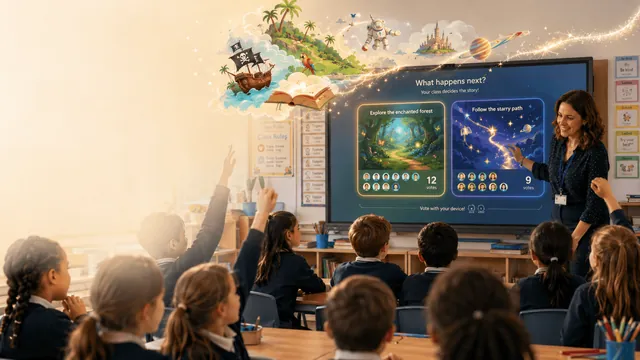
An illustration of a class reading a Litsee story on the whiteboard and voting on what happens next.

FREE TEACHER STORY UNIT · KS1 AND KS2

Diwali story lesson for KS1 and KS2

A gentle festival-of-lights class story for early November, written with Hindu, Sikh and Jain families in mind. KS1 help their neighbour Asha paint diyas and remake a rain-smudged rangoli; KS2 follow three friends getting their street ready and write a diary entry about the evening.

When to use it
The days around Diwali, in the first half of November.
Date
In 2026, Diwali Day is Sunday 8 November, the day Leicester City Council holds its Diwali Day celebrations. The festival lasts several days and its date moves each year with the lunar calendar, and some families mark it on a different day: check the date with the families in your class. Source
Story world
Diwali Lights Town
Subject focus
Religious Education · Festivals
Suggested story settings
Genre: Friendship · Length: 2 chapters · Time: 10–15 minutes

Story feel: Wonder & discovery. Story shape: Character change.

About this unit

Diwali is the festival of lights. It is celebrated by Hindu, Sikh and Jain families, in different ways and for different reasons. For Sikhs, the same time of year is Bandi Chhor Divas, which remembers the release of Guru Hargobind from prison; for Jains, it marks Mahavira’s moksha, which Jains believe was his freedom from the cycle of rebirth. What many families share is light: rows of little clay lamps called diyas, rangoli patterns at the door, fireworks, new clothes, sweets and visits to friends and neighbours.

The stories show the festival through family, neighbours, light and sharing, as the briefs ask, and they leave religious stories and ceremonies to your RE lessons. In KS1, children help Asha get ready and learn the words for what they see. In KS2, three friends from different families talk about what Diwali means at home, and children compare their traditions using respectful, accurate words.

Litsee’s notes for this pack ask for the story briefs to be checked with Hindu, Sikh and Jain families or educators, including whether each tradition is described fairly and the spellings of diya, rangoli and mithai. That check is planned and has not happened yet; we will say so here when it has.

KS1 (Reception to Year 2): The Brightest Diya

Learning objective

Describe how some families celebrate Diwali and why light and sharing are important to them.

Talk questions

  1. How did Asha's family get ready for Diwali?
  2. What do you do with your family to celebrate special days?

Writing task

Draw a rangoli pattern. Write one sentence about Diwali: 'At Diwali, families ___.'

Suggested story settings: Genre: Friendship · Length: 2 chapters · Time: 10–15 minutes

The story brief

What the class story is asked to do. “Our hero” is the character your class chooses.

A Diwali story for young readers, written with Hindu, Sikh and Jain families in mind. Our hero's neighbour, Asha, invites them to help get ready for Diwali, the festival of lights. Together they paint little clay diyas, make a colourful rangoli pattern on the doorstep and share sweets with the whole street. When rain smudges the rangoli, everyone helps make an even more beautiful one. Show the festival through family, light, kindness and sharing. Do not retell religious stories or show worship; focus on how families and neighbours celebrate together. End with the street glowing with lights.

Word bank

Diwali
a festival of light celebrated by Hindu, Sikh and Jain families in the autumn
diya
a small clay lamp with a cotton wick, filled with oil and lit at Diwali
rangoli
a colourful pattern made on the floor or doorstep with coloured powder, rice or flowers
festival
a time of year when people get together to celebrate something special
share
to give some of what you have to other people, so that everyone can enjoy it

Text-type features: information report

Purpose: to tell the reader facts about a subject. Plan it with the free information report plan template.

Reception to Year 2

  • A title
  • Facts, not a story
  • Headings
  • Labelled pictures

National Curriculum statements

  • “being encouraged to link what they read or hear read to their own experiences”

    Year 1, Reading – comprehension (statutory)

  • “discussing word meanings, linking new meanings to those already known”

    Year 1, Reading – comprehension (statutory)

  • “writing about real events”

    Year 2, Writing – composition (statutory)

Sample opening · KS1

A sample written for this page to show the brief in action. It is not the story Litsee writes for your class.

On Asha’s street, everyone was getting ready for Diwali.

“Will you help us?” asked Asha. She held out a tray of little clay lamps. “These are diyas. We paint them, and then we light them at Diwali.”

Ben painted his diya blue with yellow dots. Asha painted hers orange, like a marigold.

Next, they made a rangoli on the doorstep. They poured red, green and purple powder into a pattern of petals.

But then, pitter-patter, it began to rain. The rangoli went smudgy and runny.

“Oh no!” said Ben.

Asha’s grandad smiled. “Then we make a new one,” he said, “even brighter than before.”

Model text (WAGOLL)

A model answer to the writing task, pitched at Year 2, written for this page. Read it with the class and find where it meets each success criterion.

At Diwali, families light little clay lamps called diyas.

They make bright rangoli patterns on the doorstep with coloured powder.

Some families share sweets with their neighbours, so the whole street feels happy and glowing.

What makes it good

  • little clay lamps called diyas Uses a word from the word bank and explains it.
  • Some families Says “some families”, not “everyone”: respectful and accurate.

By year group

Reception

Grammar focus: Capital letters and full stops

On Asha’s street, everyone was getting ready for Diwali.

Year 1

Grammar focus: Capital letters and full stops

She held out a tray of little clay lamps.

Year 2

Grammar focus: Expanded noun phrases

“Then we make a new one,” he said, “even brighter than before.”

A week of lessons

  1. Lesson 1

    Hook

    • Show a clay diya, a photograph of a rangoli and a marigold (real or paper). Ask: what do you think these are for? Then read the opening.
    • Talk: How did Asha's family get ready for Diwali?
  2. Lesson 2

    Plan

    • Talk: What do you do with your family to celebrate special days?
    • Words: Diwali, diya, rangoli, festival, share.
  3. Lesson 3

    Draft

    • Write: Draw a rangoli pattern. Write one sentence about Diwali: 'At Diwali, families ___.'
  4. Lesson 4

    Edit

    • Grammar focus. Capital letters and full stops: “She held out a tray of little clay lamps.”
  5. Lesson 5

    Publish

    • Arrange the rangoli drawings and sentences into one big class rangoli pattern on the floor or the wall.
The printed plan adds the planning frame and the full steps for each lesson.

Support, core and stretch sheets

Support

Draw a rangoli pattern. Choose a word from the mat and copy: “At Diwali, families ___.”

Core

Draw a rangoli pattern. Write one sentence about Diwali: 'At Diwali, families ___.'

Stretch

Write two sentences about Diwali: what families do, and why light matters.

Vocabulary mat

One A4 page for every table: the word bank with its meanings, sentence stems, useful words and grammar words.

KS2 (Years 3 to 6): Lights Along the Street

Learning objective

Explain how and why Diwali is celebrated by different communities, using respectful vocabulary.

Talk questions

  1. What did each friend's family do to celebrate? What was the same and what was different?
  2. Why do you think light is such an important symbol for so many festivals?

Writing task

Write a short diary entry from one of the friends about their Diwali evening, including what they saw, heard and felt.

Suggested story settings: Genre: Friendship · Length: 2 chapters · Time: 10–15 minutes

The story brief

What the class story is asked to do. “Our hero” is the character your class chooses.

A Diwali story for older primary readers, written with Hindu, Sikh and Jain families in mind. In Diwali Lights Town, three friends from different families are helping prepare their street's Diwali celebration: lighting diyas, designing rangoli, making and sharing mithai, and sending messages of good wishes. Through the friends, show gently that Diwali is celebrated by Hindus, Sikhs and Jains, sometimes for different reasons, and that light over darkness and kindness to others matter to all of them. Do not retell religious stories in detail or show worship; let the characters speak respectfully about what the festival means to their own families. Include a small problem the friends solve together. End with the street full of light.

Word bank

celebration
a happy event or party to mark a special day
community
a group of people who live near each other or share something important
symbol
an object or picture that stands for an idea, as light can stand for hope
tradition
a way of doing something that is passed down in a family or group for many years
mithai
South Asian sweets, such as barfi and ladoo, that families make and share at Diwali

Text-type features: diary entry

Purpose: to recount events and share feelings. Plan it with the free diary entry plan template.

Years 3 and 4

  • First person and past tense
  • Events in time order with time words
  • Thoughts and feelings
  • A chatty, personal voice

Years 5 and 6

  • First person, mostly past tense
  • Reflection on events, not just a list
  • Thoughts, feelings and questions
  • An informal, personal voice
  • Hopes or worries for tomorrow

National Curriculum statements

  • “making comparisons within and across books”

    Years 5 and 6, Reading – comprehension (statutory)

  • “select and use appropriate registers for effective communication”

    Years 1 to 6, Spoken language (statutory)

  • “composing and rehearsing sentences orally (including dialogue), progressively building a varied and rich vocabulary and an increasing range of sentence structures (English Appendix 2)”

    Years 3 and 4, Writing – composition (statutory)

Sample opening · KS2

A sample written for this page to show the brief in action. It is not the story Litsee writes for your class.

Three days before Diwali, the street committee put Priya, Harjot and Nisha in charge of the lights.

“Fifty diyas along the front walls,” Priya read from the list, “and a rangoli at the end of the street, where everyone can see it.”

They worked all afternoon at Nisha’s kitchen table, pressing patterns into soft clay. Priya told the others that her family would put diyas in every window, because light reminds them that brightness always comes back after dark. Harjot said his family would go to the gurdwara for Bandi Chhor Divas, then come home for fireworks and food. Nisha explained that, for her family, Diwali was a quieter, thoughtful time, when they remembered Mahavira, a great teacher.

“So it’s the same night,” said Harjot slowly, “but not quite the same reasons.”

“And all of us light lamps,” said Nisha.

Then Priya counted the finished diyas again and frowned. There were only thirty-eight.

Model text (WAGOLL)

A model answer to the writing task, pitched at Year 5, written for this page. Read it with the class and find where it meets each success criterion.

Sunday 8th November

Dear Diary,

Tonight our street looked like a river of light. Every front wall had a row of diyas on it (all fifty of them, in the end, because Nisha’s grandad made the last twelve), and the rangoli at the end of the road glowed orange, pink and gold.

My family lit our diyas at sunset. Mum says the light reminds us that brightness always comes back after dark, and that we should share it. Harjot’s family came home from the gurdwara and joined us for the fireworks, and Nisha’s family brought a tray of barfi for everyone.

I could hear sparklers fizzing, music from three different houses and Mrs Kaur laughing at the top of the road.

I felt proud, because our little street had made something beautiful together.

What makes it good

  • Tonight our street looked like a river of light. Opens with a strong image that sets the scene.
  • (all fifty of them, in the end, because Nisha’s grandad made the last twelve) Brackets add extra information without breaking the sentence.
  • Mum says the light reminds us Speaks about the writer’s own family, which keeps the words respectful.

By year group

Year 3

Grammar focus: Conjunctions to join clauses

Nisha explained that, for her family, Diwali was a quieter, thoughtful time, when they remembered Mahavira, a great teacher.

Year 4

Grammar focus: Conjunctions to join clauses

I felt proud, because our little street had made something beautiful together.

Year 5

Grammar focus: Words for time, place and cause

Then Priya counted the finished diyas again and frowned.

Year 6

Grammar focus: Paragraphs and headings

A week of lessons

  1. Lesson 1

    Hook

    • Show three photographs of streets lit for Diwali in different places. Ask: what is the same in every picture? Light is the answer the story builds on.
    • Talk: What did each friend's family do to celebrate? What was the same and what was different?
  2. Lesson 2

    Plan

    • Talk: Why do you think light is such an important symbol for so many festivals?
    • Words: celebration, community, symbol, tradition, mithai.
  3. Lesson 3

    Draft

    • Write: Write a short diary entry from one of the friends about their Diwali evening, including what they saw, heard and felt.
  4. Lesson 4

    Edit

    • Grammar focus. Conjunctions to join clauses: “I felt proud, because our little street had made something beautiful together.”
  5. Lesson 5

    Publish

    • Read the diary entries aloud in a lit “street” of paper diyas, and choose lines from different entries for a class Diwali poem.
The printed plan adds the planning frame and the full steps for each lesson.

Support, core and stretch sheets

Support

Write three diary sentences about the evening: one for what you saw, one for what you heard and one for how you felt.

Core

Write a short diary entry from one of the friends about their Diwali evening, including what they saw, heard and felt.

Stretch

Write the entry in the voice of one friend, and include what another friend’s family does differently, using respectful words.

Vocabulary mat

One A4 page for every table: the word bank with its meanings, sentence stems, useful words and grammar words.

Teaching notes

If you have Hindu, Sikh or Jain pupils, talk to their families before you teach the unit: some will be glad to share how they celebrate, and others will prefer not to. Never ask a child to speak for everyone of their faith. The stories let each character talk about their own family, which is a good model for class talk.

For KS1, make a class rangoli on paper or with chalk in the playground. Halfway through, “smudge” part of it on purpose, as the rain does in the story, and ask the class how Asha’s family felt and what they did next.

For KS2, draw a three-column table with Priya’s, Harjot’s and Nisha’s families at the top and fill it in as you read: what each family does, and why. Then circle what all three share. Collect the respectful phrases the friends use (“in my family”, “for us”, “we remember”) for children to use in their diary entries.

If some families would rather their child did not take part in a festival unit, the autumn unit has the same cosy, lantern-lit feel with no festival in it, and it is written for the same weeks.

Printable lesson sheet

One A4 page for each key stage, ready for your planning folder: the story title, objective, story settings, talk questions, writing task, word bank with meanings, success criteria, curriculum statements and the sample opening to read aloud. Printing this page prints only the two sheets.

About this page

How it works · Sources

Sources

The curriculum quotations are copied word for word from these documents. Dates were checked on 29 October 2026.

About this page

Built from Litsee’s curriculum data. The story titles, briefs, objectives, talk questions, writing tasks, word lists and story settings come from the seasonal class-story packs in the Litsee app; the text-type features come from the app’s curriculum data; the National Curriculum quotations are quoted word for word from the Department for Education’s documents. The word meanings, sample openings and teaching notes were written for this page, and every date was checked against the source named beside it. Ideas or corrections? Email info@litsee.com.

Last updated: .

Questions parents and teachers ask

When is Diwali 2026?

Diwali Day 2026 is Sunday 8 November, and the celebrations last several days. The date moves each year, because it follows the lunar calendar, and some families mark it on a different day, so check the date with families in your class.

Who celebrates Diwali?

Hindu, Sikh and Jain families, in different ways and for different reasons. For Sikhs it is also Bandi Chhor Divas, and for Jains it marks Mahavira’s moksha. Light, family and sharing matter to all of them.

Do the stories retell religious stories?

No. Both briefs show Diwali through family, neighbours, light and sharing. Religious stories and ceremonies are left to your school’s RE syllabus.

Is there a version for children who do not celebrate festivals?

Yes. The autumn unit has a lantern-lit woodland story with no festival in it, written for the same weeks of the year.

Run this as a live class story in Litsee

In Litsee, a seasonal brief like this becomes an illustrated, narrated class story. You preview the first chapter before reading it with your class, and the class chooses what happens next together.

Diwali story unit · KS1 (Reception to Year 2)

The Brightest Diya

Learning objective: Describe how some families celebrate Diwali and why light and sharing are important to them.

Suggested story settings: Genre: Friendship · Length: 2 chapters · Time: 10–15 minutes · Story world: Diwali Lights Town

Talk questions

  1. How did Asha's family get ready for Diwali?
  2. What do you do with your family to celebrate special days?

Writing task

Draw a rangoli pattern. Write one sentence about Diwali: 'At Diwali, families ___.'

Word bank

Diwali
a festival of light celebrated by Hindu, Sikh and Jain families in the autumn
diya
a small clay lamp with a cotton wick, filled with oil and lit at Diwali
rangoli
a colourful pattern made on the floor or doorstep with coloured powder, rice or flowers
festival
a time of year when people get together to celebrate something special
share
to give some of what you have to other people, so that everyone can enjoy it

Success criteria (information report)

Reception to Year 2: I can write facts. I can use a heading. I can label a picture.

National Curriculum statements

  • “being encouraged to link what they read or hear read to their own experiences” (Year 1, Reading – comprehension (statutory))
  • “discussing word meanings, linking new meanings to those already known” (Year 1, Reading – comprehension (statutory))
  • “writing about real events” (Year 2, Writing – composition (statutory))

Sample opening (written for litsee.com, to read aloud)

On Asha’s street, everyone was getting ready for Diwali.

“Will you help us?” asked Asha. She held out a tray of little clay lamps. “These are diyas. We paint them, and then we light them at Diwali.”

Ben painted his diya blue with yellow dots. Asha painted hers orange, like a marigold.

Next, they made a rangoli on the doorstep. They poured red, green and purple powder into a pattern of petals.

But then, pitter-patter, it began to rain. The rangoli went smudgy and runny.

“Oh no!” said Ben.

Asha’s grandad smiled. “Then we make a new one,” he said, “even brighter than before.”

Notes

Free from litsee.com/teachers/story-units/diwali

Diwali story unit · KS2 (Years 3 to 6)

Lights Along the Street

Learning objective: Explain how and why Diwali is celebrated by different communities, using respectful vocabulary.

Suggested story settings: Genre: Friendship · Length: 2 chapters · Time: 10–15 minutes · Story world: Diwali Lights Town

Talk questions

  1. What did each friend's family do to celebrate? What was the same and what was different?
  2. Why do you think light is such an important symbol for so many festivals?

Writing task

Write a short diary entry from one of the friends about their Diwali evening, including what they saw, heard and felt.

Word bank

celebration
a happy event or party to mark a special day
community
a group of people who live near each other or share something important
symbol
an object or picture that stands for an idea, as light can stand for hope
tradition
a way of doing something that is passed down in a family or group for many years
mithai
South Asian sweets, such as barfi and ladoo, that families make and share at Diwali

Success criteria (diary entry)

Years 3 and 4: I can write in the first person and past tense. I can use time words. I can share thoughts and feelings.

Years 5 and 6: I can reflect on events, not just list them. I can keep a personal voice. I can keep my tense consistent.

National Curriculum statements

  • “making comparisons within and across books” (Years 5 and 6, Reading – comprehension (statutory))
  • “select and use appropriate registers for effective communication” (Years 1 to 6, Spoken language (statutory))
  • “composing and rehearsing sentences orally (including dialogue), progressively building a varied and rich vocabulary and an increasing range of sentence structures (English Appendix 2)” (Years 3 and 4, Writing – composition (statutory))

Sample opening (written for litsee.com, to read aloud)

Three days before Diwali, the street committee put Priya, Harjot and Nisha in charge of the lights.

“Fifty diyas along the front walls,” Priya read from the list, “and a rangoli at the end of the street, where everyone can see it.”

They worked all afternoon at Nisha’s kitchen table, pressing patterns into soft clay. Priya told the others that her family would put diyas in every window, because light reminds them that brightness always comes back after dark. Harjot said his family would go to the gurdwara for Bandi Chhor Divas, then come home for fireworks and food. Nisha explained that, for her family, Diwali was a quieter, thoughtful time, when they remembered Mahavira, a great teacher.

“So it’s the same night,” said Harjot slowly, “but not quite the same reasons.”

“And all of us light lamps,” said Nisha.

Then Priya counted the finished diyas again and frowned. There were only thirty-eight.

Notes

Free from litsee.com/teachers/story-units/diwali

Try it in LitseeYour child creates the hero, picks the world and chooses what happens next, in an illustrated story that is read aloud.Start your free trialUse it in classRead an illustrated, narrated story together on the whiteboard, and let the class choose what happens next.Start a free classroom trialSee Litsee for schools