
Help us improve Litsee

With your permission, Google Analytics measures visits and Microsoft Clarity records clicks, scrolling and page interactions, with form inputs and page text masked. We use no advertising cookies.

Change it any time with Cookie settings. Privacy policy · Google privacy · Microsoft privacy

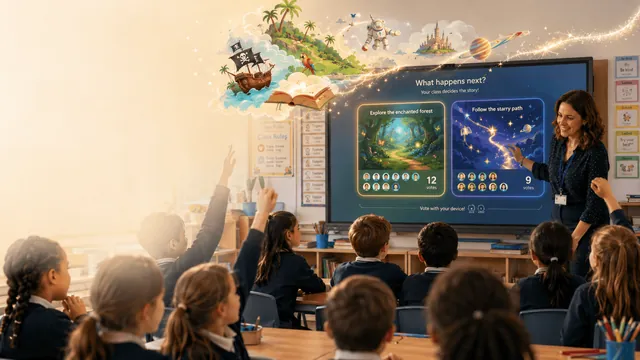
An illustration of a class reading a Litsee story on the whiteboard and voting on what happens next.

FREE TEACHER STORY UNIT · KS2

Vikings story lesson for KS2

An adventurous class story for the Vikings topic in Years 4 to 6, without any fighting. Our hero sails with Astrid’s family of settlers, reads runes, hears sagas and helps the newcomers and an Anglo-Saxon village trade fairly. Children write a saga about the voyage.

When to use it
Any time during your Vikings and Anglo-Saxons topic in Years 4 to 6.
Story world
Fjord Harbour
Subject focus
History · The Vikings and Anglo-Saxons
Suggested story settings
Genre: Adventure · Length: 2 chapters · Time: 10–15 minutes

Story feel: Friendship & teamwork. Story shape: Quest / journey.

About this unit

The Vikings are often taught as raiders, but many came to Britain to settle, farm and trade. This unit tells that side of the story: a family crossing the sea in a longship to find new land, and a careful first meeting with an Anglo-Saxon village.

Children meet runes, sagas, longships and trade, and the second talk question asks them to imagine how the meeting could have gone differently. The writing task is a saga, so children try the Vikings’ own way of telling stories.

KS2 (Years 4 to 6): The Longship’s New Home

Learning objective

Explain why many Vikings came to Britain, and how settlers and villagers could live and trade together.

Talk questions

  1. Why were Astrid’s family looking for a new home?
  2. How did trading help the settlers and the villagers? Could it have gone differently?

Writing task

Write a short saga about the voyage, as the oldest sailor would tell it, with a strong opening, the journey, the problem at the village and how it was solved.

Suggested story settings: Genre: Adventure · Length: 2 chapters · Time: 10–15 minutes

The story brief

What the class story is asked to do. “Our hero” is the character your class chooses.

A Viking voyage for older primary readers. Our hero sails on a longship with Astrid and her family, settlers looking for new land to farm across the sea. On the voyage they read runes on an old map, steer by the sun and the stars, and listen to sagas told by the oldest sailor. When they land, the Anglo-Saxon villagers are wary, and the two groups cannot understand each other. Our hero helps them trade fairly instead, swapping wool and amber for grain and a place to build. Show Viking life accurately (farming, crafts, trading, ships, sagas) and that many Vikings came to settle and trade. Adventure without fighting.

Word bank

longship
a long, narrow Viking boat with oars and a sail
saga
a long Viking story about heroes and journeys
settler
a person who moves to a new place to live
trade
to swap or sell goods
voyage
a long journey by sea

Text-type features: myth or legend

Purpose: to explain how something came to be, or to tell of a great hero. Plan it with the free myth or legend plan template.

Years 3 and 4

  • A hero with a special quality
  • A quest or a challenge
  • A magical creature or object
  • An ending that explains something about the world

Years 5 and 6

  • A hero with a flaw as well as a strength
  • A quest with tests of character
  • A magical creature or object with rules
  • An ending that explains something about the world
  • A narrator's voice that sounds old and wise

National Curriculum statements

  • “increasing their familiarity with a wide range of books, including myths, legends and traditional stories, modern fiction, fiction from our literary heritage, and books from other cultures and traditions”

    Years 5 and 6, Reading – comprehension (statutory)

  • “in narratives, describing settings, characters and atmosphere and integrating dialogue to convey character and advance the action”

    Years 5 and 6, Writing – composition (statutory)

  • “increasing their familiarity with a wide range of books, including fairy stories, myths and legends, and retelling some of these orally”

    Years 3 and 4, Reading – comprehension (statutory)

  • “the Viking and Anglo-Saxon struggle for the Kingdom of England to the time of Edward the Confessor”

    Key stage 2, History (statutory)

Sample opening · KS2

A sample written for this page to show the brief in action. It is not the story Litsee writes for your class.

The longship rose on the grey swell and slid down the other side, and our hero gripped the edge of the bench with both hands.

“Don’t hold on so tight,” laughed Astrid, who was twelve and had sailed twice before. “Let the ship do the work.” She pointed up at the striped sail, fat with wind. “Three more days, Grandfather says. Maybe four.”

At the stern, Astrid’s grandfather held the steering oar and squinted at the sun. Around him sat the whole family: Astrid’s mother, two uncles, a cousin with a sleeping baby, five sheep in a pen made of rope, and sacks of wool, seed and amber.

“Why are you leaving?” asked our hero.

Astrid looked back towards the coast they had left, all rock and narrow valleys. “There isn’t enough good land at home for everyone,” she said. “Across the sea, there is. We’re going to farm.”

That night, under more stars than our hero had ever seen, Grandfather began to tell a saga.

Model text (WAGOLL)

A model answer to the writing task, pitched at Year 5, written for this page. Read it with the class and find where it meets each success criterion.

Listen, and I will tell you of the voyage of the sea-horse, and of Astrid, who was clever as well as brave.

Out from the narrow valley we sailed, where the land was too small for all our children. The wind filled our striped sail, and the sea-horse leapt over the grey waves for four days and four nights.

On the fifth morning we saw a green shore and a village of thatched roofs. The villagers came down to the beach with wary faces, and we could not understand a word they said.

Then Astrid stepped forward. She did not shout; she did not wave her arms. She opened a sack of amber and set one golden piece on the sand. A villager placed a bag of grain beside it, and Astrid smiled.

And that, my children, is how we came to farm by the river, and why we still trade with our neighbours to this day.

What makes it good

  • Listen, and I will tell you Opens in the voice of a storyteller, as a saga would.
  • the sea-horse A kenning: a two-word name for the ship.
  • She did not shout; she did not wave her arms. A semi-colon joins two closely linked clauses for effect.

By year group

Year 4

Grammar focus: Fronted adverbials

Three more days, Grandfather says.

Year 5

Grammar focus: Expanded noun phrases

On the fifth morning we saw a green shore and a village of thatched roofs.

Year 6

Grammar focus: Paragraphs and headings

A week of lessons

  1. Lesson 1

    Hook

    • Turn the tables into a longship: two rows of benches, a cardboard steering oar at the back. Read the opening by torchlight, as if the class were at sea.
    • Talk: Why were Astrid’s family looking for a new home?
  2. Lesson 2

    Plan

    • Talk: How did trading help the settlers and the villagers? Could it have gone differently?
    • Words: longship, saga, settler, trade, voyage.
  3. Lesson 3

    Draft

    • Write: Write a short saga about the voyage, as the oldest sailor would tell it, with a strong opening, the journey, the problem at the village and how it was solved.
  4. Lesson 4

    Edit

    • Grammar focus. Expanded noun phrases: “On the fifth morning we saw a green shore and a village of thatched roofs.”
  5. Lesson 5

    Publish

    • Hold a saga night: dim the lights, sit in a circle and let children tell their sagas aloud, as the Vikings did.
The printed plan adds the planning frame and the full steps for each lesson.

Support, core and stretch sheets

Support

Write the saga in four sentences: the start of the voyage, the sea, the village and the happy ending.

Core

Write a short saga about the voyage, as the oldest sailor would tell it, with a strong opening, the journey, the problem at the village and how it was solved.

Stretch

Write the saga with a repeated line, like a chorus, and a kenning (a two-word name such as “sea-horse” for a ship).

Vocabulary mat

One A4 page for every table: the word bank with its meanings, sentence stems, useful words and grammar words.

Teaching notes

Start with a map. Show where the Viking homelands were and where the settlers went, and ask why a family might cross the sea in an open boat. Land to farm, trade and adventure are all good answers; the story builds on the first two.

Teach a few runes before the second chapter, and let children write their names in the runic alphabet. Reading the runes on Astrid’s map then feels like a real skill, not a trick.

Before children write their sagas, read aloud a short, child-friendly retelling of a Norse saga and list its features: a bold opening, a journey, a problem, a clever or brave solution, and a voice like someone telling it round a fire.

Printable lesson sheet

One A4 page, ready for your planning folder: the story title, objective, story settings, talk questions, writing task, word bank with meanings, success criteria, curriculum statements and the sample opening to read aloud. Printing this page prints only that sheet.

About this page

How it works · Sources

About this page

Built from Litsee’s curriculum data. The topic words and their meanings, the year groups and the history, geography and science statements come from the topic data in the Litsee app, quoted word for word from the Department for Education’s documents; the text-type features and English quotations come from the app’s curriculum data. The story briefs, objectives, questions, tasks, sample openings, model texts and teaching notes were written for this page. Ideas or corrections? Email info@litsee.com.

Last updated: .

Questions parents and teachers ask

Why does the Vikings story not include raids?

Because many Vikings came to Britain to settle, farm and trade, and this story tells that side: a family of settlers crossing the sea, trading fairly and making a new home.

Which year groups is the Vikings unit for?

Years 4 to 6. The Viking and Anglo-Saxon struggle for the Kingdom of England is a KS2 history topic, often taught in Year 5 or 6.

Is there a Vikings word bank?

Yes. The Vikings word bank has the topic words with child-friendly meanings, more nouns, verbs and adjectives, and a printable word mat.

Run this as a live class story in Litsee

In Litsee, a seasonal brief like this becomes an illustrated, narrated class story. You preview the first chapter before reading it with your class, and the class chooses what happens next together.

Vikings story unit · KS2 (Years 4 to 6)

The Longship’s New Home

Learning objective: Explain why many Vikings came to Britain, and how settlers and villagers could live and trade together.

Suggested story settings: Genre: Adventure · Length: 2 chapters · Time: 10–15 minutes · Story world: Fjord Harbour

Talk questions

  1. Why were Astrid’s family looking for a new home?
  2. How did trading help the settlers and the villagers? Could it have gone differently?

Writing task

Write a short saga about the voyage, as the oldest sailor would tell it, with a strong opening, the journey, the problem at the village and how it was solved.

Word bank

longship
a long, narrow Viking boat with oars and a sail
saga
a long Viking story about heroes and journeys
settler
a person who moves to a new place to live
trade
to swap or sell goods
voyage
a long journey by sea

Success criteria (myth or legend)

Years 3 and 4: I can give my hero a special quality. I can set my hero a quest. I can end by explaining something.

Years 5 and 6: I can give my hero a strength and a flaw. I can build a quest with tests. I can write in an old, wise narrator's voice.

National Curriculum statements

  • “increasing their familiarity with a wide range of books, including myths, legends and traditional stories, modern fiction, fiction from our literary heritage, and books from other cultures and traditions” (Years 5 and 6, Reading – comprehension (statutory))
  • “in narratives, describing settings, characters and atmosphere and integrating dialogue to convey character and advance the action” (Years 5 and 6, Writing – composition (statutory))
  • “increasing their familiarity with a wide range of books, including fairy stories, myths and legends, and retelling some of these orally” (Years 3 and 4, Reading – comprehension (statutory))
  • “the Viking and Anglo-Saxon struggle for the Kingdom of England to the time of Edward the Confessor” (Key stage 2, History (statutory))

Sample opening (written for litsee.com, to read aloud)

The longship rose on the grey swell and slid down the other side, and our hero gripped the edge of the bench with both hands.

“Don’t hold on so tight,” laughed Astrid, who was twelve and had sailed twice before. “Let the ship do the work.” She pointed up at the striped sail, fat with wind. “Three more days, Grandfather says. Maybe four.”

At the stern, Astrid’s grandfather held the steering oar and squinted at the sun. Around him sat the whole family: Astrid’s mother, two uncles, a cousin with a sleeping baby, five sheep in a pen made of rope, and sacks of wool, seed and amber.

“Why are you leaving?” asked our hero.

Astrid looked back towards the coast they had left, all rock and narrow valleys. “There isn’t enough good land at home for everyone,” she said. “Across the sea, there is. We’re going to farm.”

That night, under more stars than our hero had ever seen, Grandfather began to tell a saga.

Notes

Free from litsee.com/teachers/story-units/vikings

Try it in LitseeYour child creates the hero, picks the world and chooses what happens next, in an illustrated story that is read aloud.Start your free trialUse it in classRead an illustrated, narrated story together on the whiteboard, and let the class choose what happens next.Start a free classroom trialSee Litsee for schools