
Hal Hartwell
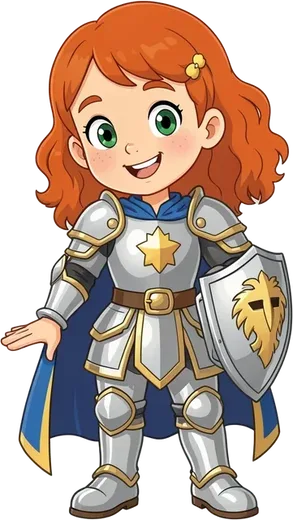
A hart is a grown-up deer, the badge this young squire has painted on his shield.
- Secret power
- ?
- Scared of
- ?
- Always says
- ?
Analytics cookies to improve Litsee? No ads.
With your permission, Google Analytics measures visits and Microsoft Clarity records clicks, scrolling and page interactions, with form inputs and page text masked. We use no advertising cookies.
Change it any time with Cookie settings. Privacy policy · Google privacy · Microsoft privacy
A hart is a grown-up deer, the badge this young squire has painted on his shield.
Make your own hero and they join every card as a friend.
What your child practises: making up a character (a name, a power, a worry and what they say), then writing their first adventure. National Curriculum, Years 3 and 4, Writing – composition: “in narratives, creating settings, characters and plot”.
Press the button for a knight name and what it means. Choose young squires, grand noble knights or clanky comic heroes, add a title such as “of Thistledown” or “the Steadfast”, or build a knightly surname. Every name is hand-picked and child-safe, with tips for KS1 and KS2 quest stories and a sample opening.
Reviewed by Joshua Younger, Education Lead, on .
Short, friendly first names with a castle-country surname, easy for young readers to sound out.
Long, old-fashioned names with gentle meanings, for wise knights who lead the quest.
Rattly, bumbling names for knights whose armour squeaks and whose quests go wonderfully wrong.
Press Big screen above the card to make one character together on the board: the class votes A, B or C for the power, the worry and the catchphrase. Then print the class set below: eight names with their meanings, with the rest left blank for each child to finish and draw.
A finished card is a small character plan. The worry gives the story its problem, the power gives the way out, and the catchphrase is the first line of dialogue. The printed card comes with a page to write the character’s first adventure.
Goes after the name
Join one from each list
Story knights often carry two names: their own, and the place they come from. Sir Hal of Hartwell or Dame Clemency of Fairholme tells the reader at once that this character has a home to care for and a long road ahead. Give children a simple pattern to follow: Sir or Dame, a first name, then “of” and a place. Inventing the place is half the fun, and it often becomes the setting for the whole story.
Look closely at a knight’s name and you can often find a quality hiding inside it. Clemency means mercy, Constance means staying loyal and Valoria comes from valour, a word for great courage. Names like these let children talk about what makes a good knight: being honest, keeping promises and helping people who need it. Ask pupils to choose a quality first, then look for a name that matches it, or build one with a part like true, brave or kind.
Place names make a brilliant word study. Many English places end in parts that once described the land: a ford is a shallow river crossing, a mere is a small lake and a brook is a little stream. Children can join a landscape word with one of these endings in build mode, then draw a map of the village their knight comes from. A knight from Willowmere and a knight from Stonebridge already sound as if they have different stories to tell.
Sound matters too. Short, crisp names like Hal, Peg or Bertie suit a young squire who is still learning, while long names with a rolling rhythm, like Aurelia Hawthorn, suit an older knight who leads the quest. Comic knights work best with clattery, bumbling sounds such as Clankington or Rattlebucket, which children can almost hear as they read.
There are a few names to steer clear of. The knights of the famous round-table legends, and real kings and knights from history, already have their own stories. Names built on fighting words give a quest the wrong shape: in a story for young children, a knight is at their best when they solve a riddle, cross a river or make friends with the dragon everyone else ran away from.
At home, press for a name and a title together and decide what the knight’s shield should show. In class, pupils can design a coat of arms, write the knight’s name underneath and add a short motto. Then let the name shape the plot: a knight called Puddlefoot will surely meet a muddy challenge, and a squire called Tamsin Trueheart might face a moment where telling the truth is the bravest thing of all. The fantasy story starters are a good next step.
Written for this page, at the level of Years 3–4
Every morning, the knights of Thistledown rode out on their quests. Every morning, Sir Clankington clattered after them, his armour squeaking like a hundred mice.
“Perhaps,” said Dame Clemency Fairholme kindly, “you could stay and look after the castle today?” Sir Clankington’s helmet drooped.
Then a small voice called from the gate. It was Peg Pennant, the youngest squire, waving a crumpled letter. “It is from the mill,” she said. “The miller’s cat is stuck at the top of the old tower, and she will only come down for someone she can hear coming.”
Sir Clankington lifted his visor and smiled. For once, being the loudest knight in the land sounded like exactly the right thing to be.
“using a capital letter for names of people, places, the days of the week, and the personal pronoun ‘I’”
Year 1, Writing – vocabulary, grammar and punctuation (statutory)
“expanded noun phrases to describe and specify [for example, the blue butterfly]”
Year 2, Writing – vocabulary, grammar and punctuation (statutory)
“in narratives, creating settings, characters and plot”
Years 3 and 4, Writing – composition (statutory)
“in narratives, describing settings, characters and atmosphere and integrating dialogue to convey character and advance the action”
Years 5 and 6, Writing – composition (statutory)
The quotations above are copied word for word from this document, with the year and section each applies to. The names, meanings, tips and story opening are Litsee’s own.
Reviewed by Joshua Younger, Education Lead, on .
Every name comes with its meaning and is shown on this page, so you always know what your child will see. The generator runs in your browser, and nothing your child chooses is sent anywhere. A card is kept on this device only if they press “Keep it”.
Choose a first name, then add where the knight comes from: Sir or Dame, the name, then “of” and a place, such as Sir Hal of Hartwell. You can make the place from a landscape word and an ending like ford, mere or brook. Build mode on this page joins two parts into a knightly surname for you.
In the UK today, Sir is the title for a man who has been knighted, and Dame is the equivalent title for a woman. In stories, children can use whichever suits their knight. A squire is a young helper training to become a knight, so it is a good title for younger characters.
Yes. In this list, Clemency Fairholme, Valoria Hartmoor and the squire Peg Pennant are every bit as brave as any Sir. Dame is the natural title for a female knight, and every title here, from “the Steadfast” to “the Riddle Solver”, works for any character a child invents.
Children usually picture knights as brave, honest and helpful. A quest gives the knight a goal, such as finding something lost or helping a village, and challenges on the way test their kindness and courage. A name can hint at these qualities, which helps young readers predict how the character will behave.
In Litsee, your child creates the hero, picks the world and chooses what happens next in an illustrated story that is read aloud.
Start your free trial7 days free. A card is needed to start, and nothing is charged if you cancel before the trial ends.