
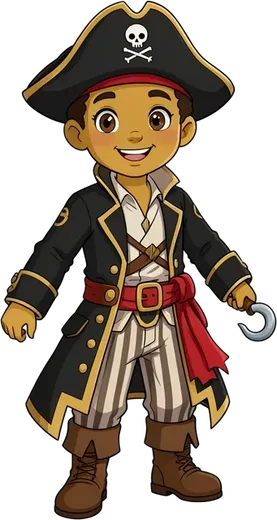
Salty Sam
So used to sea spray that even his sandwiches taste a little bit salty.
- Secret power
- ?
- Scared of
- ?
- Always says
- ?
Analytics cookies to improve Litsee? No ads.
With your permission, Google Analytics measures visits and Microsoft Clarity records clicks, scrolling and page interactions, with form inputs and page text masked. We use no advertising cookies.
Change it any time with Cookie settings. Privacy policy · Google privacy · Microsoft privacy
So used to sea spray that even his sandwiches taste a little bit salty.
Make your own hero and they join every card as a friend.
What your child practises: making up a character (a name, a power, a worry and what they say), then writing their first adventure. National Curriculum, Years 3 and 4, Writing – composition: “in narratives, creating settings, characters and plot”.
Press the button for a pirate name and what it means. Choose friendly crew, bold captains or silly sea dogs, add a title such as Captain or Bosun, or build your own salty nickname. Every name is hand-picked and child-safe, with tips for KS1 and KS2 pirate stories and a sample story opening.
Reviewed by Joshua Younger, Education Lead, on .
Cheerful nicknames that come from each sailor’s job on board, from the galley to the crow’s nest.
Grand two-part names with a sea word in the surname, for the captain who steers the whole voyage.
Giggly nicknames that come from funny habits, soggy socks and snacks, for pirates who never quite get it right.
Press Big screen above the card to make one character together on the board: the class votes A, B or C for the power, the worry and the catchphrase. Then print the class set below: eight names with their meanings, with the rest left blank for each child to finish and draw.
A finished card is a small character plan. The worry gives the story its problem, the power gives the way out, and the catchphrase is the first line of dialogue. The printed card comes with a page to write the character’s first adventure.
Goes before the name
Join one from each list
Most story pirates are known by a nickname rather than their real name, and the best nicknames come from what the pirate does. A sailor who ties every knot on board becomes Knotty Ned; the one who climbs to the lookout post first thing every morning becomes Crow’s Nest Cora. Ask children what job their pirate has on the ship, or what funny habit the crew would tease them about kindly, and the nickname almost writes itself.
Pirate nicknames love alliteration, where both words start with the same sound: Barnacle Bess, Galley Gus, Salty Sam. It makes the name bounce, it is easy to remember, and it gives young writers a natural reason to listen for first sounds. For a captain, a longer two-part name with a sea word in the surname, such as Juniper Squall or Isadora Windward, sounds grander and tells the reader who is in charge before a single order is given.
Ship words make rich name material and quietly build vocabulary. Starboard and port, galley, bosun, rigging, spyglass and crow’s nest all appear in this list, and each meaning explains the word. When a child picks Rigging Ruby, they learn what rigging is at the same time. Keep a class word wall of ship words and let pupils pair them with first names to make a whole crew.
A few things are worth steering around. Real pirates from history were not friendly people, so their names do not belong on a kind crew, and famous pirates from films and books are best left in their own stories. Names built on frightening or unkind words make a pirate tale feel mean rather than adventurous. Nicknames should tease gently about habits, like soggy socks or upside-down maps, never about how someone looks.
At home, take turns pressing for a name and act out how that pirate would walk across the deck, or use build mode to join a nickname and a salty surname. In class, give each group a ship and ask them to fill a crew list with a captain, a cook, a lookout and a navigator, writing one sentence about why each sailor has that name. The pirate story starters can launch the voyage.
Let the name steer the plot. Muddle-Map Molly holding the map upside down might be the very reason the crew finds an island nobody else could. A lookout who misses something important has a problem to put right. A nickname can even be earned during the story, so a quiet cabin hand who saves the day sails home with a brand new name of their own.
Written for this page, at the level of Years 3–4
The Jolly Kipper had been at sea for nine days when Lookout Lila spotted a smudge on the horizon. “Land ahoy!” she called from the crow’s nest.
Captain Juniper Squall unrolled the treasure map on a barrel. Everyone leaned in. Everyone frowned. The island on the map looked nothing like the island in front of them. “Ah,” said Muddle-Map Molly, turning the map the right way up. “Sorry, Captain.”
Galley Gus laughed so hard that he dropped a whole tray of pancakes. But the captain was staring at the map with a slow smile. “Molly,” she said, “I think you have found something. Look at the back.”
“using a capital letter for names of people, places, the days of the week, and the personal pronoun ‘I’”
Year 1, Writing – vocabulary, grammar and punctuation (statutory)
“expanded noun phrases to describe and specify [for example, the blue butterfly]”
Year 2, Writing – vocabulary, grammar and punctuation (statutory)
“in narratives, creating settings, characters and plot”
Years 3 and 4, Writing – composition (statutory)
“in narratives, describing settings, characters and atmosphere and integrating dialogue to convey character and advance the action”
Years 5 and 6, Writing – composition (statutory)
The quotations above are copied word for word from this document, with the year and section each applies to. The names, meanings, tips and story opening are Litsee’s own.
Reviewed by Joshua Younger, Education Lead, on .
Every name comes with its meaning and is shown on this page, so you always know what your child will see. The generator runs in your browser, and nothing your child chooses is sent anywhere. A card is kept on this device only if they press “Keep it”.
Start with the pirate’s job or a funny habit, then turn it into a nickname that begins with the same sound as their first name, such as Galley Gus or Inky Ivy. Add a title like Captain or Bosun for someone important. Build mode on this page joins a salty nickname and a surname for you.
Yes. The captains in this list include Juniper Squall, Isadora Windward and Henrietta Hightide, and the crew has as many girls as boys. Every title works for anyone, whether Captain, Bosun, Navigator or Ship’s Cook, so children can give the most important job on the ship to whoever they like.
Funny pirate names usually poke gentle fun at a habit: Soggy Socks Sally forgets to take her socks off, Snoozebeard naps all day and Parrotless Percy has a goldfish instead of a parrot. Children love inventing the story behind a silly name, which makes these great for comic writing and class plays.
They can be, when the focus is on sailing, map-reading, teamwork and treasure hunting rather than fighting. The names here are all kind or funny, and the treasure can be anything precious, from a lost friend to a map home. Pirate stories also bring in useful words such as voyage, horizon and navigator.
In Litsee, your child creates the hero, picks the world and chooses what happens next in an illustrated story that is read aloud.
Start your free trial7 days free. A card is needed to start, and nothing is charged if you cancel before the trial ends.