
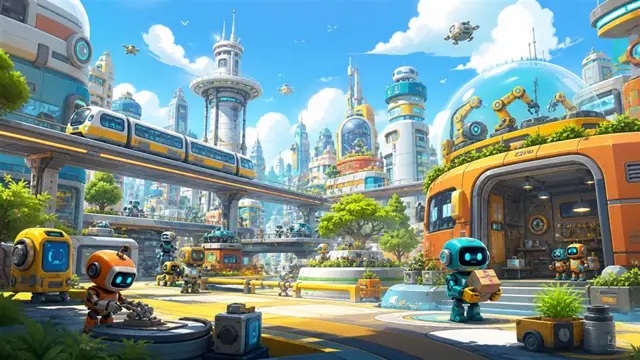

Tidybot
Named after its job: it tidies, sorts and puts every toy back in the right box.
- Secret power
- ?
- Scared of
- ?
- Always says
- ?
Analytics cookies to improve Litsee? No ads.
With your permission, Google Analytics measures visits and Microsoft Clarity records clicks, scrolling and page interactions, with form inputs and page text masked. We use no advertising cookies.
Change it any time with Cookie settings. Privacy policy · Google privacy · Microsoft privacy
Named after its job: it tidies, sorts and puts every toy back in the right box.
Make your own hero and they join every card as a friend.
What your child practises: making up a character (a name, a power, a worry and what they say), then writing their first adventure. National Curriculum, Years 3 and 4, Writing – composition: “in narratives, creating settings, characters and plot”.
Press the button for a robot name and what it means. Pick helper bots, big machines or funny clanking robots, or build a robot code like Bolt-7 from two parts. Every name is hand-picked and child-safe, with naming tips for KS1 and KS2 robot stories and a sample story opening.
Reviewed by Joshua Younger, Education Lead, on .
Friendly names for household robots, many named after the job they love doing most.
Strong, rumbling names for giant robots that build bridges, lift loads and dig tunnels.
Clanking, beeping, wobbly names for robots whose buttons never quite do what they should.
Press Big screen above the card to make one character together on the board: the class votes A, B or C for the power, the worry and the catchphrase. Then print the class set below: eight names with their meanings, with the rest left blank for each child to finish and draw.
A finished card is a small character plan. The worry gives the story its problem, the power gives the way out, and the catchphrase is the first line of dialogue. The printed card comes with a page to write the character’s first adventure.
Goes after the name
Join one from each list
Most robots in stories are built to do something, so the quickest route to a good robot name is the job itself. Tidybot tidies, Brewbot makes tea and Sockbot hunts for lost socks. Adding bot to a job word gives children a name they can read straight away, and it tells the reader what the robot will be doing before the story has properly started. It also hands the plot a ready-made problem: what happens on the day the tea robot runs out of teabags, or the tidying robot meets a truly enormous mess?
Model numbers are the other great robot habit. A name like Kettle-2 or Hoist-40 sounds as if it came off a factory line, and the number can carry a story of its own. Why is this robot number two? What happened to number one? Keep numbers short so young readers can say them, and decide whether the characters use the full code or a nickname. A robot officially called Tiddler-1 that the family calls Tiddles shows the reader that everyone has grown fond of it.
Sound matters as much as meaning. Big machines suit long names with heavy, rumbling sounds such as r, g and d: Girderon, Rumbletread, Granitor. Helper robots suit light, quick names. Funny robots can borrow the noises they make, like Clankety or Sproing, which lets children play with onomatopoeia as they write. Several big-machine names come from real engineering words, such as girder, rivet and torque, so a naming session sits happily alongside a project on wheels, levers or structures.
A few mistakes are worth avoiding. Do not name a robot after a famous film or television robot, or readers will picture someone else’s character instead of yours. Try not to give every robot in one story the same ending: Tidybot, Toastbot and Fixbot quickly blur together, so mix a bot name with a model code or an ordinary word. And give the robot a feeling as well as a function. A name like Hushbot hints at gentleness, which makes a reader care about it far more than a bare code.
At home, press the button together and read a few names aloud in your best robot voice, then keep the one that makes everyone laugh. Build mode joins a word and a number into codes like Bolt-7, which look brilliant painted on the side of a cardboard-box robot. In class, give each pair a name and ask for a labelled diagram: what the robot does, what its name means and which button should never be pressed. The space story starters make a good next step for robots that travel.
Finally, let the name shape what happens. A robot named after one job can learn to do something new, which makes a satisfying ending: Sockbot finds a lost kitten instead of a lost sock. A model number can become a little mystery to solve, and a funny name can turn into a proud one when the clumsy robot saves the day. When the name changes how the reader feels by the last page, it has done its work.
Written for this page, at the level of Years 3–4
Nobody at number 14 had asked for a new robot. Tidybot already put the toys away, and Kettle-2 made the tea (most mornings, without bubbles). But on Saturday a big box arrived, and out climbed something tall, silver and slightly bent.
“Good morning,” it said, and its left foot fell off. “I am Clunkalot. I am here to help.”
Tidybot looked at the foot. Kettle-2 gave a nervous little whistle.
Clunkalot picked up the foot, clicked it onto the wrong leg and bowed. “Do not worry,” it said cheerfully. “I am very good at one thing.”
“What thing?” asked Ruby.
Clunkalot’s eyes flashed green. “I will show you,” it whispered, “when the moon comes up.”
“using a capital letter for names of people, places, the days of the week, and the personal pronoun ‘I’”
Year 1, Writing – vocabulary, grammar and punctuation (statutory)
“expanded noun phrases to describe and specify [for example, the blue butterfly]”
Year 2, Writing – vocabulary, grammar and punctuation (statutory)
“in narratives, creating settings, characters and plot”
Years 3 and 4, Writing – composition (statutory)
“in narratives, describing settings, characters and atmosphere and integrating dialogue to convey character and advance the action”
Years 5 and 6, Writing – composition (statutory)
The quotations above are copied word for word from this document, with the year and section each applies to. The names, meanings, tips and story opening are Litsee’s own.
Reviewed by Joshua Younger, Education Lead, on .
Every name comes with its meaning and is shown on this page, so you always know what your child will see. The generator runs in your browser, and nothing your child chooses is sent anywhere. A card is kept on this device only if they press “Keep it”.
Good robot names often come from the robot’s job, like Tidybot or Brewbot, or from a model code like Kettle-2. For a big machine, try an engineering word such as girder or rivet. Read the name aloud: if it is easy to say and hints at what the robot does, it works.
Pick a job or a machine part, such as tidy, gear or bolt, then add bot, a short ending or a number. Bolt-7, Gyra and Sortabot are all made this way. Build mode on this page joins a robot word and a code for you, so you can try lots of combinations quickly.
The word robot first appeared in R.U.R., a play by the Czech writer Karel Čapek published in 1920. Čapek said his brother Josef suggested it. It comes from robota, a Czech word for forced work or drudgery, so a robot name based on a job fits the word’s history neatly.
Funny robot names often copy a sound or a mishap. Clankety clanks on the stairs, Sproing is the noise of a springy arm and Oopsatron says oops after almost everything. Long, bouncy names such as Wiggleworth and Clunkalot are fun to read aloud, which makes them good for comic stories and class plays.
In Litsee, your child creates the hero, picks the world and chooses what happens next in an illustrated story that is read aloud.
Start your free trial7 days free. A card is needed to start, and nothing is charged if you cancel before the trial ends.