
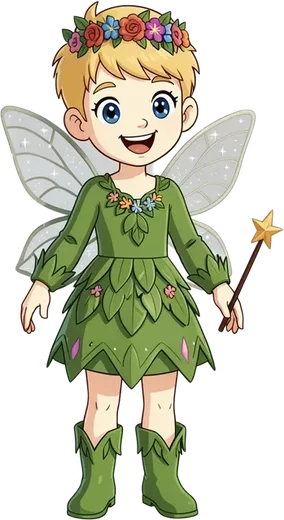
Thistlesilk
For a fairy whose wings are as soft as the silky seeds that float from a thistle.
- Secret power
- ?
- Scared of
- ?
- Always says
- ?
Analytics cookies to improve Litsee? No ads.
With your permission, Google Analytics measures visits and Microsoft Clarity records clicks, scrolling and page interactions, with form inputs and page text masked. We use no advertising cookies.
Change it any time with Cookie settings. Privacy policy · Google privacy · Microsoft privacy
For a fairy whose wings are as soft as the silky seeds that float from a thistle.
Make your own hero and they join every card as a friend.
What your child practises: making up a character (a name, a power, a worry and what they say), then writing their first adventure. National Curriculum, Years 3 and 4, Writing – composition: “in narratives, creating settings, characters and plot”.
Press the button for a fairy name and what it means. Choose garden fairies named after wild flowers, weather and sky fairies, or cheeky fairies who swap socks and borrow jam. Every name is hand-picked and child-safe, with fairy naming tips for KS1 and KS2 and a sample story opening.
Reviewed by Joshua Younger, Education Lead, on .
Names from wild flowers, herbs and hedgerows for fairies who look after growing things.
Light, airy names from dew, frost, rain and clouds for fairies of the sky.
Bouncy, giggly names for kind fairies who love a harmless bit of mischief.
Press Big screen above the card to make one character together on the board: the class votes A, B or C for the power, the worry and the catchphrase. Then print the class set below: eight names with their meanings, with the rest left blank for each child to finish and draw.
A finished card is a small character plan. The worry gives the story its problem, the power gives the way out, and the catchphrase is the first line of dialogue. The printed card comes with a page to write the character’s first adventure.
Goes after the name
Join one from each list
Fairy names in British stories usually grow out of the natural world. Flowers, hedgerow plants, seeds and weather all give names that feel small and light, and many are already lovely words: speedwell, celandine, cowslip, meadowsweet. In Welsh, fairies are called the tylwyth teg, the fair family, and Welsh nature words, such as eira for snow and enfys for rainbow, make beautiful fairy names too.
Fairies are tiny, so their names should feel tiny. English has endings that make words smaller: -let as in piglet, -ling as in duckling and -kin as in lambkin. Adding one to a nature word gives an instant fairy name, such as Seedlet, Fernling or Cloverkin. Light sounds help as well. F, l, s and w feel airy, while short vowels make a name quick and fluttery.
Think about the fairy’s job before choosing a name. A fairy who looks after snowdrops in February and one who chases summer showers live very different lives, and their names should say so. A season, a plant or a kind of weather also gives children plenty to write about: where the fairy lives, what it does all day and what goes wrong when the weather changes.
Old folk tales often show fairies as mischievous, swapping things, tangling threads and hiding what people need. The cheeky fairies in this generator keep that spirit but stay kind: they swap socks, borrow jam and tickle noses with grass. Fairy names suit any child, too. Thistlesilk, Frostling and Speedwell work just as well for a boy fairy as a girl, so nobody needs to feel left out of a fairy story.
A few things to avoid. Names from famous fairy films and book series are easy to copy by accident, so check that a favourite is not already a well-known character. Try not to end every name with -belle or -ella, which makes a whole class of fairies sound the same. Very long names are hard work in a story where the fairy appears on every page. If a child loves a long name, let other characters use a short pet name for it most of the time.
At home, take the generator on a nature walk and look for the plant or weather behind each name. In class, children can make a fairy field guide: name, home, size, favourite plant and one cheeky habit. A name can carry the plot as well: a fairy named after a flower that has stopped blooming already has a quest. The fantasy story starters page has openings to pair with any name.
Written for this page, at the level of Years 3–4
Every morning at sunrise, Speedwell flew along the hedgerow to count the flowers. Today there was something extra hanging from the hawthorn: one small blue sock. “Sockswap!” called Speedwell. A giggle came from under a dock leaf, and a cheeky face popped out. “It wasn’t me,” said Sockswap, which is exactly what Sockswap always said.
Before Speedwell could reply, a soft, misty rain began to fall, and old Mizzle drifted down from a cloud. “Never mind the sock,” Mizzle whispered. “Look at the meadow. The cowslips haven’t opened, and it is nearly May.” Speedwell looked. Mizzle was right. Something in the meadow was very wrong.
“using a capital letter for names of people, places, the days of the week, and the personal pronoun ‘I’”
Year 1, Writing – vocabulary, grammar and punctuation (statutory)
“expanded noun phrases to describe and specify [for example, the blue butterfly]”
Year 2, Writing – vocabulary, grammar and punctuation (statutory)
“in narratives, creating settings, characters and plot”
Years 3 and 4, Writing – composition (statutory)
“in narratives, describing settings, characters and atmosphere and integrating dialogue to convey character and advance the action”
Years 5 and 6, Writing – composition (statutory)
The quotations above are copied word for word from this document, with the year and section each applies to. The names, meanings, tips and story opening are Litsee’s own.
Reviewed by Joshua Younger, Education Lead, on .
Every name comes with its meaning and is shown on this page, so you always know what your child will see. The generator runs in your browser, and nothing your child chooses is sent anywhere. A card is kept on this device only if they press “Keep it”.
Good fairy names are short, light and come from nature. Speedwell, Thistlesilk, Rosehip and Dewlet are all easy to say and full of pictures. Try naming a fairy after a flower or a kind of weather that matches its personality, then add -let, -ling or -kin to make the name sound tiny.
Most nature names work for any fairy. Thistlesilk, Frostling, Fernling, Speedwell and Nettlepatch suit boy fairies especially well, and weather names such as Cloudlet or Mizzle work for anyone. Old British folk tales include plenty of male fairies, so a boy fairy in a story is nothing new.
In many British stories and pictures, fairies are tiny nature spirits who live among plants and look after them, so flower names feel natural. Plant names are also short, pretty and often familiar to children already. Naming a fairy after a local wild flower is a good way to learn that flower’s name on a nature walk.
In Welsh, fairies are often called the tylwyth teg, which means the fair family or fair folk. Welsh nature words make lovely fairy names too: eira means snow, enfys means rainbow and seren means star. They suit stories set in Wales or any story with a fairy from the hills.
In Litsee, your child creates the hero, picks the world and chooses what happens next in an illustrated story that is read aloud.
Start your free trial7 days free. A card is needed to start, and nothing is charged if you cancel before the trial ends.